Here is the uncomfortable arithmetic of modern Singapore: the Government gives married couples with children an extra ballot chance for Build-To-Order (BTO) flats, stacks housing grants on top, and reserves entire categories of flats for families — and the resident total fertility rate still fell to 0.97 in 2023, the first time Singapore's fertility has ever dropped below one child per woman.
Think about that for a second. The country with one of the world's highest homeownership rates also has one of the world's lowest birth rates. The country that famously built its social contract around the HDB flat — where marriage, family, and property ownership are practically inseparable — is discovering that housing policy may have hit its limit as a pro-family tool. This is not just a demographic story. It is a property story, with consequences for every young couple deciding whether to ballot for a flat, every parent planning for resale, and every investor trying to figure out what Singapore's housing demand will look like in 10 or 20 years.
The question framing this entire debate is simple but uncomfortable: are pro-family housing policies backfiring?
The Baby Shortage Is Now a Property Story
Singapore's population problem is no longer a slow-burning concern. It is a headline crisis.
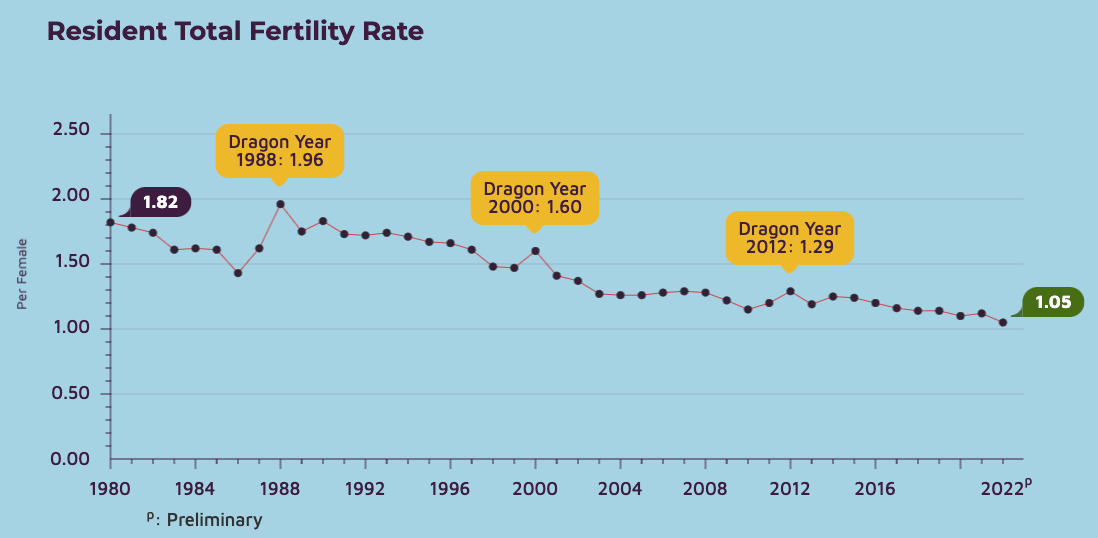
In 2023, Singapore's resident total fertility rate fell to 0.97 — well below the 2.1 needed to replace the population naturally, and among the lowest in the world. The trend has been heading in one direction for years, with only brief pauses during auspicious zodiac years.
| Year | Resident Total Fertility Rate |
|---|---|
| 2017 | 1.16 |
| 2018 | 1.14 |
| 2019 | 1.14 |
| 2020 | 1.10 |
| 2021 | 1.12 |
| 2022 | 1.04 |
| 2023 | 0.97 |
Singapore Resident Total Fertility Rate (2017–2023)
The drop below 1.0 matters psychologically as much as statistically. When a society falls below one child per woman, it means the typical woman is not even having a single child on average. The population is shrinking from within, and every year of delay makes the eventual recovery harder.
But here is what makes Singapore unusual. This fertility collapse is happening in a country where about 80% of residents live in HDB flats and close to 9 in 10 households own their homes. Housing is not scarce in the way it is in, say, Hong Kong or Tokyo. Young couples can realistically expect to own a home. The state has built an enormous apparatus of grants, priority schemes, and subsidies precisely to help them do so.
So why aren't Singaporeans having more babies?
The answer, increasingly, is that homeownership and parenthood have become entangled in ways that may be working against each other. The very policies designed to make housing cheaper and more accessible for families have created a system where housing is no longer a neutral backdrop to family life — it is a gatekeeper. And when the gatekeeper takes five years to open, the family clock keeps ticking.
Pro-Family Housing Policies: The Incentives on the Table
To understand the debate, you first need to understand how deeply housing is woven into Singapore's marriage and parenthood strategy.
Since the 1980s, when Singapore's fertility first fell below replacement levels, the Government has used HDB as a policy instrument to encourage marriage and childbearing. The logic has always been straightforward: if young people can get a home, they will marry; if they marry, they will have children; and if the state actively rewards childbearing with housing privileges, the children will come even sooner.
Today's toolbox is extensive.
| Scheme | What It Does | Who It Targets |
|---|---|---|
| Parenthood Priority Scheme (PPS) | Gives first-timer families with children an additional ballot chance in BTO exercises | Married couples with Singaporean children |
| Married Child Priority Scheme (MCPS) | Helps married children buy flats in or near their parents' estates, with BTO supply set aside for such applicants | Couples who want proximity to parents |
| Enhanced Housing Grant (EHG) | Provides up to S$80,000 based on income for first-timer families buying BTO or resale flats | Lower- and middle-income first-timer households |
| Proximity Housing Grant (PHG) | Provides a five-figure grant for those buying a resale flat with or near their parents or married children | Families prioritising multi-generational proximity |
| Family nucleus rules | Generally reserves the full BTO suite for married couples and families | Singles face age and flat-type restrictions (notably, the 2-room Flexi, and only from age 35) |
On top of these, families with children have benefited from successive rounds of policy "top-ups." The 2023 White Paper on Singapore Families, which consolidated recommendations from a national consultation, explicitly reaffirmed housing as a pillar of family support. The 2024 National Day Rally then went further on the non-housing side — extending paid maternity leave to 16 weeks and paternity leave to 4 weeks — while ministers continued to signal that housing would remain a key lever for encouraging parenthood.
The intended chain of cause and effect looks like this:
The theory is coherent on paper. Give parents an edge in the most competitive housing market process a young adult will ever face, and the "cost" of having a child first — rather than waiting — falls. The child stops being a financial or logistical obstacle to homeownership and becomes a ticket to the front of the queue.
So why is the queue not producing more babies?
The Backfire Question: Why Cheaper Housing Isn't Producing More Babies
This is where the analysis gets uncomfortable for policymakers.
The uncomfortable possibility is that pro-family housing policies are backfiring in at least four ways — not because the incentives are too small, but because of how they interact with prices, queues, time, and social norms.
The Capitalisation Problem: Grants Get Absorbed Into Prices
Economists have long pointed out a stubborn pattern in housing markets: when the government gives buyers more purchasing power — through grants, subsidies, or easier credit — the benefit often gets "capitalised" into higher prices rather than remaining in the buyer's pocket.
Singapore's own recent experience is a live demonstration.
After the pandemic, HDB resale prices went on a historic run. Prices rose about 5% in 2020, a record 12.7% in 2021, around 10.4% in 2022, then 4.9% in 2023 before accelerating again to roughly 9.7% in 2024.
HDB Resale Price Growth (% per year, 2020–2024)
Meanwhile, the fertility rate hit its lowest point in the same period. This is the paradox: at the exact moment the state was pouring more money into housing support, the birth rate went the other way.
Now, correlation is not causation, and resale prices rising does not mean grants caused them to rise. But the mechanism deserves scrutiny. When a large, eligible population is given grants and priority, the demand for family-friendly flats strengthens. If supply does not keep pace, prices climb. Existing homeowners capture the gain — they sell their flats for more — while the marginal first-timer family may discover that the grant simply offsets a higher asking price. The headline "up to S$80,000" looks generous. The net affordability improvement, after the market adjusts, can be much thinner.
Add in the resale levy paid by those who previously bought a subsidised flat, plus the subsidy recovery rules introduced in 2023 for Plus and Prime flats, and the picture becomes even more complex: a family may "save" on the initial purchase but face clawbacks or levies that dilute the benefit. This does not mean grants are useless. It means they are a much blunter instrument for raising fertility than their sticker prices suggest.
The Queue Is a Clock — and It Ticks Against Fertility
Here is the most direct way housing policy may be backfiring: waiting time.
During the pandemic backlog, BTO completion times stretched to four, sometimes five, years. The Government has since worked hard to bring waiting times down, and recent launches have seen significantly shorter waits. But even a three-year wait, on top of the two or three years a couple spends dating, marrying, and deciding to apply, pushes key collection into a couple's early 30s.
That matters enormously for fertility. The median age at first marriage in Singapore is already in the early 30s for men and the late 20s for women. The median age of mothers at first birth has crept past 31. When homeownership is treated by many couples as a precondition for starting a family — and the typical BTO journey takes three-plus years end to end — the state is effectively building a delay into the reproductive timeline.
Biologically, the window for having a second or third child narrows with every year. Socially and professionally, the window narrows too. A couple who collects keys at 33, spends a year renovating and settling in, and welcomes their first child at 34 will find it much harder to reach three children than a couple who started at 28.
This is the quiet tragedy of the BTO model as a fertility instrument. It does not just make housing expensive in dollar terms. It makes housing expensive in time terms — and time is the one input to fertility that no grant can buy back.
The Two-Income Trap and the Career Penalty
The third reason housing policy may be failing is rooted in Singapore's economic structure.
To service a typical HDB mortgage comfortably, most couples need two incomes. That is not a criticism — it is a reality of Singapore's cost of living, and it has a direct consequence for fertility: when a household needs both salaries to pay for the home, the opportunity cost of motherhood skyrockets.
Every year a mother steps back from work, or reduces her hours, the household does not just lose income. It falls behind on the mortgage, retirement savings, and the lifestyle expectations that the home itself represents. The "child penalty" in career terms — lost promotions, lost bonuses, lost CPF contributions — is amplified when the home loan absorbs a large share of take-home pay.
In this sense, the housing grant that helped a couple buy a five-room flat may be the very thing that makes them hesitate to have a second child. The flat becomes a financial obligation that requires continuous dual-income earning. The state's pro-family housing policies make ownership easier at the point of purchase, but they do not make parenthood easier at the point of childcare — and childcare, as every parent will tell you, is the part that breaks the budget.
The Government has responded with expanded parental leave, more preschool places, and higher baby bonuses. But these measures essentially try to tax and transfer their way past the problem. The structural issue remains: housing in Singapore is a large, inflexible fixed cost that must be paid for with time, energy, and career capital that might otherwise go toward raising children.
The Sorting Machine Problem: Who Gets Left at the Back?
There is also a subtler, almost psychological, backfire.
Singapore's pro-family housing framework does not merely reward parents. By design, it penalises everyone else — the childless couple, the single under 35, the couple who wants to cohabit before marriage. Their BTO chances are lower. Their grant entitlements are smaller. Their housing options are narrower.
Now ask yourself: what does that do to the social meaning of having a child?
When housing privileges are tied to parenthood, children become a form of currency — a way to jump the queue, access grants, and unlock the geography of your choice. Some couples may indeed decide to have children earlier to secure these benefits. That is arguably the policy working as intended. But a larger, less visible group may react in the opposite way: they may delay marriage and childbearing precisely because they do not want a life decision — arguably the life decision — to be driven by a housing ballot.
Then there is the circular trap. To qualify for the full suite of housing benefits, you generally need to be married. But to feel financially and emotionally ready to marry, many young Singaporeans say they want housing stability first. You cannot get the flat without the marriage, and you do not want the marriage without the flat. The policy logic assumes marriage is the starting point. For a growing number of young adults, marriage is the finish line — and they are not sure they can reach it.
The White Paper on Singapore Families acknowledged that society has become more diverse in its family forms. Yet the housing rules still largely reward one very specific sequence: marry first, then ballot, then reproduce. Every year that sequence becomes more out of step with the way young Singaporeans actually live.
A Shrinking Pipeline of Families Will Reshape Property Demand
Set aside the policy debate for a moment. The demographic data has its own message for the property market, and it is not a cheerful one.
A fertility rate of 0.97 means the current generation of Singaporean children is roughly half the size needed to replace its parents. Even with immigration, the pipeline of citizen families — the core demographic that drives BTO demand and, later, HDB resale activity — will shrink over time.
Consider what that implies across three time horizons:
- Short term (0–5 years): Current BTO demand remains supported by the marriage backlog, new citizens, and the sheer volume of young adults already in the system. Waiting times have been improving, and the Government has committed to keeping supply high. Prices are still firm.
- Medium term (5–15 years): The cohort of Singaporeans in their prime first-home-buying years will shrink. Fewer births in the 2000s and 2010s means fewer couples balloting for flats in the 2030s. Competition for BTO flats, particularly in non-mature estates, should ease — a slow-moving but real structural shift.
- Long term (15–30 years): The number of "family-sized" households with children will be smaller than today. Demand for large 4-room and 5-room resale flats, the traditional workhorses of the Singapore property market, may soften as the pool of growing families diminishes. Meanwhile, demand for smaller flats, 2-room Flexi units, and well-located resale homes for childless couples and seniors will be comparatively more resilient.
This is not a prediction of crashing prices. Singapore's property market has powerful counterweights: a steady inflow of immigrants and new citizens, a constrained land supply, and the sheer desirability of the city-state as a financial hub. But the mix of demand will change. A low-fertility Singapore is a Singapore that needs fewer "growing family" homes and more homes suited to:
- Dual-income, no-kids households (the famous "DINKs") who prioritise location over size
- Empty-nesters downsizing from 5-room flats to 2-room or 3-room units
- Singles over 35 who can finally access BTO flats
- Multi-generational arrangements, where MCPS and proximity grants keep families connected across two or three units
For property watchers, the low birth rate is not merely a social issue. It is a slow-moving change in the demographic foundation of demand. The flats that win in a low-fertility future are likely to be those near transport nodes, employment clusters, and amenities — the factors that matter when you do not need a big living room and a kids' bedroom. The flats that lose are likely to be the anonymous 5-room units in far-flung estates that were designed for a family size that fewer Singaporeans will ever have.
Beyond the Ballot: What Might Actually Move the Birth Rate
If the current approach has limits, what would a more effective pro-family housing policy look like? The honest answer, drawing on both local debate and international evidence, is that housing policy can only do so much — and it may need to change shape entirely.
1. Decouple Housing Support From Childbearing Timing
Right now, the biggest housing rewards go to people who already have children. That sounds logical, but it may have the perverse effect of converting parenthood into an instrumental decision. A more neutral framework — where young couples, regardless of whether they have children yet, can access predictable, affordable housing early — might do more to support long-term fertility. Couples who secure a home in their late 20s have more biological runway for multiple children than couples who are rushed into a birth to qualify for PPS in their mid-30s.
2. Shorten the Pipeline, Not Just the Price
Every year of BTO waiting time is a year of fertility lost. The Government has already made major progress here, with significant reductions in waiting times and larger BTO supply. The logical extension is to go further: more projects with short construction times, more "ready-to-move" options, and a more robust resale market with lower transaction frictions. For a 30-year-old couple, a flat available in 18 months is genuinely worth more than a flat that is S$20,000 cheaper but arrives in four years.
3. Treat Childcare and Time as Housing Costs
Families do not need just a roof. They need the hours to be parents. Singapore's recent moves on parental leave are welcome, but the broader system still assumes a two-income household with external childcare. If the property market absorbs a large share of household income, the effective cost of the "second parent's time" becomes enormous. Policies that reduce the cost of childcare, make flexible work the norm, and lower the penalty for mothers who temporarily step back would do more for fertility than another S$10,000 on a housing grant.
4. Rethink the Family Nucleus
Every few years, there is renewed public debate about whether the family nucleus concept — the requirement that young buyers be married — is still fit for purpose. Some argue that allowing committed cohabiting couples, or a wider definition of family, to access BTO flats would align the housing system with the way young Singaporeans actually form relationships and make decisions. The counterargument, that marriage should remain the foundation of family policy, remains politically powerful. But the demographic math may eventually force the question: will Singapore keep waiting for marriage rates to rise, or accept that family formation now takes many shapes?
5. Accept That Housing Is Table Stakes, Not a Fertility Drug
The most important reframing is also the least comfortable for policymakers: housing cannot reverse a fertility decline on its own.
Across East Asia, the countries with the most aggressive pro-natal policies — Japan, South Korea, Taiwan — have seen fertility rates fall even as they threw housing subsidies, baby bonuses, and parental leave at the problem. The causes of low fertility run deeper than housing: gender norms, workplace culture, the distribution of unpaid domestic work, the psychological burden of choice, and a genuine uncertainty about the future. Housing policy can remove barriers, but it cannot manufacture desire.
The most honest conclusion is that Singapore's BTO system has been remarkable at achieving homeownership — and is increasingly inadequate at achieving parenthood.
Food for Thought
As you read the next round of policy announcements — the next grant enhancement, the next BTO priority change, the next family-friendly headline — consider these questions:
-
If pro-family housing policies merely cause couples to have their first child slightly earlier without increasing the total number of children they have, is the policy actually working? Is the goal "more babies" or "more families"?
-
Would you choose a bigger flat in a further location, or a smaller flat closer to work, if you knew that every extra 20 minutes of commute time was time taken away from your future children?
-
Is it fair that singles and childless couples who pay taxes — and contribute to the same property market — face longer queues and smaller grants than parents? Or is the state right to concentrate resources on those carrying the demographic burden?
-
When a grant of S$80,000 is announced, who actually captures the value — the young family buying the flat, or the existing homeowner selling into a market where every buyer suddenly has more purchasing power?
-
Should Singapore allow cohabiting couples, or singles below 35, into the BTO system — even if that means the "traditional family" loses some of its housing privileges?
The Bottom Line: Housing Alone Cannot Reverse the Trend
Singapore has built one of the world's most sophisticated systems for connecting housing to family formation. Yet the fertility rate has now fallen below one child per woman, and no amount of additional ballot chances appears capable of reversing that trajectory.
The reasons are structural, not incidental. Pro-family housing policies tend to be capitalised into prices. BTO waiting periods consume the very years when fertility is biologically and socially easiest. Two-income mortgages raise the career cost of motherhood. And the relentless focus on rewarding parenthood with housing privileges may inadvertently turn children into a means to an end, rather than an end in themselves.
None of this means the policies are worthless. It means they are insufficient — and in some ways, counterproductive. The property market that Singapore has built around the family is now facing the demographic consequences of a society where the family itself is changing shape. Fewer children means fewer future families, which means a slow but unmistakable shift in what Singaporeans will need from their homes.