At nearly midnight on 26 April 2023, Singapore’s Ministry of National Development dropped a bombshell: the Additional Buyer’s Stamp Duty (ABSD) rate for foreigners buying residential property would double from 30% to 60%, with effect from the very next day. It was the kind of policy shock most analysts had not modelled into their earnings forecasts. The last time the market saw anything this aggressive was the December 2021 round — and property developers had barely finished repricing that one before the next landed.
When the market opened the following morning, Singapore-listed developers took a beating. City Developments Limited, UOL Group, GuocoLand, Ho Bee Land and Hong Fok tumbled in early trade. Cooling measures hit property stocks exactly the way investors had feared, wiping out weeks of gains in a matter of hours.
But here’s the harder question: is that sudden share-price weakness a warning sign, or an entry point?
The story of Singapore’s property market is not a straight line. Every cooling measure has produced a knee-jerk sell-off in developer stocks. And every time, the market has eventually split into two camps — developers with sound balance sheets that recover, and developers whose business models struggle to adapt. The trick is telling the difference before the market does.
What Actually Changed in the April 2023 Round
The April 2023 cooling measure was not aimed at first-time homebuyers. In fact, the headline rates for Singapore citizens purchasing their first residential property remained at zero, and permanent residents buying their first home still paid 5%.
What changed was everything further up the property ladder, and especially the top of the demand pyramid.
The table below summarises the exact ABSD changes announced by the Government, effective 27 April 2023:
| Buyer profile | ABSD before (Dec 2021 – Apr 2023) | ABSD after (Apr 2023 onwards) | Change |
|---|---|---|---|
| Singapore Citizen – 1st residential property | 0% | 0% | No change |
| Singapore Citizen – 2nd residential property | 17% | 20% | +3 percentage points |
| Singapore Citizen – 3rd and subsequent property | 25% | 30% | +5 percentage points |
| Permanent Resident – 1st residential property | 5% | 5% | No change |
| Permanent Resident – 2nd residential property | 25% | 30% | +5 percentage points |
| Permanent Resident – 3rd and subsequent property | 30% | 35% | +5 percentage points |
| Foreigners (all residential property) | 30% | 60% | +30 percentage points |
| Entities (companies, associations) | 35% | 65% | +30 percentage points |
The most visible change was the dramatic jump in rates for foreigners and entities. At 60% and 65% respectively, Singapore moved to among the steepest stamp duty regimes on residential property anywhere in the world. A foreign buyer purchasing a S$2 million condominium would now be required to pay S$1.2 million in ABSD alone. In one stroke, large segments of foreign demand for private residential property became economically unviable for most buyers.
ABSD rates after April 2023 round (%)
Notice what the Government deliberately left untouched: first homes for citizens and PRs. That is a signal in itself. Policy was calibrated to cool speculative layers of demand without choking the owner-occupier base that the long-term market depends on.
Why Developer Stocks Fell Harder Than the Policy Explained
You might ask: if first-time buyers were untouched, why did cooling measures hit property stocks so hard? The answer is that listed developers depend heavily on a pipeline that runs far beyond first-time buyers.
Developer share prices are sensitive to three things:
- The pace of new-home sales, which drives revenue recognition and cash flow.
- Land-bank costs already on the balance sheet, which determine margins when projects eventually launch.
- The price investors put on future earnings, which falls when transaction volumes are expected to shrink.
ABSD hikes compress all three simultaneously. Foreigners and investors are disproportionately represented in high-end launches, so the most profitable projects on a developer’s books are often the ones most exposed. En bloc sellers, who feed developers with new land, also depend on investor demand — and that demand was suddenly priced 30 percentage points higher. Within the property sector, the shock to investor demand is not just about current sales; it signals that the entire land replenishment cycle may slow down.
That is why analyst reports in the days after the announcement carried phrases like “reduced launch velocity”, “slow-down in land bids” and “negative read-through for high-end exposure.”
But it is worth remembering: Singapore-listed developers have been through this cycle before, and the pattern of sharp drop followed by partial recovery is more consistent than many investors expect.
A Short History of Policy Shocks and Stock Recoveries
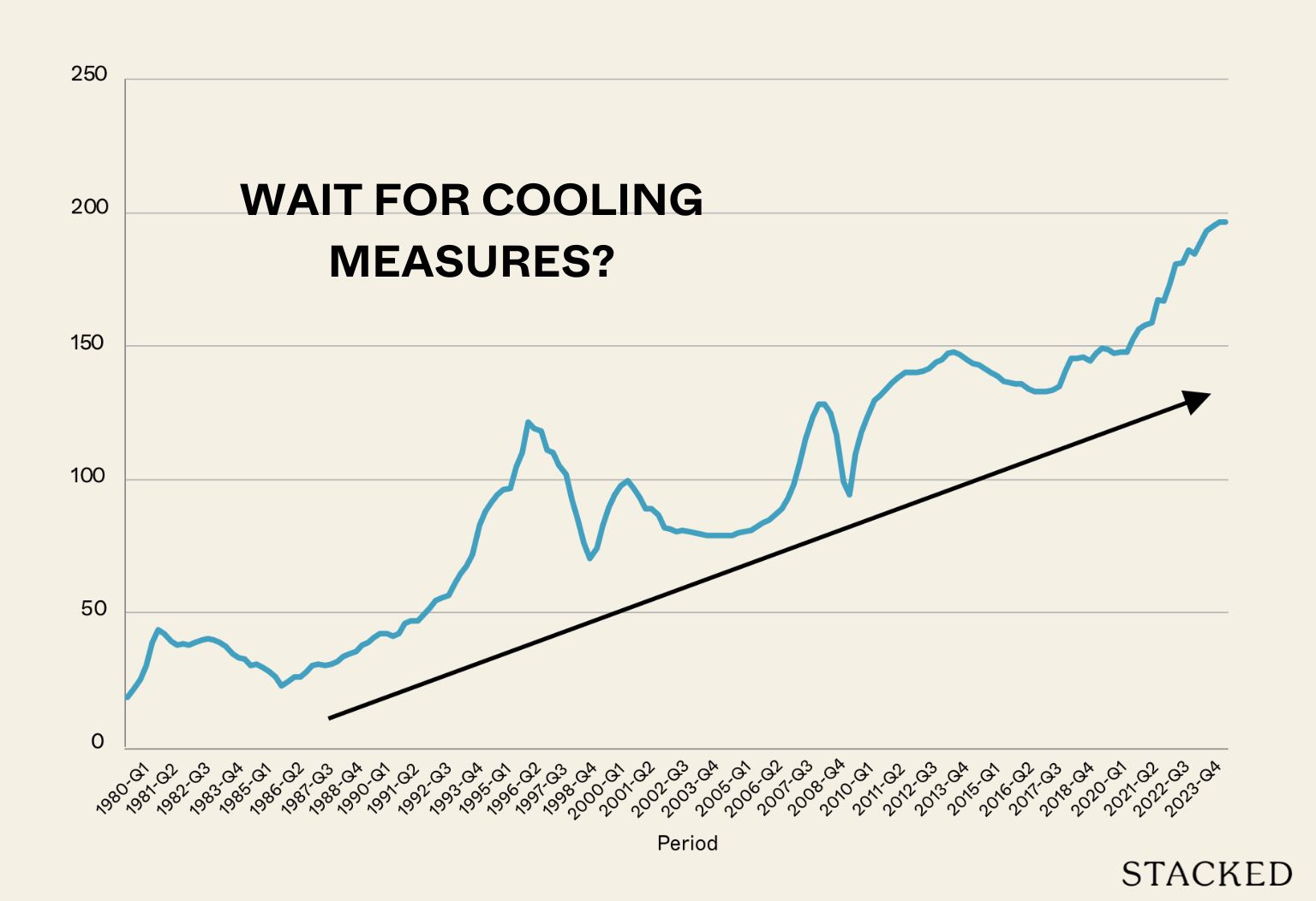
Singapore’s property cooling measures are not a one-off experiment. They have arrived in waves since 2009, with each round designed to preempt or suppress speculative momentum.
In the immediate aftermath of each round, listed developers have traded lower. The 2011 introduction of ABSD rattled the market. The 2013 TDSR framework produced one of the most prolonged periods of subdued trading volumes Singapore had seen in decades. The 2018 round triggered another sell-off in developer stocks. And the December 2021 measures, which raised the foreign ABSD rate from 20% to 30%, were followed by an equally predictable dip.
Yet the share prices of the strongest Singapore developers have repeatedly recovered after those shocks. The reasons are structural:
- Government land sales continue to release new supply, which means developers with land can keep launching.
- Domestic demand is not removed by ABSD; it is deferred and redistributed.
- High-end buyers eventually adjust, and developers recalibrate product sizes and price points.
The important nuance is that recoveries are not uniform. After 2013, for example, developers with large completed inventories and weak recurring income took years to regain lost share-price ground. Those with diversified investment portfolios and disciplined land acquisition recovered faster.
The lesson is not that every dip is a bargain. The lesson is that policy shock creates a price dislocation that separates resilient businesses from vulnerable ones. The dip merely offers you a chance to buy the former at a discount.
Who Has the Fortress Balance Sheets?
This is where the analysis turns practical. If you are considering buying developer stocks after a cooling measure, the single most important variable is not how low the share price has fallen. It is what the company owns, how it funds its assets, and whether it can keep generating cash when new-home sales slow.
Listed Singapore developers are not a monolith. Their businesses range from highly leveraged development plays to large landlords with hotels, offices and retail malls. The distinctions matter enormously when the transaction market slows.
UOL Group: Recurring Income as a Shock Absorber
UOL is often cited by analysts as one of the more defensively positioned developers because of its substantial recurring-income base. The group owns and operates a significant portfolio of commercial, residential and hotel assets, including offices and hotels under the Pan Pacific brand.
When development sales slow, those rental streams keep flowing. UOL’s balance sheet has historically been managed conservatively, giving it flexibility to bid for Government Land Sales sites when competitors are distracted by debt. Its long-term growth story is tied to urban regeneration and integrated developments — projects that combine commercial, residential and hospitality components, which tend to retain value even in cooler markets.
The risk is that UOL seldom trades at as steep a discount to its net asset value as some of its peers. You get safety, but you may pay a premium for it.
City Developments Limited: Scale With a Higher Pulse
City Developments Limited (CDL) is among Singapore’s most globally recognised listed property groups. Its portfolio spans residential development, commercial investment properties and a large global hotel business via Millennium & Copthorne.
CDL’s strength is scale. Its global footprint allows it to rotate capital between markets — shifting focus from Singapore residential to London, Japan or China when local market conditions turn. That geographic diversification is a genuine advantage when cooling measures compress Singapore demand.
However, CDL also runs with higher financial leverage than some peers, particularly after years of overseas acquisitions. In a rising-interest-rate environment, that leverage makes its share price more sensitive to policy shocks. If cooling measures hit property stocks, CDL will often fall harder than UOL — but its long-term asset quality means it can also snap back with more force when sentiment reverses.
The key for investors is watching how quickly CDL’s finance costs consume operating cash flow, and whether its hotel income is recovering enough to offset slower residential sales.
GuocoLand: The Integrated Development Play
GuocoLand has transformed itself from a mid-sized residential developer into an owner and operator of landmark integrated developments. Its flagship Guoco Tower in Tanjong Pagar anchors a portfolio that expanded with Guoco Midtown along Beach Road.
The group’s long-term growth strategy depends less on churning out condominiums and more on creating mixed-use districts where residential units sit above offices and retail. This gives GuocoLand a different type of resilience. Its office component provides recurring income, while its residential launches benefit from being part of a larger lifestyle ecosystem.
GuocoLand’s balance sheet is not as conservative as UOL’s, so its share price tends to be more volatile during policy sell-offs. But its integrated assets, if leased well, provide a platform for compound growth that pure residential developers cannot match.
Ho Bee Land and Hong Fok: Steady Hands With Property
Smaller names sometimes deserve attention in a broad sell-off.
Ho Bee Land built its reputation as a residential developer in Sentosa Cove, later expanding into commercial properties in Singapore, Australia and London. Its residential land bank is substantial but contains higher-value, slower-turnover projects that face headwinds when foreign and investment demand is taxed heavily.
Hong Fok takes a different approach. Known for its prime commercial assets like One Raffles Place and Tong Eng Building, it proceeds through property cycles with a cautious, almost family-office style of capital management. It is hardly the fastest-growing Singapore developer, but it rarely needs to panic-sell assets or chase expensive land. In a post-cooling-measure environment, that conservative posture can count for a lot.
Why "Buy the Dip" Demands a Screening Framework
Momentum traders will tell you to buy the panic. But property stocks are not momentum instruments; they are slow-burn compounders that trade at discounts to the value of the physical assets underneath. To distinguish a real bargain from a falling knife, you need a framework.
The framework above is deliberately simple, but it captures the deeper discipline: you are not betting on whether prices will recover tomorrow; you are checking whether the business itself is protected while you wait.
Specific factors worth examining include:
- Net asset value per share: If the company’s land bank is worth more than its share price implies, the dip is offering you assets at a discount.
- Financial leverage: Developers with high debt are more vulnerable when sales volumes stagnate because interest costs still accumulate.
- Recurring income coverage: Malls, offices and hotels generate cash even when no new condominium unit is sold.
- Land-bank affordability: A developer holding land bought at cyclical lows can launch at lower price points; a developer holding expensive land bought at the top of the cycle faces margin compression.
- Launch pipeline: Shares recover fastest when there are visible, upcoming projects that can sustain revenue without relying on frothy buyer sentiment.
It also helps to assess the macro backdrop. Interest rates, population growth, and Government land supply decisions shape the demand side. Policy shocks do not override all of those factors. They simply reset the rhythm in which demand expresses itself.
The Developer Response Will Differ by Market Segment
One subtlety that gets lost during broad sell-offs is that cooling measures do not hit every market segment equally. The April 2023 round hit foreigners and entities hardest, but Singapore citizens buying their first home remained completely unaffected. That means developers focusing on owner-occupier-driven suburban and mid-tier projects have a fundamentally different outlook from developers with large luxury inventories.
Developers pivoted in response. Some shifted product mix toward smaller units in affordable price bands. Others delayed high-end launches and refocused marketing on Singapore citizens and PRs who qualify for lower stamp duty rates. Still others had already secured the land at low prices and could absorb slower sales without cutting profits.
So ask not only “is the developer strong?” but “which end of the property market does it depend on?”
What History Says About the Timing of Recovery
Recovery times after cooling measures vary, but the pattern is generally the same: an immediate rejection, a period of price discovery, then a rebound once the market realises the policy has not destroyed demand — only deferred it.
In December 2021, developers sold off after ABSD rates were raised. But by the first half of 2022, the market had found its footing again. In September 2022, another round of measures aimed at private homeowners downgrading to HDB flats produced another scare — and again prices stabilised within weeks.
None of this is a guarantee for the future. Every cycle arrives with its own interest-rate backdrop, household balance sheet and inventory situation. But it does suggest that the market repeatedly overestimates the long-term damage of cooling measures while underestimating the adaptability of developers with strong balance sheets.
Illustrative pattern: developer stock reaction to policy shock
The chart above illustrates the shape of the market’s response — not a precise forecast. The magnitude of the dip and the speed of recovery depend on interest rates, global risk sentiment and each developer’s financial position.
Food for Thought
Before you decide whether to buy the dip, sit with these questions:
-
If the cooling measure caused a permanent structural drop in demand for high-end property, would the developer with the steepest NAV discount actually be the safest? Or would you prefer a lower-discount company whose income does not depend on selling high-end units?
-
Foreign buyers are now paying 60% ABSD. How much new demand do you think that segment contributed to recent developer earnings? When those numbers are not visible in quarterly reports, what signals would you use to measure the impact?
-
Developers often compete for the same land through Government land sales. If cooling measures reduce launch prices, how does a developer who bought land at a high price two years ago respond without destroying its margins?
-
Singapore’s owner-occupier demand is underpinned by income growth, household formation and limited land. If those are intact, should a cooling measure be considered negative for the long-term value of prime land?
-
How would your investment decision change if the same developer’s share price fell again six months later? Is your thesis based on the asset value or on the timing of the next policy tweak?
The Long View on Property Stocks and Real Estate Data
For Singapore investors, the property stock dilemma always comes back to a data question. Is the developer’s share price decline outpacing what is actually happening in the local property market? Are specific project locations still holding their value even as demand cools? Would a portfolio of high-quality suburban developments outperform a luxury launch in the post-measure world?
That kind of question cannot be answered by headline ABSD rates alone. It requires project-level detail — pricing across districts, transaction trends by buyer profile, and an understanding of how each launch performs relative to its neighbourhood.