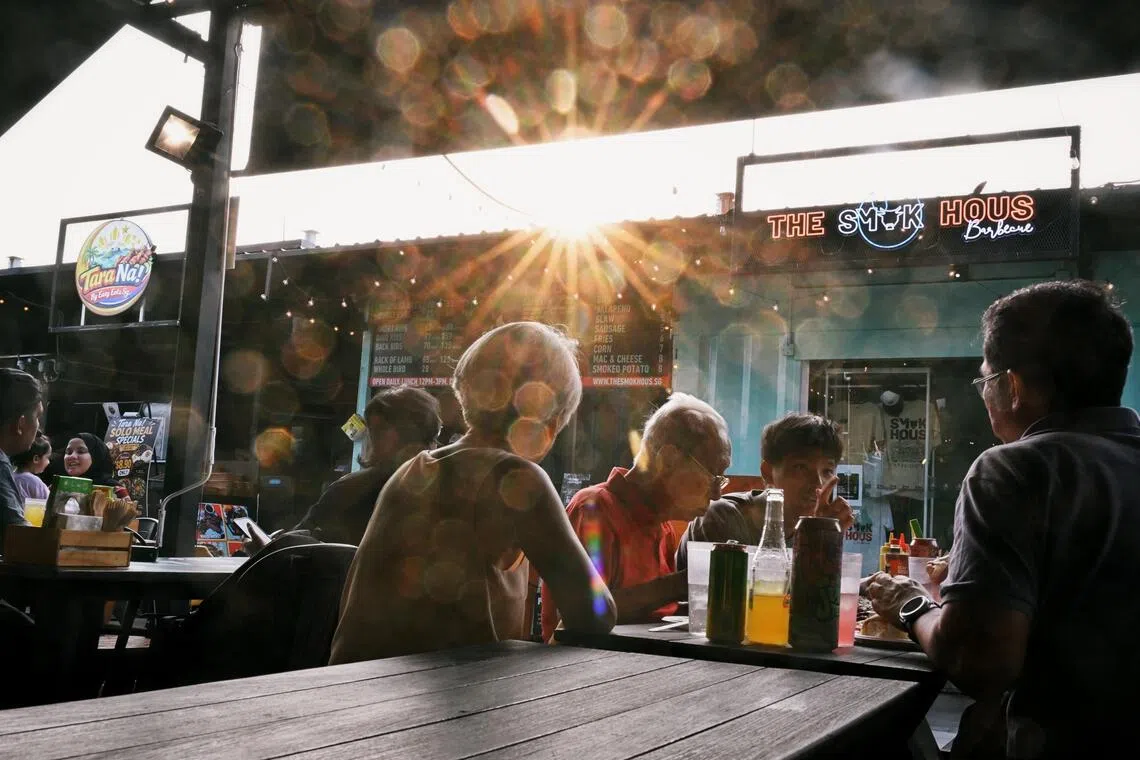
There is a particular kind of quiet that settles over a Singapore pop-up when its last night arrives. The string lights are still up. The shipping containers are still painted in their cheerful colours. But the benches are stacked, the grills are cold, and the only thing left on the chalkboard is a farewell message. That scene has now played out at Punggol East Container Park, the waterfront cluster of container-style eateries that became a weekday dinner spot and weekend hangout for a generation of young families in the northeast.
The park, which opened in the late 2010s on a temporary lease, was never meant to be permanent. That was the point. It sat on state land that had been earmarked for something bigger, something that had not yet been funded, designed, or scheduled. So instead of leaving a prime plot empty, the state handed it to operators willing to build fast, build light, and leave without a trace when the time came. The containers could be craned onto lorries; the concrete pads could be broken up; the land could be handed back in almost the same condition it was found.
Now that the containers are going, the question every resident, investor, and first-time buyer around Punggol East is asking is a simple one: what comes next?
The answer is not a rumour. It is not a secret developer deal. It is a matter of public record, although you have to know how to read it. In Singapore, the future of any piece of land is written in the URA Master Plan — the statutory land-use blueprint that tells you whether a plot is destined for housing, commerce, greenery, or something in between. Read that map correctly, and the container park's closure starts to look less like an ending and more like the most reliable property signal a young buyer can get.
This article digs into the Master Plan for Punggol East, looks at the realistic scenarios for the land — housing, mixed-use development, or parkland — and examines how each future could ripple through Punggol East property prices.
The Container Park Was Never the Final Plan
To understand what happens next, it helps to remember what the Punggol East Container Park actually was: a temporary use of state land.
In Singapore, land is too scarce and too carefully planned to sit idle. But the gap between "a plot is zoned for future development" and "a development actually breaks ground" can stretch for years. There are engineering studies to complete, budgets to approve, infrastructure to sequence, and sometimes a whole new town or precinct to design around it. Leave the land empty during those years, and you get scrub, mosquitos, and the slow creep of illegal dumping. So the state — usually through the Singapore Land Authority (SLA) — does something clever instead. It awards a short-term lease to an operator who can activate the space quickly with lightweight, removable structures.
This is the model behind most of Singapore's beloved pop-ups: container food parks, temporary skate parks, pop-up malls, and community gardens on plots that are "waiting" for their permanent purpose.
The economics of these leases are straightforward. The operator gets land at a fraction of the cost of a permanent commercial site. The state earns rental income on land that would otherwise produce nothing. The surrounding neighbourhood gets amenities years before the permanent plan arrives. And because the structures are modular — shipping containers are literally designed to be moved — the whole thing can be dismantled in weeks.
For the Punggol East site, this model worked almost too well. What began as a modest cluster of food and beverage operators grew into a genuine destination. There were Korean fried chicken nights, late-night prata runs, and the kind of casual, outdoorsy dining that Punggol's young, family-heavy demographic loved. On weekend evenings, the park generated the sort of human traffic that urban planners spend careers trying to manufacture.
But the lease always had an expiry date. Temporary occupation licences of this kind are typically short — a few years at a time — and while they can be extended, they are ultimately at the state's discretion. When the Master Plan's longer-term intentions for the area hardened into concrete development plans, the containers had to go.
That is the part that often gets lost in the eulogies for Singapore's pop-up spaces. The closure of a container park is not a sign that the state is taking something away. It is a sign that the state is finally ready to build what the Master Plan always intended. The pop-up was the placeholder. The real plan was always waiting in the background.
Greenfields Have a Clock: How Temporary Land Use Works in Singapore
Punggol East is not uniquely unlucky. Container parks and temporary lifestyle destinations have been closing across Singapore for a decade, and almost always for the same reason: their land has matured into its permanent purpose.
The lifecycle looks something like this:
Container parks make ideal tenants for this cycle because they embody the gig economy of real estate: flexible, fast, and reversible. The same qualities that made Punggol East Container Park charming — the industrial aesthetic, the informality, the sense that it could not last forever — are exactly the qualities that made it legally and practically disposable.
Globally, this model has produced some famous experiments. London's Boxpark Shoreditch, which opened in 2011, proved that shipping containers could anchor a thriving retail and dining district. Seoul's Common Ground did the same for Korean street food and fashion. In Singapore, the container park format showed up in several neighbourhoods, and Punggol East was among the most successful iterations — partly because the surrounding town had a genuine shortage of casual, open-air dining options when it opened.
The temporary-use model works best precisely in places where the permanent plan is still years away. And Punggol East, for all its leafy waterway charm, was exactly that kind of place: a young Housing Board town whose infrastructure was still catching up with its population.
But here is the crucial detail for anyone watching the property market: temporary leases are not renewed indefinitely. When the land is needed — for a Build-To-Order (BTO) launch, a Government Land Sales (GLS) site, a new park, or a community facility — the SLA gives notice, the operators pack up, and the land returns to the state.
The only real question is what the state does with it next. And that question is answered, plot by plot, in the URA Master Plan.
What the URA Master Plan Says About the Punggol East Site
Every few years, the Urban Redevelopment Authority (URA) reviews and republishes Singapore's Master Plan — a statutory land-use plan that governs what can be built where. The most recent version, Master Plan 2025, continues the zoning framework that shapes neighbourhoods across the island. For ordinary buyers, the Master Plan is the closest thing Singapore has to a public map of the future.
Each plot of land in Singapore is assigned a zoning that determines its use. If you open the Master Plan online and pan over Punggol East, you will see a patchwork of colours, each representing a different permitted use:
| Master Plan Zone | What It Allows | What It Signals |
|---|---|---|
| Residential | HDB flats, condominiums, and landed housing | Future housing supply; BTO launches or private sales |
| Residential with Commercial at First Storey | Homes with shops and eateries on the ground floor | Heartland retail life; convenience for residents |
| Commercial & Residential | Larger mixed-use developments with offices, shops, and homes | A neighbourhood node or town-centre extension |
| Open Space / Park | Greenery, sports fields, park connectors | Protected vistas; recreation; an amenity for nearby homes |
| Reserve Site | Held for future planning; no use committed yet | Watch this space — change is likely in the next review |
The broader Punggol East area is, on paper, a primarily residential district. It sits within Punggol, the HDB town that was once branded Singapore's "Waterfront Town of the 21st Century" when plans for it were first unveiled under the Punggol 21 vision in the late 1990s. That vision was centred on the 4.2-kilometre man-made Punggol Waterway, which threads through the town and gives Punggol East much of its character.
Around the waterway, the Master Plan shows generous bands of Open Space and Park — the green ribbons that make Punggol feel more resort town than housing estate. Along the main corridors and near transport nodes, the zoning shifts toward Commercial & Residential or Residential with Commercial at First Storey, creating the neighbourhood centres where residents shop, eat, and gather. The spaces in between are largely Residential, earmarked for the ongoing rollout of BTO flats and, where the land is tendered privately, condominiums.
For the container park site specifically, the exact zoning line matters enormously — and it is publicly viewable on the URA's Master Plan portal. But based on the surrounding pattern, several things are clear.
First, Punggol East is not a finished neighbourhood. Large parts of the town are still being built out, which means the state is holding land parcels for future housing. Second, the area's amenity model is increasingly shifting from temporary pop-ups to permanent integrated developments — the most notable local example being Oasis Terraces, the HDB-built neighbourhood centre nearby that combines a community club, medical facilities, shops, and dining in one permanent complex. Third, the waterway and its park connectors are protected green assets, and any plot that buffers them is likely to remain permanently green.
A plot that once hosted a container food park could, under this framework, go in several directions. It could be absorbed into a larger residential parcel. It could become a compact mixed-use node if the zoning allows ground-floor commercial uses. It could revert to parkland if it sits within the waterway green buffer. Or it could be classified as a Reserve Site, giving the state flexibility while the surrounding infrastructure — schools, roads, and rail — catches up with the population.
This is why the Master Plan, not the container park's farewell Instagram post, is the real story for anyone tracking property values in the area.
Housing, Mixed-Use or Parkland? Three Futures for the Plot
It is tempting to imagine a single developer emerging with grand plans for the site — a new condo launch, perhaps, or a lifestyle mall. But in a mature HDB town like Punggol East, the "developer" is often the state itself. The URA sets the zoning. HDB acts as the master developer for public housing. Private developers enter the picture only when the state releases land through the Government Land Sales (GLS) programme or when a site is part of a mixed-use tender.
So when we ask what has been "planned" for the land, we are really asking which of three futures the Master Plan has set in motion.
Scenario One: Public Housing (BTO)
This is the most likely future if the plot falls within a Residential zone — and much of Punggol East does. The site, possibly combined with adjacent state land, could become a new BTO launch.
A BTO future would suit the neighbourhood's demographics. Punggol is one of Singapore's youngest towns, with a high proportion of young couples and families. HDB has been steadily replenishing the area's housing stock, and the town's remaining developable plots are largely designated for this purpose.
Importantly, the BTO landscape has changed since the container park first opened. Under the new Flat Classification Framework introduced in late 2024, new BTO flats are grouped into Standard, Plus, and Prime categories, with varying subsidies and resale restrictions. Depending on a future Punggol East project's proximity to transport and amenities, it could fall into the Standard or Plus band — a decision that would shape both launch prices and the resale market years later.
A BTO launch would not happen overnight. The typical sequence involves site preparation, HDB's annual sales exercise announcements, a launch exercise, and then a construction period of roughly four to five years before the first keys are handed over. For the container park plot, the earliest realistic outcome is a launch within one to three years, with new residents moving in toward the end of the decade.
Scenario Two: A Permanent Mixed-Use Node
There is a second possibility, one that feels almost poetic: the site could be redeveloped as a permanent replacement for the container park's food-and-community role.
If the plot's zoning is Commercial & Residential or Residential with Commercial at First Storey, the next development could be a compact mixed-use block — homes above, shops and eateries at ground level, and perhaps a childcare centre or clinic tucked into the podium. This is the model that has quietly transformed many heartland areas: instead of a temporary cluster of containers, you get a permanent, air-conditioned, all-weather version of the same idea.
The precedent is already visible in Punggol East. Oasis Terraces, the neighbourhood centre built by HDB along the waterway, shows how a permanent development can deliver what a container park offers — food, community space, and a place to linger — while adding the medical, social, and commercial services that a mature town needs.
A mixed-use future would be a win for property values. Permanent retail and dining within walking distance is exactly the kind of amenity that supports resale demand, because it makes daily life more convenient for families. And unlike a BTO-only outcome, a mixed-use development would keep some of the commercial buzz that made the container park popular — just in a more durable form.
Scenario Three: Parkland and Waterway Green
The third possibility is quieter but no less valuable: the land could become part of Punggol's green network.
If the plot sits close to the waterway or within a designated Open Space buffer, the Master Plan may not allow buildings on it at all. Instead, the land would be landscaped as part of the park connector system — potentially linking into the island-wide Round Island Route, the recreational corridor that is gradually connecting Singapore's parks and green spaces.
Some residents would mourn the loss of a dining destination. But for property owners, a permanent parkland outcome is hardly bad news. Homes that face unblocked greenery and waterway views consistently command a premium in Singapore's resale market, and a plot that becomes parkland is a plot that will never be built on — which means the views from nearby blocks are protected in perpetuity.
There is also a hybrid possibility worth noting. The state sometimes phases its plans: a plot may first be landscaped as temporary green space — or left as a grass field — while the surrounding infrastructure matures, and only later converted to housing. Either way, the land is not "wasted"; it is being sequenced.
How You Will Know Which Future Is Coming
Singapore's planning process is unusually transparent. The signals are public — you just have to know where to look:
- HDB land parcel announcements in its annual sales programme reveal upcoming BTO sites, often years before launch.
- URA and HDB GLS lists show state land being released for private residential or mixed-use development.
- Master Plan amendments signal zoning changes for specific plots between comprehensive reviews.
- Site preparation works — hoarding, tree clearance, and earthworks — indicate that development is imminent.
For the Punggol East container park site, the absence of any immediate GLS listing suggests the state is not rushing to sell the land to private developers. That leans the balance toward either a future HDB launch or a longer-term green or reserve outcome. But in Singapore's planning system, a plot's destiny can shift with a single Master Plan amendment — which is why buyers should treat the current zoning as a strong hint, not a guarantee.
Punggol East Property Prices: How the Next Land Use Moves the Market
Now for the question that matters most to buyers and homeowners: what does all this mean for property prices?
The closure of a much-loved container park can feel like a downgrade — fewer dining options, less buzz, and an empty fenced-off plot where families once gathered. But property prices are not driven by nostalgia. They are driven by a handful of factors that the land's next use will directly influence: supply, amenity, environment, and employment.
The Supply Effect
If the site becomes a BTO project, it adds new housing supply to Punggol East — but only after a lead time of several years. In the near term, the plot contributes nothing. In the medium term, a new BTO launch will bring hundreds of new households to the area, which supports demand for surrounding services and, eventually, increases the pool of flats entering the resale market after their five-year Minimum Occupation Period (MOP).
For existing HDB owners, new BTO supply has a moderating effect on resale price growth — more choice for buyers means less urgency to bid up older flats. For buyers, that is a feature, not a bug. A future BTO launch nearby means the area will continue to attract young families, keeping the neighbourhood's demographic profile fresh.
The Amenity Effect
If the site becomes a mixed-use node or a permanent commercial development, the amenity effect is positive and immediate. Homes within walking distance of shops, eateries, and services have consistently stronger resale demand than homes that require a bus ride for a carton of milk. The container park's departure would be more than offset by a permanent, integrated replacement.
If the site becomes parkland, the effect is more subtle but equally powerful. Greenery and waterway views are scarce urban goods. A permanent park next to a residential block improves the desirability of every unit that overlooks it — and protects those views from future development.
The Identity Effect
There is also a less tangible factor: what the land's future says about the neighbourhood's trajectory. Punggol East is not a mature town resting on its laurels. It is a town still being assembled. The Punggol Digital District is rising nearby as Singapore's first enterprise district, with the Singapore Institute of Technology's new campus welcoming students in phases and JTC projecting the district to attract tens of thousands of workers, students, and residents in the years ahead. The North East Line extension added Punggol Coast station at the end of 2024, directly serving that new economic zone.
These are the forces that move property prices over a five-to-ten-year horizon — not the presence or absence of a container food park. A plot returning to the state for its Master Plan use is evidence that the town's infrastructure and amenities are finally catching up with its ambitions. That is a bullish signal, not a bearish one.
What Different Buyers Should Watch
| Type of Buyer | What the Land's Next Use Means | Key Signal to Track |
|---|---|---|
| BTO applicants | A future launch nearby is more choice, possibly with Plus/Prime classification | HDB's annual sales exercise site list |
| Resale HDB buyers | Moderate supply growth ahead; buy for the area's trajectory, not the park | Master Plan zoning and MOP expiries in the estate |
| Private property buyers | A GLS launch would set a new price benchmark for the district | URA/HDB GLS tender announcements |
| Investors | Mixed-use or park outcomes support rental demand and capital values | Commercial zoning details and infrastructure timelines |
The near-term picture is more muted. In the months immediately after the container park's closure, the site will be an empty construction plot — and empty plots do not help street-level vibrancy. But property markets are forward-looking. By the time the first hoarding goes up and the first site investigation works begin, the market will already be pricing in the next use.
For buyers, the practical lesson is this: do not buy a home based on the pop-up that is there today. Buy it based on what the Master Plan says will be there tomorrow. The container park was never the destination. It was the trailer for the main feature.
The Bottom Line for Punggol East Prices
Punggol East's pricing story was always going to be written by the same factors that drive property values across the northeast: rail connectivity, school catchment demand, the health of the HDB resale market, and the gravitational pull of the Punggol Digital District. The container park contributed atmosphere, but it was never the main event.
What the site's redevelopment does is remove a layer of uncertainty. A plot in temporary use is a plot whose future is unresolved. A plot returning to the Master Plan's intended use — whether housing, mixed-use, or park — is a plot whose future is now in motion. For a young town like Punggol East, that motion is almost always in the direction of greater maturity, greater amenity, and greater durability.
None of this means prices will spike the moment the containers are gone. But it does mean the area's long-term fundamentals remain intact — and in some scenarios, such as a permanent mixed-use node or protected parkland, they improve.
Food for Thought
As you watch the hoardings go up around the former Punggol East Container Park, here are a few questions worth sitting with — whether you are a resident, a first-time buyer, or just someone who liked the late-night fries:
-
Which future would you actually prefer? If you lived next to the site, would you rather see a new BTO block with ground-floor shops, a permanent mixed-use development, or protected parkland along the waterway? Each choice trades off convenience, greenery, and community in different ways.
-
Can permanence replace serendipity? Container parks feel alive because they are informal, slightly rough-edged, and temporary. If the site becomes a polished mixed-use development, will it generate the same spontaneous community energy — or do we need to accept that some magic cannot be engineered into a master plan?
-
How should you weigh future supply against current prices? If you are buying a resale flat near the site today, a future BTO launch could temper price growth in five or six years. Is the convenience of living in a still-developing town worth that trade-off?
-
What role do "soft signals" play in your decision? The container park's closure is a soft signal: land is maturing, infrastructure is arriving, and the state is committing to a permanent vision. How many soft signals do you need before you treat them as a hard fact?
-
Are you buying the neighbourhood's present or its trajectory? Punggol East today is not what it will be when the Digital District matures, the SIT campus is full, and the remaining state land parcels are built out. Young buyers in particular should decide whether they are paying for what the town is now — or what the Master Plan says it will become.