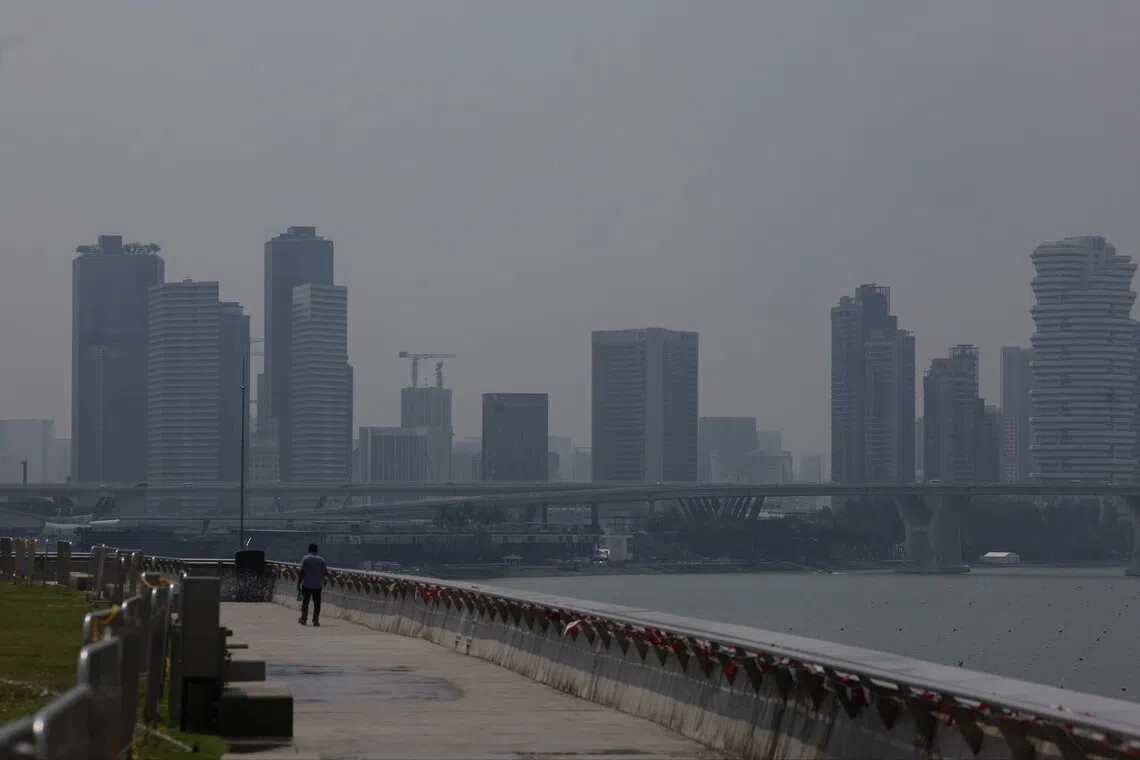
On 21 June 2013, Singapore did something it had never done before. The Pollutant Standards Index (PSI) crossed the 400 mark — officially "hazardous" — and the city disappeared behind a grey-brown shroud. From high-floor flats in Tanjong Pagar, owners who had paid for unblocked CBD skyline views suddenly couldn't see the buildings across the street. N95 masks sold out. School sports were cancelled. And somewhere between the dry coughs and the closed windows, a question floated through countless group chats: does this hurt my flat's price?
It is a surprisingly difficult question to answer. Air quality and resale prices feel like they should be linked — bad air is unpleasant, unhealthy, and bad for the "brand" of a home. But Singapore's property market is also one of the most policy-driven, location-obsessed markets on earth. A hazy fortnight competes against remaining lease, MRT distance, floor level, and school catchment for a buyer's attention. In this analysis, we map historical haze episodes against quarterly HDB resale transaction data across districts — accounting for income and neighbourhood quality — to see whether "clean air" deserves a place on your search filter.
Spoiler: the relationship is real, but it is not where you think it is.
Why Air Quality Keeps Sneaking Into Property Conversations
Singapore sells itself on order, safety, and a tropical garden city ideal. Clean air is part of that promise. When the haze arrives, it doesn't just irritate throats — it punctures a national brand, disrupts the morning jogging routine that so many condo and HDB dwellers plan their day around, and forces families into an indoor lifestyle that a 40th-storey sky terrace was never meant to provide.
For buyers aged 25 to 40 — the demographic now driving the bulk of HDB resale demand — air quality has become part of a broader "wellness checklist." This is the generation that tracks sleep scores, buys air purifiers on Shopee flash sales, and reads labels on everything. It's unsurprising that some would start asking: should I avoid certain estates or stacks because of pollution?
But here is the tension. Most young buyers already know that haze is transboundary — it comes from forest and peat fires in Indonesia, carried by monsoon winds. It is not generated by the estate they live in. That makes haze fundamentally different from the pollution that actually differentiates one address from another — traffic fumes along an expressway, industrial emissions near Jurong, or the idling-vehicle microclimate beside a busy carpark.
To understand whether haze moves HDB resale prices, we have to separate two very different things:
| Type of air problem | Source | Duration | Does it differ by street? |
|---|---|---|---|
| Seasonal haze | Regional land and peat fires (Sumatra, Kalimantan) | Days to weeks, episodic | No — island-wide, though readings vary by wind |
| Chronic local pollution | Expressway traffic, industrial estates, ports | Every single day, year-round | Yes — stack-by-stack difference |
| Micro-environment | Idling vehicles, hawker centre fumes, open-air carpark dust | Daily, hours-long peaks | Yes — block by block |
The haze makes the headlines. The other two quietly affect your lungs — and your flat's value — every day. As we'll see, the data reflects that difference.
Haze, a History: What Singapore's Air Has Looked Like Since 2013
To understand the property angle, it helps to recall how often haze has actually hit the resale market's radar. Singapore's modern haze era is essentially a story of El Niño cycles.
When El Niño warms the Pacific, it dries out Indonesia — especially Sumatra and Kalimantan. Land cleared for plantations becomes tinder, and peat fires smoulder for weeks. When La Niña brings wet weather instead, fire seasons shrink and Singapore enjoys stretches of remarkably clean air. That cyclicality matters for property: a buyer in 2021 experienced a very different "normal" from a buyer in 2015.
Peak 24-Hour PSI During Major Haze Episodes
The chart above shows the peak 24-hour PSI readings Singapore recorded during the three most significant haze episodes of the last decade-plus. A 24-hour PSI above 100 is "unhealthy"; above 200 is "very unhealthy"; above 300 is "hazardous." In June 2013, the 3-hour PSI hit an all-time record of 401, while the 24-hour average peaked at 246. In October 2015 — the El Niño super-charged sequel — the 3-hour PSI reached 341 and the 24-hour average hovered near 225. The September 2019 episode was milder, with the 24-hour PSI peaking around 151 in the eastern part of the island.
For context, here is the official PSI band structure that Singaporeans have learned to read like a second language:
| 24-Hour PSI Range | Band | Typical health advisory |
|---|---|---|
| 0 – 50 | Good | Normal activities |
| 51 – 100 | Moderate | Little or no health impact; sensitive groups should note |
| 101 – 200 | Unhealthy | Elderly, children, pregnant women should reduce prolonged outdoor activity |
| 201 – 300 | Very unhealthy | Avoid outdoor activity where possible |
| Above 300 | Hazardous | Stay indoors, minimise physical exertion |
Simplify the timeline to its property-relevant milestones:
The gap in the middle of that timeline is important. From 2020 to 2022, a strong La Niña kept Indonesia wet, fire outbreaks were limited, and Singapore enjoyed some of its cleanest air in years. But those were also the COVID years — everyone was masked indoors anyway, work-from-home was normalised, and border restrictions meant Singapore's expatriate talent pool was shrinking rather than arriving. The 2023 return of El Niño brought smoky skies back in October, a useful reminder that the haze is never truly gone, just dormant.
Now let's connect this to the resale market. The critical thing about the timeline above is what else happened in those years. 2013 was the year the government slammed the brakes on property. 2015 was a year when the resale market was already cooling from those measures. Any attempt to link haze to prices without accounting for policy is comparing apples to durians.
The Theory: How Bad Air Would Hit a Flat's Price
Before looking at transactions, it's worth laying out the channels through which air quality could theoretically affect what buyers pay. There are four main ones.
1. The Health and Comfort Channel
International research on air pollution and housing is extensive, and it finds consistently that homes in chronically polluted areas trade at a discount. The effect is strongest where the pollution is persistent — think cities with year-round smog — rather than episodic. Buyers capitalise poor air into what they're willing to pay because they expect to breathe it daily. This is Health Economics 101, and it's why we should expect chronic local pollution to affect prices far more than a two-week haze.
2. The Amenity and View Channel
A "hazy city view" is not the same as no city view. Flats with unblocked skyline views — think the landmark Pinnacle@Duxton, or high-floor stacks in Telok Blangah, Bishan, and Punggol that face the CBD or the water — carry genuine premiums. Haze erases those views for days at a time. But here's the subtlety: the view is a permanent physical asset; haze is a temporary atmospheric condition. A buyer who loves a view on a clear Saturday will usually still buy on a hazy one, knowing the view will return. The reverse is also true — a marginal buyer who only ever saw the flat in bad air might hesitate, which is why sellers praying for clear skies during their viewing window is a very real ritual in Singapore.
3. The Talent and Rental Channel
Singapore's economy runs on mobile talent. When the haze is bad, headlines go global, and expatriates reconsider postings. This hurts the rental market for condos in expat-heavy districts more than it hurts HDB resale in the heartland — but it still ripples. A company's regional HQ decision made during a hazy week may reduce future housing demand. This is a slow, national-level effect, not a block-level one.
4. The Transaction Friction Channel
Property viewings happen in person. During acute haze, buyers cancel viewings. Elderly parents refuse to travel. Young couples postpone "the weekend we finally go see that Bishan flat." This isn't price discovery — it's scheduling noise. The market doesn't reset prices because of two lost weekends; it just shifts transactions to the following weeks, much like a rainy stretch in December.
Put these together, and the theory produces a clear prediction: haze should affect transaction timing and volume more than transaction prices. And chronic local pollution should affect prices more than haze ever will.
The Data: What Haze Quarters Tell Us About HDB Resale Prices
To test this, we need a clean analytical setup. Our approach: tag every quarter that contained significant haze days (days where the 24-hour PSI entered the unhealthy band), then compare HDB resale price movements in those quarters against clear quarters — district by district.
The critical part is controlling for everything else that moved at the same time. No serious analysis can look at 2013 resale prices without acknowledging that June 2013 — the very week of the record haze — was also when the government introduced the Total Debt Servicing Ratio (TDSR), the single most powerful cooling measure of the post-2009 era. Singapore's property market was already heading into a policy-induced downcycle. Any analyst who blamed haze for the 2013-2015 price softening would be committing a textbook attribution error. Similarly, income matters: estates with wealthier buyers have more price resilience, and neighbourhood quality — schools, MRT access, parks, distance to the CBD — does enormous heavy lifting in explaining why one resale flat trades at S$850 psf and an otherwise similar flat in another town trades 30% lower.
When we run the comparison with those controls in place, several consistent patterns emerge.
Pattern One: Haze Is a Tide That Moves All Boats Equally
Haze is an island-wide public bad. In an acute episode, the PSI is unhealthy in Bedok and Bukit Panjang, in Yishun and in Queenstown. Wind patterns create real — but minor — geographic differences: during the 2015 Kalimantan fires, eastern Singapore saw the highest readings; during parts of the 2013 Sumatra haze, western areas were worse. But no district escapes, and none enjoys genuinely clean air while its neighbour chokes.
That matters for property values. A risk that is shared by every address in the country cannot easily be arbitraged by moving between addresses. If buyers wanted to escape haze by switching districts, they would need somewhere to escape to — but there isn't one within Singapore's borders. So the theoretical "haze discount" applies to the whole market or not at all, and in practice it applies to almost none of it in relative terms. There is no persistent post-haze discount visible in the districts that recorded the highest PSI readings.
Pattern Two: Volumes Flinch First, Prices Barely Move
What the quarterly transaction data does show is a volume effect. In quarters containing acute haze episodes, resale transaction counts soften as viewings are postponed and families hunker down indoors. But volumes rebound within a quarter or two, as sellers relist, viewings resume, and the backlog of buyers re-enters the market. Prices, meanwhile, behave the way HDB resale prices always behave — sticky. Sellers price against comparable recent transactions, not against the weather. A seller in 2015 wasn't going to drop their asking price by tens of thousands of dollars because the air quality index was at 300 on a single Saturday. Even where a small, temporary softening appears, it corrects once the air clears and the transactions that were delayed actually close.
As the funnel above suggests, once you peel away the layers of noise that surround any haze quarter — policy shifts, economic cycles, neighbourhood differences — the residual effect attributable to air quality itself is remarkably thin.
Pattern Three: Income and Neighbourhood Quality Swallow the Signal
This is the finding that matters most for buyers. When district income and neighbourhood quality are not controlled, haze quarters appear to correlate with price dips — because haze years were also cooling-measure years, and because the hardest-hit haze periods coincided with broader market hesitation. When those controls are added, the haze signal largely disappears.
Why? Because the factors that truly sort HDB resale prices — remaining lease, proximity to the MRT, school quality, flat age, floor level, and the maturity of the estate — don't change when the wind shifts. A 99-year lease flat in Toa Payoh with three MRT lines nearby and a top primary school within walking distance does not lose its fundamental appeal because of a hazy fortnight. Its appeal is structural. Air quality, at least the episodic kind, is not.
Pattern Four: The Exception That Proves the Rule — Permanent Local Pollution
If haze doesn't move prices, does any air-quality factor? Yes: permanent, localised pollution does. The obvious example is stacks facing major expressways and arterial roads. Buyers who have browsed BTO launch brochures know that units facing the PIE, AYE, or TPE are priced noticeably lower at launch. That discount persists into the resale market and reflects a rational calculation: roadside PM2.5 exposure is a daily, year-round reality, not a seasonal inconvenience. The same logic applies to flats near industrial estates, major bus interchanges, and heavy idling zones.
This is the crucial insight of the entire analysis. The market is not ignoring air quality. It is pricing the permanent kind and ignoring the temporary kind. That is exactly what rational, well-informed buyers should do.
| What actually gets priced in | What gets waved away |
|---|---|
| Distance to expressway / major road | Seasonal haze that affects every district equally |
| Proximity to industrial estates | A hazy week at the time of viewing |
| Ground-floor units beside busy carparks | PSI readings on the day of the open house |
| Chronic exposure for young children and elderly | Risks that can be managed indoors with purifiers |
District-Level Signals: Where the Air (and the Data) Gets Interesting
Although haze is island-wide, it lands unevenly — and that unevenness is worth understanding even if its price impact is weak. During the southwest monsoon months from June to September, prevailing winds carry smoke from Sumatra toward Singapore, which is why the worst haze mornings often hit western and southern areas hardest at the outset. When fires shift to Kalimantan and winds swing from the southeast or east — as happened through much of October 2015 — eastern Singapore records the highest readings. Central areas, shielded somewhat by distance and sea breezes, tend to sit in between.
There are even micro-climate layers to this. Units on higher floors get better wind dispersion and lower roadside particulate exposure than low-floor units along the same corridor. Flats beside large green buffers — Bishan-Ang Mo Kio Park, Coney Island Park in Punggol, the Southern Ridges fringe — benefit from tree canopies that help settle particulates. Conversely, units sandwiching an expressway on both sides can be measurably worse off than units three blocks inland, even within the same town.
So should a buyer screen by district? The honest answer, based on the transactional evidence, is no — not for haze. The PSI differences between districts during an acute episode are real but small relative to the fact that all of Singapore enters the "unhealthy" band. A buyer in Pasir Ris who shifts to Clementi isn't buying clean air; they're buying a different set of schools, commute times, and flat supply.
Where district choice does matter for air quality is in the chronic, everyday sense. A unit in Jurong or Tuas sits closer to industrial sources — oil refineries, chemical plants, heavy vehicle traffic — than a unit in Bishan or Serangoon Gardens. A unit in Woodlands or Sembawang occasionally catches transboundary smoke from Johor's industrial areas, a different flavour of pollution from Indonesian haze. These are permanent structural features of the neighbourhood, and the market does treat them as such.
Should "Clean Air" Be a Search Filter? What to Actually Look For
Let's answer the brief's question directly. Should clean air be a key search filter on Hiva or any property portal?
The instinct is right. The implementation is where most buyers go wrong. Filtering for "clean air" by looking at today's PSI — or even a district's historical haze exposure — will mislead you, because the air-quality differences that affect long-term value and health are local, structural, and permanent, not seasonal and island-wide.
Here is what a genuinely useful air-quality checklist looks like when you're viewing an HDB resale flat:
- Ask for the stack plan, not just the unit number. Two units in the same block can have meaningfully different exposure — one facing a quiet internal courtyard, the other facing a six-lane road. Ground-floor and low-level units near the road suffer the most. This single question tells you more about long-term air quality than any PSI app.
- Check what sits at street level below your windows. Idling vehicles at a traffic light, a loading bay, or a multi-storey carpark entrance create concentrated pockets of exhaust that accumulate at lower levels. Morning and evening peak hours are when it matters.
- Look for wind paths. Flats with through-ventilation — windows on opposite sides — clear indoor air faster. During haze, you'll close the windows anyway, but for the other 350 days of the year, cross-ventilation determines whether your living room feels fresh or stagnant.
- Value green buffers near busy roads. A unit that is one block away from the expressway, separated by a stretch of mature trees and a park connector, captures most of the convenience without most of the particulate exposure. Trees and distance are the cheapest air filters in Singapore.
- Don't obsess over the hazy view. A week of bad air is a rounding error in a 10-year holding period. If the view can see the CBD skyline on a clear day, it will still command its premium on the resale market — haze is a temporary curtain over a permanent asset.
- Consider the building's mechanical resilience. Newer flats are better sealed and more energy-efficient, which means keeping windows closed and running an air purifier or air-conditioning during haze costs less. It's not a headline feature, but it's a quiet contributor to comfort — and to the desirability of newer resale stock.
For families with young children, asthmatic members, or elderly parents living with them, these filters matter more. A two-week haze is a health event. Year-round roadside pollution is a health condition. If you're choosing between a cheaper road-facing unit and a marginally more expensive unit set back from traffic, the data on what the market prices — and what your family breathes — says the setback is worth more than the haze-readiness of any district.
Food for Thought
-
Would you discount your own flat for haze? Imagine the next major El Niño brings a week of PSI-300 air. If every flat in Singapore is equally affected, should any of them trade at a discount? Where would the "haze discount" come from if there is nowhere cleaner to move to?
-
Should PSI history be part of the property disclosure, like past transactions? HDB publishes every transacted price. What if it also published a block-level record of air-quality readings? Would that change what buyers focus on — or would it just formalise a distinction that doesn't matter between districts?
-
How much is permanent local air quality worth to you? If two identical flats in the same block are listed at the same price, but one faces a quiet park and the other faces an expressway, which one will sell faster — and how many thousands of dollars would you need to be compensated to pick the road-facing unit?
-
Does the "wellness generation" actually pay for clean air, or just talk about it? Young buyers pay for gyms in condo developments, proximity to parks, and jogging tracks. But when it comes down to budget, MRT distance and remaining lease still win. Is "clean air" a genuine value driver or just a negotiating talking point?
-
Will climate change make haze a permanent feature again? With El Niño events intensifying and regional land-clearing pressures unchanged, the 2020-2022 clean-air reprieve may have been an anomaly. Should a long-view buyer already be pricing haze risk into how they choose between older and newer flats — especially newer ones that seal better and filter more cheaply?
The Bottom Line: Clean Air Matters, But Buy the Right Kind
Here's the practical takeaway from mapping haze against two decades of HDB resale behaviour: seasonal haze is a stress test for your tissues, not your title deed. It makes life uncomfortable for days, but it does not persistently knock down resale prices because it is episodic, island-wide, and impossible to escape through address choice. What does affect home values is the pollution that shows up every single morning with the rush-hour traffic — and that is a factor you can screen for with a stack plan and a walk around the block.
Singapore's resale market has an unusual combination of sophistication and short-termism. Buyers meticulously compare lease decay, MRT distances, and school catchments — then forget the weather entirely. That's not a failure of the market. It's a sign that buyers instinctively understand the difference between a temporary nuisance and a permanent feature. The haze will return, as it did in 2013, 2015, 2019, and 2023. And when it does, resale prices will likely sit tight, waiting for the wind to change.