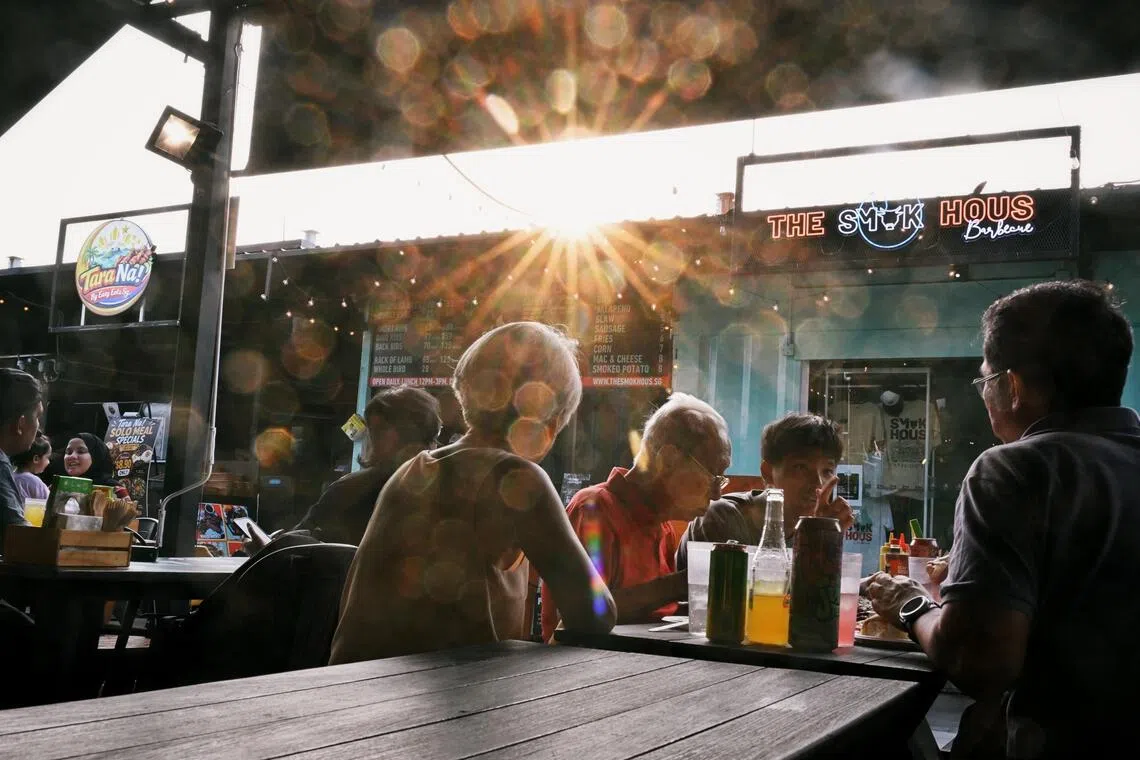
On any given weekend evening, the Punggol East Container Park is the kind of place that makes a neighbourhood feel like a neighbourhood. Fairy lights strung across repurposed shipping containers, the clatter of cutlery at outdoor tables, families cycling past on the way to the Waterway, dogs trotting between café chairs. It is exactly the scene that the marketing brochures for Punggol's BTO launches promised a decade ago.
So when news broke that the Punggol East Container Park is winding down — with tenants reportedly given notice and the cluster of container eateries and lifestyle shops expected to close its doors in the coming months — the reaction among residents was predictable. Along with "where will we go for supper?", the question that followed was far more anxious: "Will my flat drop in value?"
It's a fair question. A beloved local hub is closing; surely the homes near it become less desirable? The short answer, based on how HDB resale prices actually form in Singapore, is: probably not by much — and possibly not at all. The longer answer involves land economics, the difference between essential and lifestyle amenities, and the uncomfortable truth that the value of your flat is decided by forces far larger than the café down the road.
This article looks at the Punggol East Container Park shutdown through a property-lens: what the data on amenity closures says, what genuinely drives HDB resale prices in Singapore, and what homeowners and prospective buyers in Punggol should actually do next.
The Container Park That Made Punggol Feel Like a Hood
More Than Just Cafés
Punggol East Container Park sits at the southern end of Punggol, among the older generation of estates that bookended the town's early BTO years. For those who never visited, the name undersells it. This was never merely a makan spot — it was a cluster of container-architecture concepts that gave Punggol a bit of hipster texture: specialty coffee, pet-friendly seating, weekend markets, boutique fitness classes, and F&B concepts that you'd otherwise expect to find in Tiong Bahru or Jalan Besar.
It mattered to the town for reasons that have little to do with nutrition. Punggol, despite its Waterway and its newer integrated hubs, has historically been a bedroom town. Residents commute out in the morning and come back at night. Spaces like the Container Park gave the town a local third place — somewhere between home and work where community actually happens.
Its popularity also made it a visible talking point in property advertisements. Estate agents listing flats in the neighbouring blocks frequently cited the Container Park as a lifestyle perk. Walking distance to "hip F&B concepts" sounds better than walking distance to a bus stop.
But here is the first reality check for worried owners: what agents use to market a flat and what banks and valuers use to price a flat are two very different things.
The Land Economics Behind "Temporary" Hubs
To understand why the Container Park is closing, and why that closure is less traumatic for prices than it feels, you need to understand what the site actually is.
The land on which the Container Park sits was never intended to be a permanent lifestyle destination. It is state land, made available under an interim-use arrangement — a practice Singapore has refined over decades. When land is zoned for future development but not needed immediately, the relevant agencies can release it on a short-term basis for uses that activate the area: container parks, community farms, pop-up event spaces, even temporary car parks. The operator gets a site at below-market rents; the neighbourhood gets a lively amenity; the state keeps the land warm (and sometimes generates a little revenue) until its long-term use arrives.
That's the lifecycle of most beloved interim spaces in Singapore.
Exactly what will replace the Punggol East Container Park site has not been fully detailed in public announcements, and reports at this stage remain partial. What is understood is that the plot was always on borrowed time — its interim tenancy has run its course and the land is slated for a longer-term use. For residents, the closure is an emotional event. For the land system, it is simply the final step in a process that began years ago.
Crucially, the same mechanism that produces the closure also produces the replacements. Punggol has not lost a town centre amenity; it is losing a temporary one. And the history of such sites in Singapore suggests the next use will bring far more durable value than a row of container cafés ever could.
Why a Closure Feels Like It Should Crash Prices
The Psychology of Amenity Loss
Before looking at the price data, it's worth understanding why the "my flat will drop in value" instinct is so strong. Behavioural economists have a name for this: loss aversion. Losses hurt roughly twice as much as equivalent gains feel good. A new café opening across the street gives you a small warm glow. That same café closing produces outsized anxiety — even if the café contributed almost nothing to your home's transacted value.
There's also a cognitive bias called the availability heuristic. When you try to estimate your flat's value, you naturally reach for the most vivid, memorable facts about your neighbourhood — and a popular weekend hangout that's closing is extremely vivid. Meanwhile, the forces that actually move HDB resale prices — interest rates, buyer sentiment, supply pipeline, national price trends — are abstract and invisible. Your brain does the equivalent of blaming the visible iceberg for the ship's sinking while ignoring the current underneath.
Prices Do Not Form on Feelings
Here's the uncomfortable truth: the price of your HDB flat is not set by how nice your street feels. It is set by comparable transactions. When a valuer or a bank assesses an HDB flat, they look at recent transacted prices of similar flats: same town, comparable lease remaining, similar floor level, size, and orientation. The valuers are not doing a lifestyle audit of the neighbourhood's cafés. They are checking what other buyers actually paid for comparable homes.
This means that if the Container Park closure were going to depress Punggol East prices, it would have to show up in the transaction data — through buyers offering less for flats in the area, or through sellers accepting lower offers. And that only happens if the closure changes how buyers rank Punggol against alternative towns.
Which brings us to the more important question: what actually changes how buyers rank towns?
What Actually Drives HDB Resale Prices in Singapore
Property researchers in Singapore broadly agree that HDB resale prices are driven by a hierarchy of factors. Not all are equal. Some are worth hundreds of thousands of dollars over a flat's life; others are worth almost nothing at the margin.
| Factor | What it measures | Typical influence on price |
|---|---|---|
| Remaining lease & flat age | Years left on the 99-year lease | High and growing — lease decay becomes a bigger discount as flats cross 25-30 years |
| Distance to MRT/LRT | Walking time to the nearest station | High — a well-documented premium for flats within comfortable walking distance |
| Flat attributes | Floor level, layout, size, orientation, renovations | High — the single biggest driver of differences between two flats in the same block |
| School proximity | Distance to popular primary schools | Moderate to high — buyers pay for ballot proximity as a hedge |
| Town-level amenities | Mall, hawker centre, polyclinic, sports facilities within reach | Moderate — and absorbed into the town's baseline pricing |
| "Lifestyle" retail | Cafés, niche concepts, Instagram-able spots | Low — these come and go and buyers know it |
Notice what's missing from this table: single retail outlets. A container park — however beloved — sits near the bottom of the hierarchy. What matters for HDB values are the sticky, permanent features of a location: the train track, the school catchment, the lease, the flat itself. Retail tenants are the opposite of sticky. They churn constantly, in every town, in every market cycle.
The National Tide Is the Tide
The most important factor for HDB prices in Punggol East isn't found in Punggol at all. It's the national HDB resale market.
Look at the broad trajectory of HDB resale prices in recent years:
Singapore HDB Resale Price Growth by Year (%)
These figures, drawn from HDB's published resale price estimates, tell a remarkable story: in the space of five years, Singapore HDB resale prices rose cumulatively by well over 40%. No single amenity closure, café migration, or container park shutdown did anything to interrupt that trend — because the trend was driven by national forces: post-pandemic demand, a strong job market, delayed BTO completions, and the sheer scale of young families wanting homes.
Punggol rode this same wave. Its resale prices did not move because the Container Park existed, and they will not move because it is closing. They move with the national cycle, modulated by Punggol-specific fundamentals: the town's remaining lease profile, its transport connectivity, the pace of new supply around it, and its reputation as a family-oriented waterfront estate.
The Location Premiums That Last
None of this is to say location doesn't matter. It absolutely does — but the location features that matter are the ones that cannot be deleted by a landlord.
Consider what Punggol offers that genuinely moves prices:
- Punggol MRT and the LRT network — the North East Line connects the town directly to the city and to major employment nodes like one-north and Clarke Quay via transfers. Transport infrastructure is permanent, and proximity premiums are among the most robust findings in Singapore property research.
- Punggol Coast MRT — the new station at the northern end of the line, opened in December 2024, shortened journeys for the Northshore and Punggol Point estates and signalled continued state investment in the town.
- The Waterway and park connectors — Punggol's entire identity is built around its waterway, Coney Island, and cycling networks. These are permanent public goods, not commercial tenants.
- School catchment options — for young families, proximity to well-regarded primary schools shapes buyer pools.
- Future-proofing infrastructure — the Punggol Digital District and the Singapore Institute of Technology campus are embedding a long-term economic argument for the town that no café closure can reverse.
Notice that none of these factors — transport, greenery, schools, jobs — is affected by the Container Park shutdown. The things that pulled buyers into Punggol East in the first place are still there. What is leaving is a commercial tenant. And commercial tenants, as Singapore's property history repeatedly shows, have a limited effect on values when they leave — as long as the essentials remain.
Singapore's History of Amenity Closures: What Actually Happens to Prices?
It would be convenient if we had a clean, controlled dataset of "beloved amenity closes → measure nearby HDB prices five years later." Unfortunately, Singapore doesn't run natural experiments for us. The closure of a commercial cluster is almost always entangled with other changes — redevelopment, new infrastructure, demographic shifts — making it impossible to isolate one variable.
But the directional evidence is consistent.
The Big Splash Pattern
Take one of the most prominent recent examples of a beloved leisure destination closing: Big Splash at East Coast. For generations, Big Splash was the watery playground for Singapore families — waterslides, wave pools, weekend birthday parties. When it closed in late 2016 to make way for redevelopment, the predictable hand-wringing followed. Would nearby East Coast properties suffer?
They didn't. Prices in the surrounding East Coast condo enclaves continued to track the broader regional market, because demand for those homes was driven by proximity to the sea, to schools, to the city — not by a waterslide that had, frankly, been showing its age for years. The site's redevelopment ultimately became part of the neighbourhood's ongoing story rather than an interruption of it.
The lesson: when an amenity closes because the land is moving to a higher-value, longer-term use, property markets tend to look forward, not backwards. The market prices the future state of the neighbourhood, not the loss of its present one.
Punggol's Own Precedent
Punggol has already lived this once. Before the Punggol East Container Park became the town's go-to lifestyle cluster, Punggol Settlement — the container-themed F&B hub near Punggol Point Jetty — played that role. Over the years, Punggol Settlement has gone through waves of tenant churn, with operators coming and going, some closures generating their own rounds of neighbourhood worry.
Did those closures dent resale prices in nearby Northshore and Matilda House estates? There is no evidence they did. The towns' prices followed the national trajectory and the gradual maturation of Punggol's infrastructure. Individual food and beverage outlets — even entire clusters of them — have remarkably short half-lives in the consumer memory, and the transaction data reflects that.
Essential vs. Lifestyle: The Distinction That Matters
The reason analysts distinguish between types of amenities is that they have very different relationships with home prices:
| Type of amenity | Examples | Price effect if lost |
|---|---|---|
| Essential daily needs | Hawker centre, supermarket, clinic, pharmacy, childcare | Potentially significant — if residents must travel far for daily needs, the location's convenience premium erodes |
| Civic / community anchors | Library, community club, polyclinic, sports complex | Moderate — these draw people daily and support the town's identity |
| Transport / green infrastructure | MRT, LRT, park connectors, waterway | Very high — permanent, publicly funded, impossible to "close" |
| Lifestyle / discretionary retail | Cafés, container parks, boutique fitness, weekend markets | Low to negligible — high churn, quickly replaced, rarely capitalised into prices |
When a lifestyle cluster closes, the essential fabric of the neighbourhood is unchanged. The Punggol East residents who loved the Container Park still have their hawker centres, their supermarkets, their clinics, their schools, their LRT stations, and their Waterway. The convenience fundamentals — the things valuers actually price — are intact.
What If New Homes Replace It?
There is also a plausible upside scenario worth considering. If the Container Park site makes way for residential development — as many observers expect — the impact on the surrounding area is more complex than simple loss.
New homes mean new residents, which means more demand for the remaining shops, coffee joints, and F&B in the area. New BTO supply in a young town also signals that the state continues to invest in the precinct. In the medium term, a site that was "merely" a weekend café strip could become the foundation of a denser, livelier neighbourhood — which is precisely how mature estates like Tampines and Jurong East evolved.
Punggol's Property Market Today: The Forces That Really Matter
To put the Container Park closure in proportion, it helps to zoom out on where Punggol sits in its own property life cycle.
From Backwater to Boom Town
Punggol's transformation is one of the great Singapore housing stories. Announced in 1996 as "Punggol 21," the town was meant to be a showpiece of waterfront living — but the Asian Financial Crisis stalled development, and for years Punggol was a punchline: a town of half-built promises and maturing unprofitable land. Then came the Waterway, the BTO wave, the malls, and the digital district.
| Year | Milestone | Why it matters for property |
|---|---|---|
| 1996 | Punggol 21 announced | The vision: a waterfront town for 21st-century living |
| Early 2000s | First HDB flats completed | The lease clock begins ticking on Punggol's oldest blocks |
| 2003 | Punggol MRT station opens | The town joins the rail network |
| 2011 | Punggol 21-plus unveiled | Waterway, parks, and lifestyle infrastructure take centre stage |
| 2016 | Waterway Point opens | Punggol gets a genuine town-centre mall anchored to the LRT |
| 2024 | Punggol Coast MRT opens | The northern estates get rail access and the town's ambition expands |
| 2025 (reported) | Punggol East Container Park winds down | A temporary lifestyle chapter closes |
Each milestone layered more durability onto Punggol's property fundamentals. The Container Park — for all its charm — was never in the same league.
A Young Town, Growing Up
Punggol's population has exploded over the past two decades as BTO after BTO delivered young families into the town.
Punggol Resident Population (Census Years, Approx.)
Census-based estimates, rounded, show the scale: from roughly 61,000 residents in 2010 to close to 176,000 by 2020 — nearly tripling in a single decade, and growing further since. This demographic weight is what really underwrites Punggol's housing market. Thousands of young families buying simultaneously, upgrading, and eventually reselling creates a deep and liquid market. A single container park closing does not dent that liquidity.
But the town's age profile carries a subtler implication for owners. Punggol's earliest flats — those completed in the early 2000s — are now more than two decades into their 99-year leases. As they cross the 25-year mark over the next few years, lease decay will begin to assert itself in resale pricing. This is a far more meaningful determinant of value than the Container Park's fate. Buyers comparing an older Punggol East flat with a newer Northshore flat are making decisions based on lease years, not café proximity.
The Infrastructure Pipeline
If you want a sense of Punggol's property trajectory over the next decade, look at what is being built, not at what is being demolished:
- Punggol Digital District (PDD) — Singapore's first enterprise district, anchored by the Singapore Institute of Technology's Punggol campus. The district is projected to bring tens of thousands of jobs into the town, creating a work-live-play dynamic that Punggol has never had. Job proximity is one of the strongest structural supports for housing demand anywhere in the world.
- SIT Punggol Campus — the university welcomed its first students in 2024. A permanent student population brings rental demand, retail vitality, and a long-term signal that the government is staking serious capital on Punggol's future.
- Northshore and Punggol Point BTOs — continued new supply at the town's northern edge keeps the estate young and ensures a constant inflow of residents.
- Integrated hubs — One Punggol and the various integrated developments around the LRT network ensure that daily essentials, community facilities, and healthcare sit within walking distance of most blocks.
This is the context in which the Container Park closure must be understood. A town gaining a university campus, a digital district, a new MRT station, and thousands of new homes is not a town in decline. It is a town in transition — and transitions always involve some loss of the familiar.
What the Closure Means for Homeowners and Prospective Buyers
So what should you actually do if you own a flat near the Punggol East Container Park — or if you're considering buying one?
If You're an Existing Owner
The first piece of advice is deceptively simple: do not panic-sell, and do not anchor your asking price to a café. If you sell in the coming months, your flat's value will be set by comparable transactions of similar flats in Punggol East — not by the status of the Container Park across the road. Recent transactions in your block and neighbouring blocks are a far better guide to your flat's worth than any news cycle.
Instead, focus on the factors you can control:
- Position your flat against its true comparables — same block or nearby blocks, same flat type, comparable remaining lease, similar floor level. These determine value far more than the retail mix down the street.
- Consider the medium-term story, not the short-term noise. The Container Park site's redevelopment — whatever it becomes — will almost certainly be a net positive for the precinct over a five-to-ten-year horizon.
- Track the town-level fundamentals, not individual outlets: PDD hiring announcements, LRT connectivity, new school balloting patterns, and the national HDB price trend.
- If you're selling, don't let agents use the closure as a negotiating weapon. And if you're buying, don't let it become a reason to lowball — because the comparable transactions won't support a discount.
If You're a Prospective Buyer
For buyers, the closure is arguably an opportunity in disguise. A transient bout of negative sentiment around a beloved local spot can occasionally create windows where sellers are more anxious than the data warrants. If you find a well-priced flat in Punggol East whose owner is worried about the Container Park closure, you're benefiting from psychology, not economics.
But buy for the right reasons:
- Compare against the broader Punggol resale market, not just the blocks nearest the Container Park. If similar flats in the same town are transacting at similar prices regardless of distance to the soon-to-close hub, the closure isn't priced in — and shouldn't be.
- Look at lease, layout, and light, not lifestyle. A well-kept 4-room flat at a fair price with a long remaining lease will outperform a "trendy" flat with a fading lease — regardless of what's across the street.
- Walk the site's future, not its past. If the Container Park land becomes housing, the area will gain new residents, new demand for shops, and possibly better infrastructure. That's a positive for the surrounding blocks.
A Note on Timing
The most common mistake in situations like this is overreacting to a single event on a specific date. Property prices incorporate information slowly and imperfectly. A closure announced today might cause a few anxious WhatsApp chats among residents, but it takes many months of reduced buyer demand for a genuine price effect to appear in transaction data — and in the case of a non-essential lifestyle amenity, that reduced demand rarely materialises at all.
What would be more concerning is a different kind of closure: the loss of a hawker centre, a major supermarket, or an MRT station. Those are the amenities whose absence genuinely reduces convenience and therefore value. A container café is not in that category, and treating it as such distorts both selling and buying decisions.
Food for Thought
Before you decide how to react to the Punggol East Container Park shutdown — or any similar amenity closure in your neighbourhood — consider these questions:
-
Why do we treat visible losses as more significant than invisible gains? The Container Park's closure is visible and imminent. The Punggol Digital District's job creation, the new MRT station, and the BTO pipeline are equally real but diffuse. Are we pricing what we can see rather than what matters?
-
At what point does an amenity become "essential"? Is the line drawn at hawker centres and supermarkets, or does a beloved community space eventually cross into essential territory? Where would you draw that line in your own neighbourhood?
-
If the Container Park site becomes new homes, is that a loss or a gain for nearby flat values? New supply can compete with older resale flats — but new residents also bring demand for remaining shops and services. How should owners weigh these opposing forces?
-
How long is the "memory" of a good amenity in property prices? When a new café opens, does it add to your flat's value? If it doesn't add on the way in, why would it subtract on the way out?
-
What information would actually change your view of your flat's value? If you track the transaction data for your block over time, you might find that your asking price anxiety has very little relationship with the actual market — and that's a liberating realisation.
The Bigger Picture for Punggol Owners
The Punggol East Container Park shutdown is a genuine loss for the community that loved it. But it is not a property event. It is a land-use event — the latest turn in Singapore's endless cycle of temporary activation giving way to permanent development. The same system that brought container cafés to a young HDB town is now recycling that land into the town's next chapter. Owners who understand this cycle tend to make calmer, better decisions than those who read every closure as a signal of decline.
Punggol itself is a testament to how fast a town's narrative can change. Three decades ago it was a fishing village; two decades ago it was a stalled planning vision; a decade from now it will be a digital economy hub with a university on its doorstep. In that arc, a row of container shops was always going to be a supporting character, not the plot.
The fundamentals that built Punggol's property market — rail connectivity, waterfront living, family-oriented planning, and now a jobs-and-education pipeline — remain untouched by this closure. Buyers will continue to compare Punggol East flats against other HDB towns on the metrics that matter: price per square foot, remaining lease, distance to the station, and the trajectory of the estate. The Container Park will be remembered fondly, and that's about it.