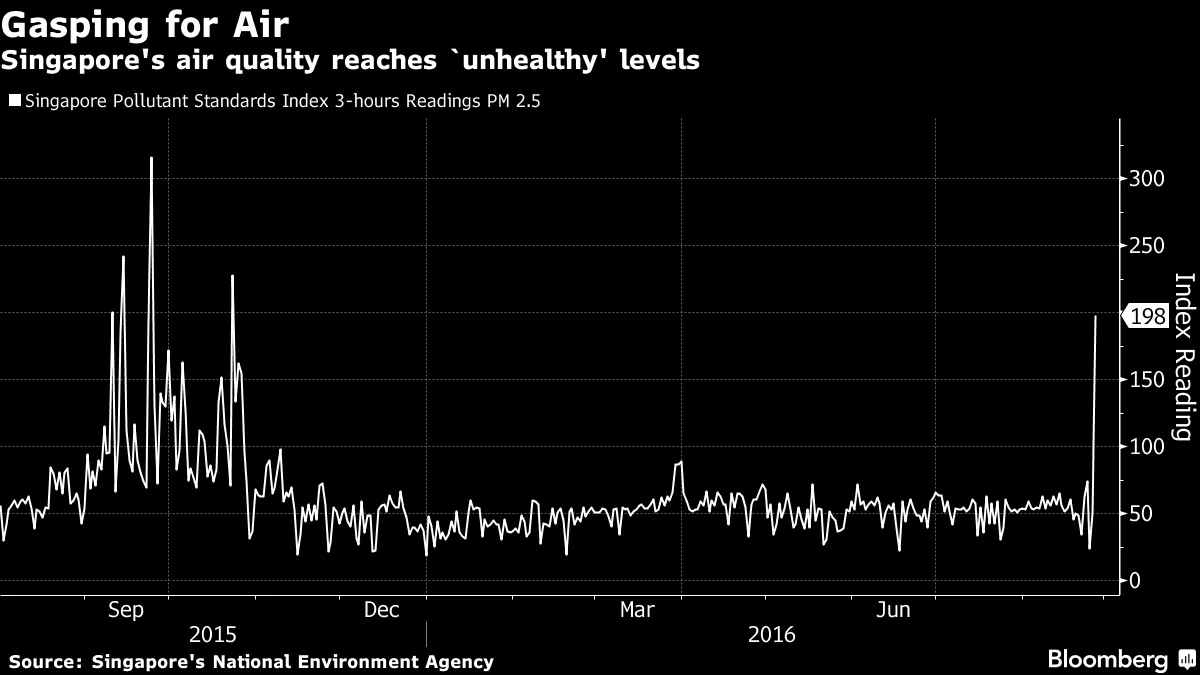
21 June 2013. The sky over Singapore turned a sickly orange. By early afternoon, the three-hour Pollutant Standards Index (PSI) had touched 401 — "hazardous," the worst reading the country had ever recorded. Offices sent people home. Surgical masks vanished from pharmacy shelves within hours. The Marina Bay Sands disappeared into a sepia curtain, and Raffles Place emptied out as office workers hurried underground like extras in a disaster film.
The property WhatsApp groups, naturally, lit up with the same anxious question: is the haze going to hit property prices?
More than a decade later, that question returns every dry season. The haze came back in 2015 with a vengeance, supercharged by El Niño. It returned in 2019 and again in 2023. And each time, the logic seems unassailable: buyers stay indoors, viewings get postponed, expatriates start googling "air-purified condos," and surely — surely — property values must take a hit.
The short answer from the data: not really, and not for long.
This article digs into what PSI readings, resale transactions, and rental trends actually show — separating the genuine discomfort of a smoky week from the far more powerful forces that really move Singapore property prices. Spoiler: the haze is one of the most visible, most emotional, and least consequential factors in this market. Here's the data behind that claim, and the one way in which air quality is quietly becoming more important than it used to be.
The Haze, the PSI, and Why the Numbers Matter
Before we look at prices, let's get the basics right — because haze conversations are full of conflated numbers and half-remembered panics.
The haze is not local pollution. It is transboundary smoke from land and forest fires in Sumatra and Kalimantan, carried by prevailing south-westerly winds during the June-to-October dry season. When El Niño dries out the peatlands, the fires — many started illegally to clear land for plantations — burn longer and hotter, and the smoke gets thicker. Singapore doesn't generate the problem; it imports it, literally downwind of vast burning landscapes.
The PSI is Singapore's official measure of air quality, published by the National Environment Agency (NEA). The scale runs from 0 to 500, and the health bands look like this:
| PSI Range | Band | What You're Told to Do |
|---|---|---|
| 0 – 50 | Good | No advisory |
| 51 – 100 | Moderate | Unusually sensitive people reduce prolonged exertion |
| 101 – 200 | Unhealthy | Elderly, pregnant women, children reduce outdoor activity |
| 201 – 300 | Very Unhealthy | General population reduce prolonged outdoor exertion |
| Above 300 | Hazardous | Avoid outdoor activity; stay indoors where possible |
In the quarter-century that Singapore has tracked the PSI, the island has crossed into the "Hazardous" band only a handful of times. The major episodes form a familiar timeline:
Three of those episodes — 2013, 2015, and 2023 — were severe enough to dominate the news cycle for weeks and trigger official crisis responses. Each one became, in effect, a natural experiment for the property market. And each produced essentially the same result: no durable impact on prices.
Peak 3-Hour PSI During Major Haze Episodes
The two worst episodes — 2013 and 2015 — are statistical outliers even by Singapore's generous standards. If the haze were a true price driver, you would expect visible downward kinks in property indices around these years. You don't. Here's what actually happened.
The 2013 Experiment: The Worst Haze on Record
Let's start with 2013, because it's the cleanest test. On 21 June 2013, the 3-hour PSI hit 401 — a level so far past "Hazardous" that NEA's own advisory told the general population to avoid outdoor activity altogether. Schools cancelled outdoor activities. The government distributed masks. It was, by any measure, a genuine environmental crisis.
Now here's the uncomfortable fact for the "haze hurts prices" theory: June 2013 was the exact month the HDB resale market peaked.
The HDB Resale Price Index (RPI, base Q1 2009 = 100) peaked at around 186 in the second quarter of 2013 — the highest reading in Singapore's history at that point. The haze was at its apocalyptic worst in the same quarter the market topped out. If smoke were a price killer, we would have expected to see prices stagger in the second half of 2013. Instead, they held roughly flat for several months before the real slide began.
And that slide was not caused by the wind. In June 2013, the government introduced the Total Debt Servicing Ratio (TDSR) framework, alongside tighter loan-to-value limits. These were deliberate, calibrated policy shocks designed to cool a market that had run far ahead of incomes. The TDSR throttled the amount buyers could borrow, and demand fell off a cliff. Prices declined steadily from mid-2013 through 2017, ultimately falling about 30% from peak to trough.
The haze contributed approximately nothing to that. It was a policy-driven correction wearing smoke-coloured glasses.
What Nearly Two Decades of Resale Data Shows
If 2013 is one data point, the full trend line is even more conclusive. The chart below tracks the HDB Resale Price Index from 2013 through 2024 — a period covering the four most significant haze episodes in recent history.
HDB Resale Price Index (Annual Average, Q1 2009 = 100)
Superimpose the major haze years on this chart and a pattern emerges — but not the one you might expect:
| Year | Peak PSI | RPI Movement | What Was Actually Driving Prices |
|---|---|---|---|
| 2013 | 401 | Peaked at ~186, then flat | Multi-year boom ending; TDSR and cooling measures hit in June 2013 |
| 2015 | 333 | Fell roughly 6% | Market already in a two-year downcycle; weak economy, loan curbs |
| 2019 | 199 | Flat at ~136 | Quiet market; no momentum in either direction |
| 2023 | 163 | Rose roughly 8% | Post-COVID rebound; tight supply; rental boom |
Read that table carefully. The worst haze in Singapore's recorded history coincided with the absolute peak of the resale market. The second-worst haze arrived during a decline that had begun two years earlier — and was driven by policy, not smoke. The relatively mild 2019 haze saw prices do nothing at all. And 2023, the year the haze returned after a four-year holiday, was one of the strongest years for HDB resale prices in history, with the index climbing to fresh record highs.
Then there is the wider context: rents in 2023 also hit all-time records, driven by a post-COVID influx of expatriates and a construction supply crunch. Landlords in Punggol, Sengkang, and Tampines — suburbs that regularly record among the highest PSI readings during haze episodes — had no trouble finding tenants at record prices. If smoke were a meaningful price killer, 2023 would not have been the banner year it was.
The analytical point bears repeating: haze episodes overlay neatly on top of price movements, but they do not cause them. The big forces — interest rates, cooling measures, supply pipelines, population flows — are orders of magnitude larger than a few weeks of smoky air.
District-Level Reality: Where the Smoke Goes, and What Prices Do
One of the most common assumptions in the haze-property debate is that some districts "catch it" more than others, and that those districts should therefore be discounted. There is some truth to the first half of that sentence.
Because Singapore's haze arrives with south-westerly winds, eastern and southern parts of the island — East Coast, Marine Parade, Pasir Ris, Tampines, Punggol — tend to register higher PSI readings during haze episodes than western districts like Jurong. NEA's regional readings during past episodes have consistently shown the east registering the highest numbers, with the west often a step behind.
Here is what the property data says about those same districts:
| District(s) | Areas | Typical Haze Exposure | What Prices Did |
|---|---|---|---|
| D15 / D16 | East Coast, Marine Parade, Bedok | High — windward side | Resale demand stayed robust; new launches crossed S$2,000 PSF |
| D18 | Tampines, Pasir Ris | High | Tampines joined the million-dollar HDB club in 2024 |
| D19 | Punggol, Sengkang | High | Resale prices hit records across the 2020s |
| D5 | Jurong, West Coast | Moderate | Steady, but no "clean air premium" |
| D28 | Yishun, Sembawang | Moderate | Strong resale demand on affordability, not air quality |
The pattern is striking. The districts that catch the most smoke are the same districts that have seen some of the strongest price growth over the past five years. Eastern Singapore's resale boom was driven by newer flats, larger floor plans, coastal living, and proximity to new infrastructure — not by any shortage of hazy afternoons. If a "haze discount" existed in any meaningful form, D15, D18, and D19 would be the places to find it. They aren't.
This is not to say East Coast residents are wrong to notice the haze. They aren't. It's simply that the market does not price that experience into the transacted value. Buyers consistently pay for what a location offers across the year, not for what the sky looks like during one bad fortnight in October.
Why Haze Hardly Moves the Needle: The Transmission Channels
Of course, it's not as if the haze does nothing to the property market. It just doesn't do very much, for very long. To understand why, it helps to map the channels through which air quality could theoretically affect prices — and then test each one against reality.
Channel 1: Health concerns. During haze episodes, property viewings do drop. People don't want to trudge between show flats in smoky air, and NEA advisories tell vulnerable groups to stay indoors. But here's the timing problem: haze episodes in Singapore typically last days, occasionally a few weeks. Property transactions take months to close. A buyer who postpones a viewing by a week does not abandon the purchase — they reschedule. At most, you see a small dip in transaction volumes during the affected weeks, followed by a catch-up spike once the air clears. Sales get delayed, not destroyed.
Channel 2: Visibility and aesthetics. A home with an unblocked view is worth more — that is a real, well-established pricing fact. During a haze, that view dissolves into beige nothingness. But the view does not permanently vanish; it comes back with the rain. Buyers are rational enough to price a view based on 360 clear days a year rather than the 20 hazy ones. No valuation firm in Singapore applies a "haze discount" to an apartment because the skyline occasionally disappears.
Channel 3: Outdoor lifestyle. Singapore's property premiums are built on amenities — pools, gyms, parks, proximity to the sea. When the haze arrives, those amenities become temporarily unusable. This is genuinely annoying, and for families with young children or elderly parents, it can be a serious inconvenience. But it is also temporary. Even the worst haze years in Singapore have never come close to the chronic, months-long air quality crises faced by cities like Delhi or Beijing — where poor air is a permanent feature and prices genuinely do reflect it. Singapore's smoke is episodic, not endemic, and the market prices it that way.
Channel 4: Rental and corporate demand. This is the channel most people worry about, because expatriates are mobile and corporate relocation budgets are sensitive. In 2013, some multinationals did evacuate non-essential staff for a few days. But Singapore's corporate rental market is stubbornly sticky: leases run 12 to 24 months, companies rarely uproot talent over a three-week air quality event, and Singapore's baseline air quality in non-haze months is genuinely good — a huge draw for families relocating from far more polluted Asian megacities. Short-term panic, long-term stability.
There is also a structural reason haze fails to dent prices: Singapore's baseline air quality is spectacularly good. Even in "moderate" months, Singapore's readings compare favourably with most regional capitals. Buyers and renters benchmark Singapore against Hong Kong, Shanghai, Mumbai, or Jakarta — and by that standard, Singapore wins easily, haze included. The occasional smoky week registers as a shrug, because the alternative set is so much worse.
Resale vs Rental: Who Actually Feels the Smoke?
If any segment of the market is sensitive to haze, it is the rental market — not because rents drop, but because the rhythm of rental demand shifts briefly. Let's separate the data from the vibes.
Private residential rents are driven by expatriate package levels, work pass approvals, and the supply of new completions. In 2023, Singapore rents soared to record highs while the haze made its first significant return since 2019 — a combination that makes it nearly impossible to argue haze suppresses rents. If anything, the 2023 data shows the opposite: rents blew past records precisely when the PSI was at its annual worst, powered by a post-COVID surge in foreign talent and a construction supply crunch.
HDB rental volumes tell a similar story. Tenant demand in 2023 was historically strong, with rental agreements hitting new highs across heartland towns. Housing agents in the eastern suburbs, the first to smell the smoke, reported no shortage of tenants at record rents.
So where does haze actually show up in the rental market? In the soft data, not the hard price indices:
- Housing agents report more enquiries about air purifiers and window-sealing during haze weeks.
- Viewing attendance drops on days when the 24-hour PSI crosses "Unhealthy" — anecdotally by a visible margin, before recovering the following week.
- Corporate housing providers note that some relocating executives ask about air quality in specific districts — but almost none change their chosen district because of it.
- Serviced apartments see a slight uptick in demand during severe haze weeks, from families who book a filtered hotel room for a weekend escape. This is a blip, not a trend.
The honest summary: haze creates noise in the rental market, not signals. It shifts the timing of viewings and adds a talking point to lease negotiations. It does not reset price levels, because the underlying supply and demand — headcounts, housing inventory, employment cycles — do not move with the wind.
The Quiet Shift: Air Quality as an Amenity
Now we get to the part of the story that is genuinely changing. While historical data shows haze has no lasting price impact, the intangible factor — how buyers think about air quality — is shifting, especially among Singaporeans aged 25 to 40.
Three forces are driving this:
Health consciousness after COVID. The pandemic permanently changed how people value indoor air. What was once an invisible amenity — ventilation, air filtration, sealed windows — is now a checklist item. Newer HDB flats and condominiums generally have better mechanical ventilation; older walk-up apartments rely on natural cross-ventilation, which is precisely what you cannot use during a haze.
Work-from-home changed the calculus. When Singaporeans went to the office five days a week, a hazy day meant a slightly worse commute. Now many people work from home several days a week. A hazy day is an entire day of bad air in the space where you live, sleep, and work. The cost of haze has risen because daily exposure has risen.
The wellness real-estate trend. Developers have noticed. New launches increasingly market wellness features — air-purification systems, green-certified materials, biophilic design, proximity to parks. Government schemes like the BCA Green Mark certification and HDB's Green Town programme have made environmental performance a semi-official part of the property conversation. Showflats in 2023 and 2024 were as likely to talk about filtered air as about marble foyers.
Does any of this show up in prices yet? Not in the aggregate data. Eastern districts that routinely record the highest PSI readings during haze — Pasir Ris, Tampines, Punggol — have been among the strongest performers in the country. If haze were a dominant buyer concern, these districts would be structurally discounted. They are not. Coastal living, newer flats, and better greenery outweighed the occasional smoky east wind.
So what does this mean for your decision? A simple framework:
The takeaway: air quality is becoming an amenity, not a price-setter. Buyers increasingly want homes that can cope with a hazy day — better windows, sealed units, good air-conditioning — but they are not yet willing to pay less for a home in a district that catches more smoke, nor a premium for one that catches less. The conversation has changed; the transaction prices, so far, have not.
Haze vs the Forces That Actually Move Prices
If the haze is not moving prices, what is? Look at the major shocks of the past decade and the hierarchy is clear:
- Interest rates. The 2022–2023 rate spike compressed buyer budgets and cooled the private property market faster than any haze could.
- Cooling measures. TDSR in 2013, ABSD hikes in 2018, 2021, and 2022, and the 15-month wait-out rule for private upgraders in 2022 have each shifted prices more in a month than the PSI has in a decade. The September 2022 cooling measures alone triggered an immediate, measurable slowdown across both HDB and private markets.
- Supply. BTO completion pipelines, private residential launches, and government land sales determine the rental and resale equilibrium far more than weather patterns.
- Demographics and migration. The 2023 rental boom was powered by a surge in work pass holders and students — not by clear skies.
- Connectivity and amenities. New MRT lines, schools, and malls shift district premiums in ways the wind never will.
Compare that list to the haze: a few weeks of elevated PSI per year, concentrated in the late summer and autumn months, with no impact on interest rates, no impact on mortgage approvals, no impact on supply, and no impact on where jobs locate. It is a noise factor in a signal-dominated market.
There is one caveat worth naming: tail risk. If climate change makes haze episodes both worse and longer — say, multi-month seasons comparable to the Indonesian fires of 2015 but stretched across half the year — the calculation changes. Chronic air quality problems do get priced into property markets, as cities from Bangkok to Delhi demonstrate. That is a scenario worth watching, but it is not the Singapore of the past decade.
What This Means for Buyers, Sellers, Renters and Investors
Whether you are buying, selling, renting, or investing, the haze should sit low on your list of decision criteria. Here is the practical breakdown.
For buyers:
- Don't pay a "haze premium" for a supposedly haze-free district — the data does not support such a distinction.
- Don't reject a district because it caught more smoke last October; check the full-year PSI pattern before deciding.
- Do look for haze-resilient features: good air-conditioning, well-sealed windows, mechanical ventilation. These will matter more than any district-level folklore about the wind.
For sellers:
- Don't panic-list during a haze episode; buyers who postpone are buyers who return.
- Do time your marketing flexibly. The same flat photographed on a clear day and a smoky day looks like two different properties.
For renters:
- A severe haze episode is a legitimate moment to negotiate. Landlords hate vacant units, and a week with zero viewings is a psychological pressure point, even if market-wide rents are unmoved.
- Rents may not budge, but lease terms can: a waived last month, a free air purifier, a slightly earlier move-in date.
For investors:
- Rental yield, location, and lease expiry cycles matter thousands of times more than yearly PSI readings.
- If you are underwriting a long-term hold, the haze is a rounding error. If you are buying a short-term flip, it is still a rounding error — just a slightly more visible one in the weekly transaction volume numbers.
Food for Thought
-
If a severe haze episode stretched into two or three continuous months, at what PSI threshold do you think buyers would start demanding a discount? What would have to happen for air quality to become a permanent price factor, the way it is in some Asian megacities?
-
Eastern Singapore — Pasir Ris, Punggol, Tampines — consistently registers higher PSI readings during haze, yet its resale prices have boomed. Does that say more about the strength of coastal amenities, or about how little buyers actually weigh air quality?
-
Now that remote work is entrenched, indoor air quality is arguably more valuable than ever. Should property listings disclose ventilation and filtration details the way they disclose floor area and tenure?
-
Developers are marketing "wellness" features like air-purification systems and green-certified building materials. Are these genuine value-adds, or marketing costs that will quietly be absorbed by the next buyer?
-
Singapore imports its haze — fires across the region carried by regional winds. How should a city-state price an environmental risk it can influence, but never fully control?
The Bottom Line
The haze is real. It is unpleasant, it is unhealthy, and it deserves to be taken seriously as a public health issue. But as a property-market force, it has been — and remains — a minor player. The 2013 haze struck in the same quarter the HDB resale index hit its all-time peak. The 2015 haze arrived in the middle of a policy-driven correction that had started years earlier. The 2023 haze rode along as prices and rents surged to records. If smoke were a serious price driver, those charts would look very different.
What has changed is perception. Younger buyers spend more time at home, care more about air quality, and are increasingly choosing homes that can weather a hazy day — better ventilation, sealed windows, greener surroundings. That shift will slowly make air quality a more visible part of the property conversation. But the price tag is still written by interest rates, supply, and policy — not by the wind.