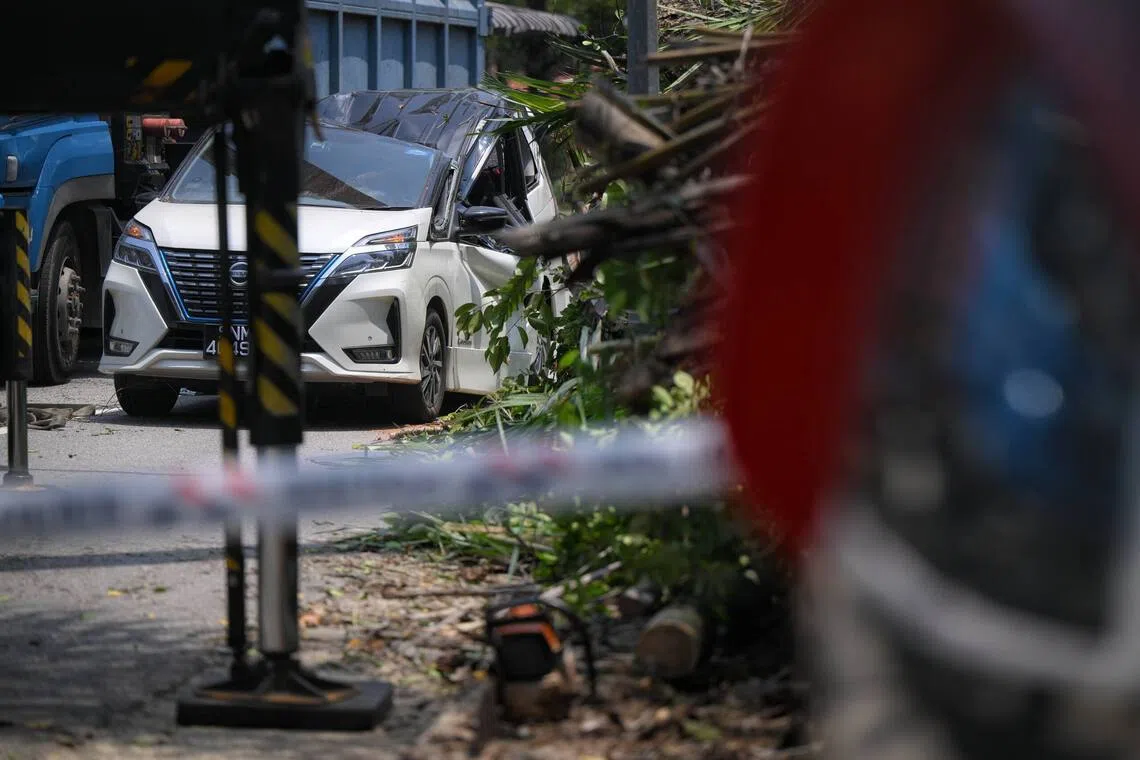
It was the kind of weekend morning Dempsey Hill is made for. Brunch crowds settled onto colonial-era verandas, steam curling off lattes while rain trees — some of them older than the Republic itself — draped their canopies over gravel car parks. Then, with a crack that cut straight through the chatter, one of those giants came down across a parked car, folding its roof like tinfoil.
Nobody was hurt. But the owner of that wrecked vehicle is now learning a hard lesson about a question most of us never think about until a tree lands on something we own: who is liable for tree damage in Singapore?
The answer is rarely simple. It depends on where the tree stood, who controlled the land, what condition the tree was in, whether the storm was genuinely "extraordinary" — and, crucially, what your own insurance policy actually covers. For homeowners, tenants, and drivers alike, this is a crash course in the quiet legal machinery that sits behind Singapore's lush, green exterior.
This article unpacks every layer of that question — from the statute books to the insurance fine print — so that if a tree ever comes down on your property, you're not the one left holding the bill.
The Scene: Old Trees, New Money, and One Very Crushed Car
Dempsey Hill occupies a strange, lovely niche in Singapore's mental map. The former British army barracks, tucked just off Holland Road and a stone's throw from the UNESCO-listed Botanic Gardens, have been reborn as one of the island's most atmospheric dining and lifestyle destinations. Behind its weathered brick walls sit high-end restaurants, wine bars, boutique stores, and one of the city's best-known gourmet markets.
But the area's defining feature isn't the food — it's the green. The site is shaded by dozens of mature trees, including large rain trees whose canopies can spread 30 metres or more. When car parks are carved out beneath these giants, drivers are effectively parking underneath a weight bomb. A healthy mature rain tree can weigh several tonnes. Its canopy can be the size of a tennis court. And when a tree like that comes down, it doesn't clip a side mirror — it flattens whatever is underneath.
That is what happened in the recent Dempsey Hill incident: a tree gave way under wet, storm-lashed conditions and slammed into a parked car, causing significant damage. No one was injured, but the vehicle's roof, pillars, and frame were badly compromised — the kind of damage that can write off a car entirely or leave an eye-watering repair bill.
The first reaction of most victims is: "That's what insurance is for." And it is — partly. But one fallen tree raises a stack of questions that insurance alone can't answer:
- Was the tree on public or private land?
- Did the responsible party — whether NParks, a condominium's management corporation (MCST), or a private landowner — breach its duty of care?
- Was the fall an unpredictable "Act of God," or a foreseeable failure of maintenance?
- If the tree's owner isn't at fault, who absorbs the cost?
- And if the car owner claims on their own policy, will their no-claim discount take a hit?
The answers can mean the difference between a two-week insurance claim and a year-long legal battle. Let's break it down, layer by layer.
Whose Tree Is It? The Land Question Comes First
In Singapore law, a tree is not a standalone object. Legally, it is a fixture of the land on which it grows. That means liability follows land ownership and land control. Ask "who owns that tree?" and you are really asking "who owns — or controls — the land beneath it?"
That might sound pedantic, but it's the single most important question in any tree damage case. Singapore's urban landscape is a patchwork of ownership types, and each carries a different duty-holder:
| Land type | Who manages the trees | Real-world examples |
|---|---|---|
| Public streets and parks | NParks | Roadside trees, the Botanic Gardens, East Coast Park |
| Other state land | Relevant state agencies (e.g. Singapore Land Authority) | Vacant state land, some infill plots and heritage sites |
| Condominium common areas | MCST / managing agent | Condo landscaping, carpark shade trees, clubhouse greenery |
| Landed private homes | Homeowner | Garden trees, trees within the property line |
| Commercial and heritage leases | Leaseholder / tenant | Dempsey Hill operations, conserved shophouses, restaurants |
Dempsey Hill is a particularly instructive case because it sits across several of these categories. The area is largely state land, held by the Singapore Land Authority and leased out to private operators. Depending on exactly where a tree stands, it could be:
- a "state tree" on a public verge or roadside — NParks is responsible;
- a tree inside a restaurant's leased compound — the leaseholder is responsible;
- a tree in a common carpark serving multiple tenants — the leaseholders or their managing agent share responsibility;
- a heritage tree with special protection — NParks retains regulatory oversight even on nearby private land.
If the Dempsey Hill tree stood within the grounds of a commercial operator, that operator — and its insurer — is the first port of call. If it stood on a public roadside or verge, the spotlight turns to NParks.
Here's a simple way to visualise the decision:
How to find out which category applies:
- OneMap (Singapore Land Authority's free map portal) shows land parcel boundaries and helps identify state land.
- The OneService app lets you report issues on public land — and creates a digital record that may become useful evidence later.
- For condos, ask the managing agent; for landed homes, check the title deed or simply ask the neighbour whose tree overhangs your fence.
- On leased sites like Dempsey Hill, ask the leaseholder directly — in writing.
The Legal Toolkit: How Singapore Law Treats a Fallen Tree
Once you know who controls the land, the next question is: what legal standard binds them? Singapore's approach rests on four pillars.
1. The Parks and Trees Act
The Parks and Trees Act (Cap. 216) is the main statute governing the planting, maintenance, and conservation of trees in Singapore. Among other things, it gives NParks its mandate to manage trees on public land, and it regulates what private landowners can do with their own trees.
A little-known fact for homeowners: under the Act, it is an offence to cut down, remove, or damage a tree with a girth of roughly one metre or more without NParks' permission — even on your own land. The penalties can run into five figures. So while you may be responsible for maintaining the trees in your garden, you are not free to simply chop them down when they become an inconvenience. The law treats large trees as a public resource, not just a private nuisance.
This matters for liability because it means tree management is a regulated, professional activity — and the regulatory backdrop raises the standard of care. You can't defend a collapsed tree by saying "I'm not an arborist." The law expects you to act like one, or hire someone who is.
2. The Tort of Negligence
The heart of most tree damage claims is the common law tort of negligence. The duty of care descends from the famous English case of Donoghue v Stevenson: you must take reasonable care to avoid acts or omissions that could foreseeably injure your neighbour. For trees, that translates to a duty to:
- inspect the trees on your land or under your charge;
- maintain them (pruning, bracing, removing deadwood);
- act on warning signs such as decay, fungus, cracks, leaning trunks, or exposed roots.
To win a negligence claim against a landowner or public authority, you must prove four elements:
- The defendant owed you a duty of care;
- The defendant breached that duty (e.g. failed to inspect or ignored a defect);
- That breach caused the damage;
- The damage was foreseeable and not too remote.
In practice, the decisive battleground is almost always element two: Did the tree's managers know, or should they have known, that the tree posed a danger?
3. The Occupiers' Liability Act
Singapore's Occupiers' Liability Act 1960 adds a second layer: the occupier of premises owes a "common duty of care" to all visitors. Note that "occupier" can be broader than "owner." An MCST occupies and controls a condo's common areas. A restaurant occupying a Dempsey Hill unit is an occupier of that unit's grounds. This matters because you can't escape liability by outsourcing maintenance to a contractor — the occupier's duty remains theirs.
4. Suing the Government
If the tree was on public land, you can't just sue "the Government" casually — but you can. The Government Proceedings Act (Cap. 121) allows claims in tort against the Government in the same way you would sue a private party. Claims are typically channelled through the Attorney-General's Chambers, and in many cases, matters are settled before reaching a courtroom.
One practical note: claims against the Government can be settled if you present strong evidence of negligence. If the evidence is weak — if the tree was healthy and recently inspected — the Government may rightly decline to pay, and you'll be left with your own insurance.
When NParks Pays: Public Trees and the Burden of Proof
Singapore is perhaps the only city-state on earth whose skyline is as famous for greenery as for glass. NParks manages millions of trees across the island — along expressways, in neighbourhood parks, around reservoirs, and throughout its network of nature reserves. Keeping that urban forest standing is one of the most complex engineering challenges the country faces.
After every major storm, the news cycle fills with photos of toppled trees blocking roads or crushing cars. Most are cleared within hours. But each incident carries a quiet question: did the system fail?
The 2017 Botanic Gardens Tragedy: A Watershed
The most sobering reminder of what's at stake came in February 2017, when a large tree at the Singapore Botanic Gardens — about a five-minute drive from Dempsey Hill — fell during a thunderstorm, killing a 38-year-old woman attending an event and injuring several others. It was a national shock, and it forced a complete rethink of how the state manages its trees.
In the aftermath, NParks revamped its tree-risk management protocols, expanded its team of certified arborists, and adopted more sophisticated inspection technology — including drones, airborne laser scanning (LIDAR), and ground-penetrating radar to detect decay inside trunks and roots that the human eye cannot see. The tree that fell at the Botanic Gardens reportedly had internal decay that was not visible from outside — a failure that arguably no inspection routine could guarantee against.
What You Must Prove Against a Public Authority
The bar for proving NParks negligent is not impossibly high, but it is real. Inspections follow a risk-based hierarchy: high-traffic areas, heritage trees, and known-problem species are checked more often; low-risk areas less so. If your car was crushed by a public tree, the crucial evidence is:
- The inspection history of that specific tree (request it through official channels);
- Visible defects that a reasonable inspection should have caught — cracked bark, fungal brackets, cavities, a leaning trunk, deadwood, or soil heaving around the roots;
- Prior complaints — did anyone report the tree via the OneService app? Unheeded complaints are powerful evidence of negligence;
- Species and condition — certain species (rain trees among them) are known for shallow root systems and are prone to toppling in wet soil. Failure to account for that can amount to negligence.
The "Act of God" Defence
The government's strongest counter is the "Act of God" defence — the claim that the storm was so extraordinary that no reasonable inspection or maintenance could have prevented the fall. But Singapore courts interpret this narrowly. A monsoon downpour in December is not an Act of God; it's a Tuesday. If the tree was in poor condition, or if the storm was intense but foreseeable, the defence is unlikely to succeed.
That said, if the tree was healthy, had been inspected recently, and fell only because an exceptionally freak gust struck at the wrong angle, the Act of God defence may well hold — and the car owner's own insurance becomes the primary source of compensation.
When the Landowner Pays: Condos, Landed Homes, and Dempsey's Leaseholders
Private land is where most confusion — and most litigation — lives. Homeowners and tenants often assume that "someone else" is responsible for trees, without ever checking who that someone is.
Condominiums and the MCST
If a tree on condo common property falls on a car in the multi-storey carpark, the Management Corporation Strata Title (MCST) is the duty-holder. The MCST is legally obliged to maintain common property in a state of good repair, and that includes landscaping. The managing agent acts on the MCST's behalf, but the legal responsibility cannot be contracted away.
In practice:
- The car owner's comprehensive motor insurance usually pays first.
- If the MCST was negligent — say, a resident had complained about the tree's lean months earlier and nothing was done — the car owner's insurer may subrogate (step into the victim's shoes) and claim against the MCST's insurance.
- Condo residents should ask to see the landscape maintenance schedule at their next AGM. If there isn't one, that's a red flag.
Landed Homes: Your Garden, Your Problem
Homeowners in landed estates carry a surprising amount of legal exposure. If a tree in your garden falls on your neighbour's car, their house, or a passer-by, you can be held liable if you failed to maintain it. Your home insurance policy's legal liability cover is designed for exactly this scenario — but only if the policy is in place and the premium is paid.
Equally important: your neighbour cannot simply give you a nasty letter and expect you to pay for a collapsed tree if there was no warning sign. A healthy tree that falls in a genuinely freak storm is usually an Act of God — a risk that falls where it lands, rather than on the tree's owner.
Tenants: Know Your Role
For renters, the picture is somewhere in between. In a typical landed-property lease, the landlord is responsible for the structural integrity of the building and, generally, major landscape elements — including big trees. But tenants have a duty to report visible hazards in a timely manner. If a tenant noticed a tree leaning dangerously or shedding large branches, and said nothing, and the tree later collapsed on a neighbour's car, liability could shift partly toward the tenant.
Tenants in condos should also remember that the MCST's insurance covers the building, not their belongings. Contents insurance is the tenant's own responsibility.
The Dempsey Hill Leaseholder Question
Here's where Dempsey Hill becomes a case study in how leases reshape liability. Much of the Dempsey Hill site is state land leased to commercial operators. Under typical state lease terms, the lessee must maintain the premises in good and tenantable condition — which includes the trees within the leased area. So if the fallen tree stood inside a restaurant's compound, the first claim is against that restaurant's public liability and property insurance.
But if the tree stood on a public verge, road reservation, or area maintained by NParks, the leaseholder layers disappear and the claim runs against the state. A single tree can straddle both worlds — a canopy that hangs over a car park while its roots sit on state land — which is precisely why establishing the facts on the ground comes first.
Insurance: The Fine Print Between You and the Repair Bill
Legal liability is one half of the story. The other half is insurance — and this is where most people discover that their protections are thinner than they assumed.
Car Insurance: Does a Fallen Tree Count as "Own Damage"?
If you drive a car in Singapore, you have at least third-party coverage by law. But third-party insurance only pays for damage you cause to someone else. It will not pay a single cent for your own crushed roof.
If you have a comprehensive policy, the news is better. Comprehensive car insurance in Singapore typically covers own damage from events beyond your control — including fire, theft, floods, and falling objects. A tree that lands on your car is usually covered as an own-damage claim, subject to the policy's excess (the amount you pay out of pocket, typically a few hundred dollars).
However, there are two catches:
- No-Claim Discount (NCD): In most cases, an own-damage claim costs you your NCD — which can be worth 20% to 50% of your premium. Even if the tree was "not your fault," your insurer may treat it as a claim against your own policy.
- Recovery: If your insurer determines that a third party (say, NParks or a negligent landowner) is at fault, it may pay you out and then pursue that party through subrogation. If the recovery succeeds, your NCD may be restored. It's worth asking your insurer explicitly whether your NCD will be preserved while recovery is pursued.
Home Insurance: Your House, Not Your Car
Most home insurance policies in Singapore cover damage to your home's structure and contents from named perils — including fires, floods, storms, and falling trees. If a tree lands on your roof, an enhanced home insurance policy should respond. But here's a common misconception: home insurance does not cover your car, even if the car is parked in your driveway. Vehicles are excluded from home policies; they belong under motor insurance.
For HDB homeowners, the basic fire insurance (mandatory under the HDB mortgage framework) covers fire, lightning, and in some schemes explosions — but not falling trees. If you live in an HDB flat and want coverage against storm damage, you need an enhanced home insurance plan from a private insurer.
Public Liability and the Other Guy's Policy
If the tree belonged to a third party and that party was negligent, their insurance — whether a homeowner's legal liability cover, a condo's common-property policy, or a restaurant's public liability policy — is the ultimate source of money. But insurers do not pay out on charity; they pay on evidence of negligence. That's why documentation matters so much.
A useful rule of thumb: your own comprehensive insurance is the fastest money; the liable party's insurance is the fairest money; the gap between them is measured in documents.
What to Do If a Tree Falls on Your Car or Home: A Step-by-Step Action Plan
If it ever happens to you — and in Singapore, with our storms and our greenery, it easily could — here is a practical sequence that protects both your finances and your legal position:
-
Ensure safety first. Don't approach the tree, don't try to move debris, and warn others away. If there is any risk of live wires, falling branches, or structural collapse, call the relevant emergency services.
-
Document everything. Photograph the scene from every angle: the fallen tree, the damage, the root plate (if the tree was uprooted), the soil, and the weather conditions. Take videos. Note the time and date. A phone camera can create evidence worth thousands of dollars.
-
Identify the land. Use OneMap or the OneService app to determine whether the tree stood on public or private land. This single step determines the entire route ahead.
-
Report in writing. Use the OneService app for public trees — the report becomes a timestamped record. For private trees, notify the landowner, MCST, or leaseholder in writing (email or text, not a phone call). That record may be crucial later.
-
File your insurance claim. Call your motor or home insurer promptly. Provide the photos, the report number, and any third-party details. Ask explicitly about your excess, your NCD, and whether subrogation against a liable third party is possible.
-
Get independent repair quotes. Don't rely solely on the workshop your insurer sends you to. A second quote gives you negotiating power and informs any later claim against the liable party.
-
Consider legal recourse last. If negligence is clear and the liable party's insurer is resisting, a lawyer's letter of demand often resolves matters faster than a writ. For claims against the Government, be prepared for a methodical, evidence-heavy process.
-
Mind the limitation period. In Singapore, claims for property damage in tort must be brought within six years of the damage occurring. That sounds generous, but memories fade, evidence decays, and witnesses move. Start the process within months, not years.
Food for Thought
-
City in Nature, city under trees. Singapore is deliberately planting more trees under its "City in Nature" vision. More urban greenery means more cars and homes exposed to falling timber. How should we balance the benefits of shade and biodiversity against the physical risk — and who should bear the cost of that balance?
-
Do you know what's in your own policy? Most drivers couldn't say whether their comprehensive policy covers falling trees, and most homeowners couldn't name their legal liability limit. When did you last read your policy documents — or call your agent to ask?
-
Private tree inspection is voluntary. Public trees are professionally inspected on a risk-based schedule. But for private landowners, there is no legal requirement to hire an arborist. Should Singapore follow the example of countries that mandate tree-risk assessments for properties above a certain size?
-
Tenants, whose problem is it? Many renters assume the landlord or the MCST will handle everything — until their own belongings are flattened. If you rent, do you know whether your landlord's insurance covers the fixtures, the trees, or anything you own?
-
The fairness of "Act of God." When a healthy tree falls in a freak storm, the victim's own insurance absorbs the cost — and their NCD takes a hit. Is that the fairest outcome, or should there be a public compensation fund for storm damage, as some countries have?
The Bigger Picture: What a Fallen Tree Teaches Us About Property Risk
The Dempsey Hill incident is, on one level, a story about a tree and a car. On another level, it's a story about how property ownership works in Singapore — where nothing is purely public or purely private, where leases and statutes overlap, and where the fine print of an insurance policy can matter as much as the law itself.
The homeowner who understands whose land a tree stands on, what duty attaches to it, and what their policy covers is not just legally safer — they're financially safer. And the same logic extends far beyond trees. Every property decision, from buying a home to choosing a neighbourhood, involves weighing risks that most people only discover after something goes wrong.