Every city has the side that gets the jokes. For Singapore, it was always the West — the land beyond Clementi where the skyline was made of factories and water towers, where the commute felt like a cross-island expedition, and where "going into town" meant a 45-minute train ride with a seat-change at Jurong East. For a generation of property buyers, the West was the sensible, boring choice: cheaper homes, good schools, and absolutely no glamour.
That script is being rewritten in real time.
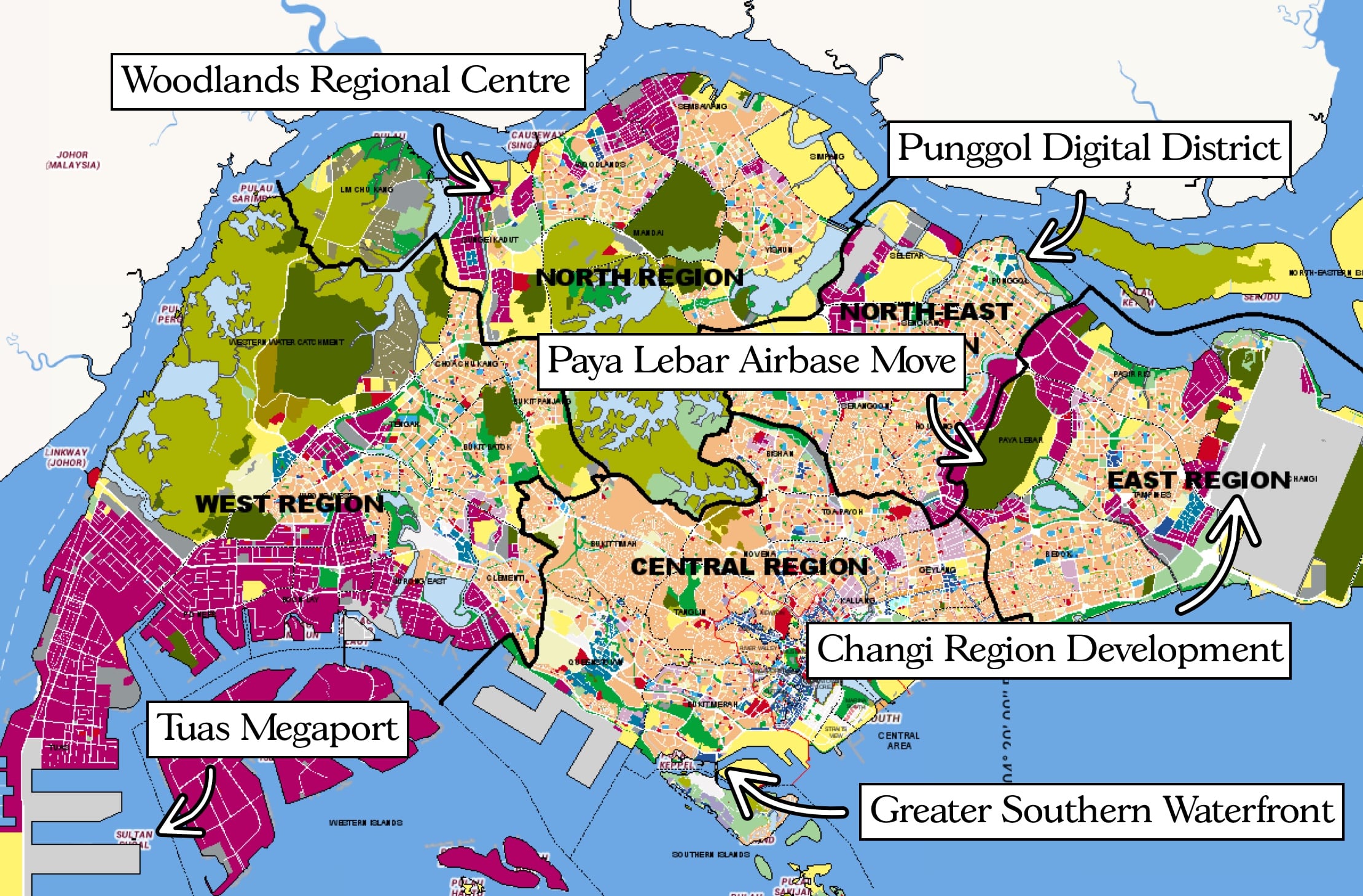
Stand at Jurong Lake Gardens today and the transformation is visible from a single spot: cranes rising over new condominiums, viaducts of the Jurong Region Line snaking past the lake, and a skyline that keeps climbing. Further west, Tengah — Singapore's first "smart town" — is filling up with young families in a car-lite, forested setting that feels like a different country from the HDB towns that came before it. And along the island's southern coastline, from Pasir Panjang all the way to Marina East, a 30-kilometre stretch of prime land called the Greater Southern Waterfront is being reprogrammed for the next wave of city-fringe living.
The simple version: Western Singapore is becoming a property hotspot because it is the only region in the country running three once-in-a-generation development plans at the same time — a new business district, a brand-new smart town, and a massive waterfront redevelopment — all knitted together by two brand-new MRT lines.
If you are a first-time buyer, an HDB upgrader, or an investor trying to figure out where the next decade of property value will come from, this is the story you need to understand.
From "ulu" to uptown: the West's reputation problem
To understand why the West is hot now, you have to understand why it was cold for so long.
The Western region — broadly the districts of D5 (Pasir Panjang and West Coast), D22 (Jurong, Boon Lay and Tuas), D23 (Bukit Batok, Bukit Panjang and Choa Chu Kang) and D24 (Lim Chu Kang and Tengah) — grew up around industry. From the 1960s, Jurong was Singapore's industrial engine room, planned by the then Jurong Town Corporation to host factories, shipyards and warehouses. Jurong Island and Tuas anchored heavy industry, petrochemicals and port operations on the island's southwest corner.
That industrial DNA shaped the property market for decades. Housing in the West was mostly public housing built to serve the workers — Jurong East, Jurong West, Boon Lay, Taman Jurong, Bukit Batok, Bukit Panjang and Choa Chu Kang are among the largest and most established HDB estates in the country. Private property existed, but it was largely suburban and modest: 99-year leasehold condominiums in Jurong and Bukit Batok, landed housing tucked into Hillview and the Dairy Farm corridor, and a sprinkling of freehold along the West Coast.
The stereotype followed accordingly. "Ulu" (a colloquial term for remote or backward) was the word most often attached to the West, along with a shrug about the commute. Even as late as the 2000s, the West's biggest property story was the sheer volume of HDB flats and the affordability that came with living far from the city.
Policymakers, however, had a different vision.
The Urban Redevelopment Authority (URA) designated Jurong as a regional commercial centre as far back as the 1998 Master Plan, then upgraded that ambition in the 2008 Master Plan by naming the Jurong Lake District (JLD) a key growth area — Singapore's answer to the challenge of decentralising an increasingly crowded city centre. The 2019 Master Plan doubled down, adding the Greater Southern Waterfront as a "major gateway" and reinforcing a "Western Corridor" of jobs and housing running from the city fringe out to Tuas.
The national direction has been consistent for two decades: bring jobs closer to homes, build new towns where people actually want to live, and don't put all the island's dynamism in a 2,000-hectare Core Central Region. The West was always going to be the biggest beneficiary of that decentralisation push — it had the land, the transport spine, and the room to absorb transformation on a scale the East and North simply don't have.
What changed in the last few years is that the plans finally became visible. Viaducts. Cranes. Launches. The transformation stopped being a PowerPoint deck and started being a skyline.
Three mega-plans, one corridor
The Jurong Lake District: the long-promised second CBD
The centrepiece of the Western transformation is the Jurong Lake District, a roughly 360-hectare precinct wrapped around Jurong Lake, and the largest mixed-use business district ever planned outside the city centre. Under URA's plans, JLD is targeted to host up to 100,000 jobs and around 20,000 new homes, with a mix of offices, hotels, retail, community spaces and waterfront housing.
For years, the JLD was a concept in search of a catalyst. The retail side arrived early — JEM, Westgate and IMM turned Jurong East into one of Singapore's busiest shopping nodes outside town. The office side lagged. The most visible setback was the cancellation of the Kuala Lumpur–Singapore High-Speed Rail in January 2021, which had been planned to terminate at Jurong East and would have supercharged the district's commercial story.
But the JLD's momentum no longer depends on a single megaproject. The Jurong Region Line (JRL) is being built to serve the district, the Jurong East interchange is being reconfigured into a more walkable, integrated hub, and new residential launches around the lake have sold steadily at prices that would have been unthinkable a decade ago. The Jurong Innovation District near NTU, a 600-hectare cluster for advanced manufacturing and smart-industry companies, adds a jobs engine on the district's western flank that is already operational rather than hypothetical.
For property buyers, JLD matters on three levels: it creates a long-term jobs base that supports rental demand, it legitimises a premium for homes within walking distance of the lake and MRT, and it keeps the West's private property market from being purely "HDB upgraders" territory.
Tengah: Singapore's first smart town
If JLD is the West's commercial heart, Tengah is its most ambitious residential bet.
Dubbed Singapore's first "smart and sustainable town," Tengah spans 700 hectares — about the size of Bishan — and will eventually provide around 42,000 homes for an estimated 55,000 residents. Conceived by the Housing & Development Board (HDB) and announced in 2016, Tengah was designed from the ground up with ideas that sound futuristic even by Singapore standards: a car-lite town centre with fewer roads and more walking paths, a centralised district cooling system that pipes chilled water to homes instead of individual air-conditioning compressors, underground bins, smart lighting, and a "Forest Town" identity built around greenery and biodiversity.
The town is divided into five distinctive districts — Plantation, Court, Garden, Park and Brickland — with a sixth, Forest Hill, added as the town expands. Its first BTO launches sold out strongly, and subsequent launches saw price increases across the board, reflecting both the novelty of the concept and the reality of rising construction costs.
Tengah is a HDB-first town, which makes it a critical case study for first-time buyers. It is also the strongest test of whether a genuinely new town can create its own price premium in the West. The early evidence is promising: Tengah flats have consistently commanded higher starting prices than comparable new towns, and the resale market has yet to meaningfully form as the first units approach their Minimum Occupation Period (MOP).
Still, buyers should keep perspective. Tengah's supply pipeline is large, and large supply tends to cap price acceleration in the short to medium term. The town's appreciation story will play out over a decade, not a year.
The Greater Southern Waterfront: the city bends around the coast
The third pillar of the Western story is not technically in "the West" — but it wraps around the region's southern rim and will reshape the districts that touch it.
The Greater Southern Waterfront (GSW), first unveiled in URA's 2019 Master Plan, covers about 2,000 hectares and 30 kilometres of coastline stretching from Pasir Panjang in the west to Marina East in the east. This includes the existing high-value land around Keppel, Telok Blangah and Pasir Panjang, much of it occupied by port operations and shipyards that are progressively relocating to Tuas. The handover of that land — some of it already prime, some of it newly reclaimed — represents the largest release of city-fringe development land in Singapore's modern history.
For the Western property market, the GSW is a slow-burn upgrade to the entire D5 corridor. Pasir Panjang and West Coast, historically quieter residential areas, will sit on the doorstep of new waterfront housing, parkland, and commercial space. Transport links are already being upgraded: the Cross Island Line's second phase will eventually tie the GSW to the Jurong Lake District and Tengah, creating a rail spine that connects the West's southern coast to its inland towns.
The GSW's first residential land parcels are not expected to come to market for some years, which means D5's existing stock — including freehold and 99-year leasehold condos along West Coast and Pasir Panjang — has a decade-long "option value" story baked into it. Savvy buyers have been positioning in this corridor for exactly that reason.
The timeline above shows why the current moment matters: the infrastructure that was announced a decade ago is now visibly landing, and the property market prices expectations well before the stations open.
Two new rail lines are rewriting the commute
No single factor matters more to a suburban property market than rail connectivity, and the West is getting two entirely new systems — something no other region of Singapore can claim.
The Jurong Region Line (JRL) is a 24-kilometre, 24-station line opening in three phases from 2027 to 2029. It will loop through Jurong East, Taman Jurong, Boon Lay, Tengah, Choa Chu Kang, Bukit Panjang and the Jurong Industrial Estate, serving hundreds of thousands of residents and workers who currently depend on the crowded East-West Line. The JRL is not just a shortcut to the city — it is a regional network in its own right, connecting homes to the JLD jobs hub, to NTU and the Jurong Innovation District, and to the industrial estates along the Ayer Rajah Expressway corridor.
The Cross Island Line (CRL) is the longer game. Singapore's eighth MRT line will span more than 50 kilometres across the island, with Phase 1 targeted around 2030 and Phase 2 in the early 2030s. The second phase is the one that ties the Western story together: it will run through the Greater Southern Waterfront, the West Coast, the Jurong Lake District and Tengah, effectively creating a southern-to-western rail arc that connects the region's biggest projects.
The impact of new lines on property prices is well documented in Singapore. Homes within walking distance of a station historically command a premium, and the gap tends to widen as opening dates approach. The West is currently in the sweet spot: the lines are confirmed and under construction, but the "opening premium" has not been fully priced in yet, especially in the corridor towns served by JRL Phase 2 and CRL Phase 2.
The national resale market has been running hot through this infrastructure build-out, and the West's HDB towns are part of that story.
HDB Resale Price Growth (% YoY, 2021-2024)
HDB resale prices rose every year between 2021 and 2024, peaking at 12.7% growth in 2021 before cooling to 4.9% in 2023 and re-accelerating to 9.7% in 2024, according to HDB's published data. Mature estates in the West — Jurong West, Bukit Batok, Bukit Panjang and Choa Chu Kang — have ridden this wave, supported by steady demand from first-timers, upgraders and tenants priced out of the central region.
What Western Singapore property prices actually look like
The private market tells a similar story at a different altitude.
Private Residential Price Growth (% YoY, 2021-2024)
URA's all-private residential price index rose 10.6% in 2021, 8.4% in 2022, 6.8% in 2023 and 3.9% in 2024 — cooling, but still positive, even with successive rounds of cooling measures. Within this national picture, the West remains one of the more accessible entry points into private housing, with median per-square-foot prices in D22 and D23 sitting well below the Core Central Region. That gap is both the appeal and the risk: the West has room to rise relative to central districts, but it will only do so if the jobs and infrastructure promises actually land.
Several West-specific dynamics are worth flagging:
- New launches near the JLD have pushed into price territory that once seemed impossible for Jurong. Recent projects in Taman Jurong and around Jurong East have reportedly transacted above the S$1,800–S$2,000 psf mark at various stages, a level that would have been dismissed a decade ago.
- EC and suburban condo demand remains deep. The West is the historic heartland of executive condominiums and mid-range private housing, and each new launch cycle tests how far budget-conscious upgraders will stretch.
- Rental yields are a quiet strength. With the JLD's jobs base and NTU's student population, eastern Jurong and D5 have historically supported respectable rental demand — useful for investors prioritising cash flow over capital gains.
- The BTO-vs-resale gap matters. Tengah's BTOs are priced for first-timers, but resale flats in adjacent estates (Jurong West, Choa Chu Kang, Bukit Batok) trade at meaningful premiums to their original prices and cater to buyers who cannot wait for a new flat.
A quick guide to the West's sub-markets
Because the West is not one market — it is several, and they behave differently:
| Micro-market | Key areas | Best suited for | Key driver |
|---|---|---|---|
| D5 – Southern fringe | Pasir Panjang, West Coast, Clementi west | Investors, city-fringe seek-ers | Greater Southern Waterfront, CRL Phase 2 |
| D22 – Jurong core | Jurong East, Jurong West, Boon Lay, Taman Jurong | HDB upgraders, first-timers | Jurong Lake District, JRL |
| D23 – North-west belt | Bukit Batok, Bukit Panjang, Choa Chu Kang, Hillview | Families, value buyers | JRL, mature estate stability |
| D24 – New town frontier | Tengah, Lim Chu Kang | Long-horizon first-timers | Smart town, future supply |
Each of these sub-markets responds to a different timeline. D22 is being repriced now, as the JLD story matures. D5 is a longer wait, riding on the GSW. D23 is steady and defensive. D24 is the speculative frontier, where patience is mandatory.
Is Western Singapore property a good investment?
The honest answer: yes for some profiles, no for others.
The West's investment case rests on three legs: a genuine jobs engine (JLD + Jurong Innovation District), brand-new rail infrastructure (JRL + CRL), and price levels that still carry a discount to the rest of the island. That combination is rare, and it is exactly the kind of structural story that supports medium-to-long-term price growth.
But the West is also a supply-heavy market. Tengah alone will add tens of thousands of homes. Future BTO launches in the corridor, plus JLD's planned private housing, mean buyers are not competing with scarcity — they are competing with a pipeline. Any buyer expecting quick flips or year-on-year double-digit gains may be disappointed. The more realistic expectation is steady, infrastructure-driven appreciation over a 5-to-10-year horizon, especially for properties within comfortable walking distance of a future JRL or CRL station.
A useful way to think about the decision:
First-time buyers who can wait should seriously study Tengah's upcoming BTO launches and, further out, the land parcels the government will release around the JLD and the southern waterfront. Buyers who need a home today should look at resale HDB flats in the mature Western towns — they get the JRL uplift at a lower price and with zero construction wait. Investors should focus on the two legs with the most self-reinforcing demand: walk-to-JRL-station homes in D22 and future-minded D5 property near the GSW.
Risks and reality checks
A balanced view requires naming what could go wrong.
- Timeline slippage is a real risk. Singapore's infrastructure is delivered with remarkable reliability, but large projects do get delayed, and the HSR cancellation of 2021 is a permanent reminder that even plotted-in-stone plans can change when economics shift.
- The supply wall. Tengah, JLD and GSW together represent a multi-decade release of land and homes. Supply caps price upside, particularly for buyers who overpay for the "story" today.
- 99-year leaseholds dominate the West. Most Western condos are leasehold, which means the land-value decay clock starts running the day you buy. Exit timing matters.
- The jobs bet is not guaranteed. JLD's 100,000-job target depends on companies actually choosing to relocate offices and operations there. The CBD's gravitational pull remains strong, and a softer office market could slow JLD's commercial build-out.
- Cooling measures are a recurring feature. Any investor buying today must model prices, loan limits and ABSD under the current, quite restrictive rules — and assume those rules are not getting looser any time soon.
None of these risks make the West a bad bet. They just mean the West is not a get-rich-quick market. It is a "buy the infrastructure, hold for a decade" market — and for buyers aligned with that time horizon, the logic is compelling.
Food for Thought
Before you decide, ask yourself these five questions:
- Which train line are you betting on? A home near a JRL station opening in 2027 has a very different risk-reward profile than one near a CRL Phase 2 station opening in the early 2030s.
- Can you actually wait? If you need to sell within five years, Tengah's MOP restrictions, lease decay and supply pipeline will work against you. If you can hold for ten, the infrastructure cycle is on your side.
- Is the "smart town premium" sustainable? Tengah's concept is genuinely novel, but novelty fades — will its green, car-lite design command resale premiums a decade from now, or will it simply be "another mature town"?
- What is the West's price ceiling? When new Jurong launches hit S$2,000+ psf, buyers are already paying for the future JLD — how much of that future is left to capture?
- Which micro-market are you really buying? A Jurong East condo, a Tengah BTO and a Pasir Panjang freehold are three completely different property products wearing the same regional label. Know which one you own.
The West is no longer the punchline
For most of Singapore's modern history, the West was where you lived when you had to — the affordable option, the compromise, the place you factored a long commute around. That is changing in front of us. The West is now where the country's biggest urban experiments are being built: a new business district by the lake, a forested smart town, a waterfront corridor that will redefine city-fringe living, and two new rail lines to stitch it all together.
The property market has noticed, which is why prices in the West have moved so decisively over the past few years. But the deeper point is that the West's story is structural, not cyclical. It is not a speculative flash in the pan; it is a deliberate, government-planned reallocation of jobs, homes and infrastructure toward a region that had the land and the patience to absorb it.
Buyers who understand that distinction — who buy for the infrastructure that is already being built, hold it through the construction noise, and price in the supply rather than ignoring it — will likely find the West one of the more rewarding parts of the Singapore property market over the next decade.