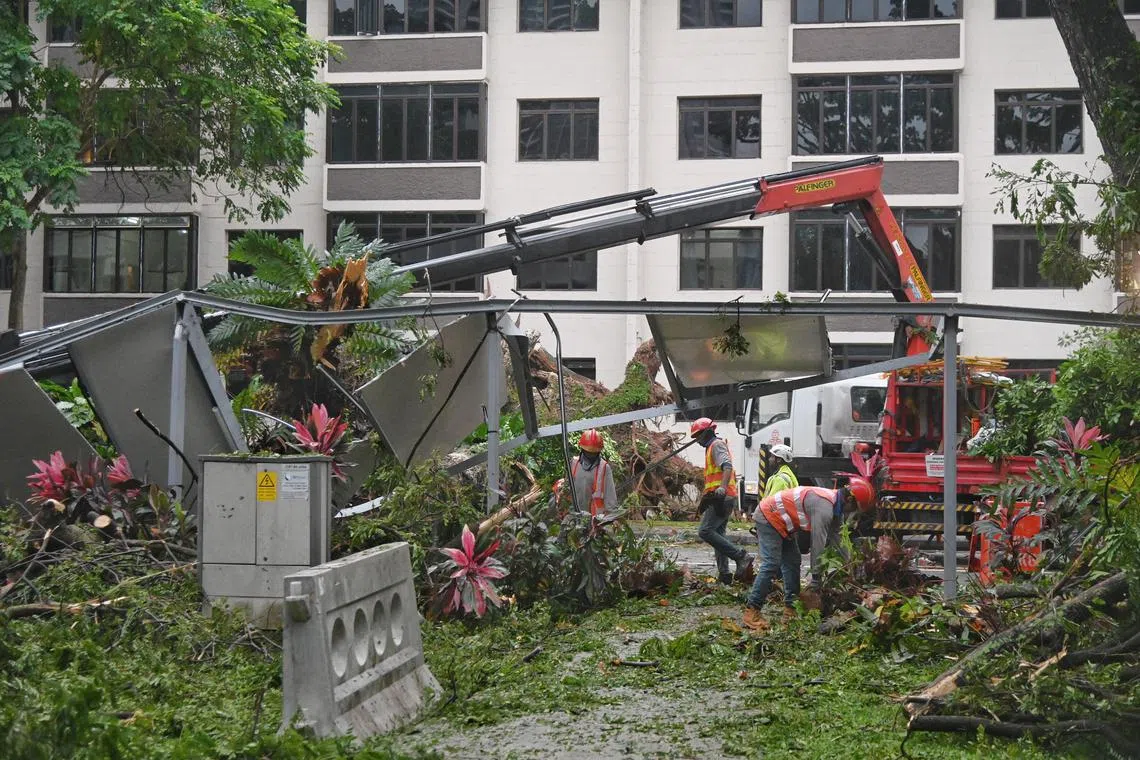
It begins with a sound most Singaporeans never hear — a deep, drawn-out crack, like something snapping under the weight of the sky. A moment later, the impact: a tree trunk slicing through a fence, flattening a car, punching through a roof. For most of us, a fallen tree is something we watch on the news after a particularly violent thunderstorm. But every year, thousands of trees fall in Singapore, and a small but significant number of them hit homes, vehicles, and people.
The tragedy at Dempsey Hill in February 2024 — when a rain tree came down on a vehicle and killed its 43-year-old driver — was a stark reminder that living in a City in Nature carries a physical risk we rarely think about. It also raised a question every property owner in Singapore should be able to answer: if a tree falls on your property, who is liable? What does your insurance actually cover? And what should you do in the hours immediately after it happens?
This guide walks through Singapore's tree liability rules, the insurance policies that do and don't protect you, and a practical, step-by-step playbook for documenting damage and filing a claim. By the end, you'll know exactly how to protect yourself — before the tree comes down, and long after.
The Constant, Quiet Risk: Tree Falls in a City in Nature
Singapore doesn't just tolerate trees; it celebrates them. NParks manages more than two million trees on state land — along roadsides, in parks, in nature reserves, and across the island's network of park connectors. Add the trees in private estates, condominium compounds, HDB precincts, and the rainforest remnants in our reserves, and the city-state's total tree population runs into the millions. These trees are the living infrastructure of the government's "City in Nature" vision, and they're a big part of why Singapore feels like home.
But trees are biological machines. They age, rot, shed branches, and occasionally — under the right combination of saturated soil, gusty winds, and structural weakness — come crashing down.
Singapore's climate guarantees the stress. The island experiences two monsoon periods — the Northeast Monsoon (November to January) and the Southwest Monsoon (June to September) — which bring sustained rainfall and strong gusts. During La Niña years, when rainfall is heavier and more prolonged, the ground becomes waterlogged, root systems lose their grip, and tree failures spike dramatically. This isn't speculation; it's measurable.
In 2021, a strong La Niña year, NParks reported that around 3,300 trees fell across the island — nearly double the previous year's count.
Tree Fall Incidents in Singapore (Reported NParks Figures)
Note: 2022 and 2023 figures are approximate, based on figures NParks has shared with the media in response to the Dempsey incident.
As the chart shows, wet years spike sharply, while "normal" years still produce well over a thousand tree incidents. NParks has stressed that the vast majority of these are branch failures and that whole-tree collapses are rare — but rare is cold comfort when a two-tonne trunk lands on your car or your roof.
The two most painful recent examples both made national headlines. In February 2017, a tree fell along Orchard Road during a heavy downpour, killing a 38-year-old pedestrian. In February 2024, a rain tree at Dempsey Hill came down on a vehicle, killing the driver. In both cases, the trees were reportedly under NParks' regular inspection regime — which uses a risk-based cycle, with higher-traffic locations checked more frequently — yet both failed. Trees are not machines, and no inspection regime can offer a 100% guarantee.
For homeowners, the takeaway is straightforward: the risk is modest but real, and it concentrates in exactly the places people love to live — leafy landed estates, streets lined with mature rain trees, and properties beside parks, reservoirs, and waterway corridors.
Who Is Legally Responsible? Singapore's Tree Liability Rules
When a tree falls and damages property, the first question everyone asks is: whose fault is it? The answer determines who pays for the repairs, whose insurance reacts first, and whether you could find yourself on the wrong end of a lawsuit.
What the Law Says
Singapore's courts approach tree damage through two legal doors:
- The Occupiers' Liability Act (Cap 146) — occupiers of premises owe their visitors a duty of care for dangers arising from the state of the premises. A hazardous tree on your land is, legally, a hazard of your premises.
- Common law negligence — even when the injured party is a neighbour rather than a visitor, a landowner can be held liable if they knew, or reasonably ought to have known, about the danger and failed to act.
The crucial concept is foreseeability. Nobody expects a landowner to guarantee that a tree will never fall. But the law expects you to notice obvious danger signs — large dead branches, fungal growth at the base, cracks in the trunk, soil heaving around the roots — and to act on them. If a tree was visibly sick and you did nothing, you are likely to be found negligent. Conversely, if a healthy-looking tree fails suddenly during an extreme weather event, the owner may successfully argue the failure was not reasonably foreseeable.
Landowners occasionally raise an "act of God" defence — the storm was so extreme that nobody can be blamed. In Singapore, this defence is narrow. Tropical thunderstorms are entirely foreseeable events, and owners of trees near buildings, roads, or boundary lines are generally expected to plan for them.
The Tree Ownership Map
The law is far easier to apply when you know who manages the tree. In Singapore, the tree population is split among several managers, and each carries a different claim path:
| Tree location | Who manages it | If it damages your property |
|---|---|---|
| Roadsides, parks, and state land | NParks | Your insurer pays you, then may recover from NParks |
| HDB estates and common areas | Town Council | Report to the Town Council; they maintain estate trees |
| Condominium common areas | MCST / management committee | The MCST's estate insurance covers common property |
| Private landed property | The landowner (you) | Your own home insurance — or you're liable to others |
| Schools, hospitals, institutions | The institution | Direct to the institution's management |
The golden rule is simple to remember: the person whose land the tree stands on is the person responsible for it. If a tree stands on your property, you own the risk. If it stands on public land, the state owns the risk — but as we'll see, that doesn't mean your insurance company isn't the one writing the first cheque.
Here's how to think about liability when you're standing at the scene with a tree across your fence:
The practical takeaway: liability follows the land, but your insurance pays you first — then worries about who's at fault.
What "Duty of Care" Looks Like in Practice
For a landed homeowner, the legal duty translates into four concrete habits:
- Inspect — have mature trees assessed by a certified arborist, ideally at least once a year.
- Act — act on the arborist's recommendations. A written report you ignored is the single worst piece of evidence you could hand an insurer, a court, or an angry neighbour.
- Maintain — prune dead wood, remove diseased limbs, and address leaning trunks before they become emergencies.
- Get permits — under the Parks and Trees Act, you need NParks' permission to fell or poison most large trees (generally those with a girth exceeding one metre), even on your own land. The paperwork is part of being a responsible owner.
The duty also extends to notice. If a neighbour's tree looks dangerous, tell them in writing. A WhatsApp message saying "your tree looks rotten, might fall" is better than nothing, but a formal email or letter is far stronger evidence of notice if the tree later damages your property. Singapore courts care about whether the responsible party knew — and written notice proves it.
What Insurance Covers When a Tree Falls (and the Gaps That Will Shock You)
The tree is down, the roof is damaged, the car is crushed. Now the financial question arrives: will insurance pay?
The answer depends on which policies you hold — and the gaps in Singapore's system are bigger than most people realise.
The Four Policies That Matter
1. HDB Fire Insurance — compulsory, but nearly useless for tree damage
Every HDB flat owner is required to buy fire insurance from HDB, at a cost of only a few dollars a year. It covers fire, lightning, and explosion — but not a tree crashing through your roof during a thunderstorm. The most common policy in Singapore is also the most commonly misunderstood one. If you own an HDB flat and your only cover is this compulsory policy, a fallen tree is an entirely uninsured event.
2. Comprehensive Home Insurance — where tree damage actually lives
This is the policy that saves you. Comprehensive home insurance bundles building cover (the structure, roof, walls, and permanent fixtures — and for HDB flats, your renovations) with contents cover (furniture, appliances, electronics, and personal belongings). Most comprehensive policies in Singapore include damage from falling trees under perils such as "impact" or "falling objects."
3. Contents-Only Insurance — protection for renters and minimalists
If you rent, the landlord's insurance covers the building — not your laptop, your sofa, or your speaker collection. A contents-only policy is cheap (often well under $100 a year) and covers belongings damaged when a tree smashes through a window. Every renter in a leafy neighbourhood should have one.
4. Car Insurance — comprehensive only
A comprehensive car policy covers damage from a fallen tree as accidental damage. A third-party-only policy does not. This is exactly why banks and finance companies insist on comprehensive cover when you take a car loan.
Here's the coverage landscape at a glance:
| Policy | Covers tree damage to structure? | Covers contents? | Mandatory? |
|---|---|---|---|
| HDB fire insurance | ❌ No (fire only) | ❌ No | ✅ Yes, for HDB owners |
| Comprehensive home insurance | ✅ Yes (typically) | ✅ Yes | ❌ No |
| Contents-only insurance | ❌ No | ✅ Yes | ❌ No |
| Landlord building insurance | ✅ Yes | ❌ No (only landlord's fixtures) | ❌ No |
| Car insurance — comprehensive | N/A (vehicle) | N/A | Required for most car loans |
| Car insurance — third-party only | ❌ No | ❌ No | ❌ No |
The Exclusions Hiding in the Fine Print
Even with a comprehensive policy, insurers can decline or reduce payment if:
- The tree was obviously diseased and you ignored it. Insurance covers accidents, not predictable neglect.
- The property was poorly maintained. Some policies include a "good repair" condition that insurers invoke aggressively.
- You failed to mitigate damage. If you left the roof leaking for a week, don't expect full payment for the ruined sofa underneath.
- The damage was pre-existing. An assessor may determine that part of the damage wasn't caused by the tree at all.
You also need to understand what your policy actually pays:
- Sum insured — the maximum payout. Homeowners often set this when they bought the property and never adjust it. Construction and reinstatement costs have risen steeply in recent years; an outdated sum insured can leave you severely under-covered.
- Excess — the amount you pay before the insurer pays. If your excess is $500 and the repair costs $450, claiming is pointless.
- Indemnity vs new-for-old — contents are often paid on an indemnity basis (replacement cost minus depreciation). That five-year-old television is not worth its retail price.
- Temporary accommodation — many comprehensive policies pay for alternative lodging if your home becomes uninhabitable. This is one of the most valuable add-ons, and one of the least talked about.
- Public liability — if your tree falls and injures a passer-by or damages a neighbour's car, public liability cover within your home policy can respond. For landed homeowners, this is quietly essential.
Who Needs What: It Depends on Where You Live
Singapore Resident Households by Housing Type (Approximate)
With roughly 78% of Singapore's resident households in HDB flats, the default assumption is often "the Town Council will handle it." The Town Council handles the tree — not your roof, your renovation, or your contents. HDB's compulsory fire insurance won't pay for tree damage; only a private comprehensive policy will.
For the 14% or so living in condos, the MCST's block insurance covers common property — not your unit's renovation, your furniture, or your car in the open carpark. For the 5% in landed homes, where the tree most likely stands on your own land, the responsibility — and the insurance — is entirely yours.
Subrogation: The Safety Net That Pays You First
Here's the most reassuring mechanism in insurance law: subrogation. If a NParks tree, a Town Council rain tree, or your neighbour's angsana falls and crushes your property, your insurer pays your claim and then "steps into your shoes" to recover the money from the responsible party.
You claim from your own policy, get paid quickly, and your insurer handles the months of negotiation with the government agency or MCST. If you have no comprehensive cover, you'd have to sue NParks or your neighbour directly — slower, costlier, and emotionally draining.
The First 48 Hours: Documenting Damage and Filing a Claim
A tree has fallen. Your adrenalin is pumping. The next two days will determine the value of your claim more than anything your insurer does later. Here's the complete sequence.
Step 1: Get to Safety Immediately
Don't stand under the broken canopy. Don't "just have a quick look" at the damage. If anyone is hurt, call 995 for an ambulance. If power lines are down or a major branch is hanging dangerously, call 999 and notify Singapore Power. Your safety, and your family's, comes before every photograph. Only re-enter the area when it's clear.
Step 2: Document the Scene Like a Forensic Investigator
Before you touch anything (except to make it safe), capture:
- Wide shots showing the tree, your property, and the surrounding context
- Close-ups of the impact point, the break, and the tree's base — is there visible rot, or a clean snap?
- Video walking through the scene, narrating what you see and hear
- Time-stamped photos — your phone's metadata captures this automatically
- Weather context — photograph the sky, and later pull NEA rainfall records for that day
- Witness details — names and contact numbers of anyone who saw the tree fall
A useful mental rule: document as if you're building a court case, because you may well end up doing exactly that if the liable party disputes liability or the insurer disputes the scope of damage.
Step 3: Report to the Right Party
- Tree on public land: report to NParks via its feedback channels or the OneService app
- HDB estate: report to your Town Council
- Condo: report to the MCST or property manager
- Neighbour's property: inform them in writing immediately — email or text message, not just a phone call
Get a reference number for every report. Insurers will ask for it, and it proves you did your part.
Step 4: Notify Your Insurer — Within Days, Not Weeks
Most policies require you to notify the insurer "as soon as reasonably possible." Some specify a window, often 30 days. Delaying notification is the classic reason claims get reduced or declined.
Call your insurer, quote your policy number, explain what happened, and reference the reports you've filed. They'll open a claim number and tell you exactly what documentation they need.
Step 5: Mitigate Further Damage — But Preserve Evidence
Your policy requires you to minimise losses. Cover the hole with a tarpaulin. Board up the broken window. Move contents out of the rain. Keep every receipt for emergency work — those costs are claimable.
But do not start permanent repairs until the insurer's assessor has inspected the damage. If an urgent repair is unavoidable, photograph the damage first, keep any removed materials, and get written approval from the insurer where possible.
Step 6: Submit a Complete, Organised Claim
Your formal claim will typically require:
- The insurer's claim form
- Your photos and videos, timestamped
- Incident report reference numbers
- An itemised list of damaged contents, with approximate purchase dates and values
- Contractor quotations for repairs
- Receipts for emergency mitigation work
The more organised your submission, the faster the claim moves. If you keep a home contents inventory — a simple spreadsheet, or a folder of receipts and room-by-room photos updated yearly — claim day becomes dramatically easier.
What Happens After You Submit
The insurer sends an assessor to verify the damage. Once the claim is approved, you receive payment — or the insurer pays the contractor directly — and repairs proceed. If you disagree with the outcome, you're not stuck: Singapore's Financial Industry Disputes Resolution Centre (FIDReC) provides mediation and adjudication for disputes with insurers, up to defined claim limits.
Six Mistakes That Kill Claims
- ❌ Cleaning up before taking photos — no evidence, no claim
- ❌ Waiting weeks to notify the insurer — grounds for delay-based denial
- ❌ Throwing away damaged items — the assessor can't verify what you lost
- ❌ Starting permanent repairs before the assessment — you may only be reimbursed on a reduced basis
- ❌ Forgetting the excess — a $500 excess on a $600 repair may not be worth claiming
- ❌ Not keeping receipts for emergency work — mitigation costs are claimable, but only if proven
Landlords, Tenants, and the Grey Zones
If you rent, remember the split: the landlord's building insurance covers the structure; your contents policy covers your belongings; and the question of who maintains the garden trees should be answered in your tenancy agreement. As a tenant, your first call after a tree falls should be to your landlord — not just your insurer. As a landlord, make sure the building's sum insured reflects current reinstatement costs, and that tree maintenance is a written, enforceable obligation rather than an informal arrangement.
Prevention: Protecting Your Property Before the Tree Falls
Insurance is a financial safety net. The better strategy is to stop the tree from falling in the first place.
If You Own a Landed Home
Your trees are your responsibility, and responsible ownership is mostly about catching problems early. Have a certified arborist (look for ISA certification) inspect mature trees at least once a year — and after major storms, do a quick visual check yourself.
Know the red flags:
| Warning sign | What it suggests | Action |
|---|---|---|
| Large dead branches in the crown | Branch failure risk | Prune professionally |
| Fungal growth (mushrooms) at the base | Root or trunk decay | Urgent arborist assessment |
| Cracks or splits in the trunk | Structural weakness | Immediate inspection; possible removal |
| Sudden lean, or soil heaving at the base | Root failure | Keep people away; call an arborist |
| Excessive leaf drop or dieback | Health decline | Assess, treat, or remove |
| Hollow cavity in the trunk | Internal decay | Structural testing |
A written arborist's report is a double-edged sword: it protects you if you act on it, and it incriminates you if you don't. So when the arborist says "prune" or "remove," put it on the calendar.
If You Live in a Condo or HDB Estate
You don't own the trees, but you can influence the people who do.
- In a condo: raise tree maintenance at the AGM, ask to see the arborist's inspection schedule, and confirm whether the MCST's insurance responds to tree damage affecting individual units. Usually it doesn't — which is exactly why your own home insurance matters.
- In an HDB estate: report dead branches or leaning trunks through the OneService app. You'll get a tracking reference, and your report goes directly to the Town Council.
If You're Buying a Home
This is where tree risk intersects with property decisions. When viewing a landed home, look up:
- Are there large trees within falling distance of the house?
- Has the current owner had an arborist's report done? Ask to see it.
- Does the home's insurance sum insured match current replacement costs?
Tree risk is one of the quiet factors that differentiate apparently similar properties in the same district — and it's exactly the kind of physical detail a price-only comparison misses. Two houses on the same street can have identical per-square-foot prices and dramatically different risk profiles, because one sits beneath a 30-metre rain tree and the other doesn't.
An Annual Checklist for Every Homeowner
- Review your insurance policy — is "falling trees" or "impact" a listed peril?
- Update your sum insured to reflect current rebuilding costs
- Keep a home contents inventory — updated yearly, photo-backed
- Report dangerous trees on public land via OneService
- Have landed-property trees inspected by an arborist; schedule follow-up work
- Store your insurer's hotline and policy number where you can find them fast
Food for Thought
-
Liability vs. luck: If a tree on state land falls and damages your home, should the government automatically compensate you — or is "living in a garden city" an accepted risk that falls on the individual? Where's the line between public responsibility and personal risk?
-
Mandatory coverage: HDB fire insurance is compulsory but doesn't cover tree damage. Should comprehensive home insurance be mandatory for all property owners instead — or would that price out exactly the households that need help most?
-
The notice problem: A written warning to a neighbour about their diseased tree is the key to shifting liability — yet almost nobody knows to do it. What would make this common knowledge: a public education campaign, or a standard disclosure clause in property transactions?
-
Conservation vs. safety: Heritage trees are beautiful, protected, and aging liabilities. Should there be subsidies for owners who maintain old trees safely, or is removal — with proper permission — a legitimate economic choice?
-
Risk-based pricing: If insurers priced premiums according to real tree-fall risk by district, would leafy landed enclaves become costlier to insure? And would that change where you choose to live?