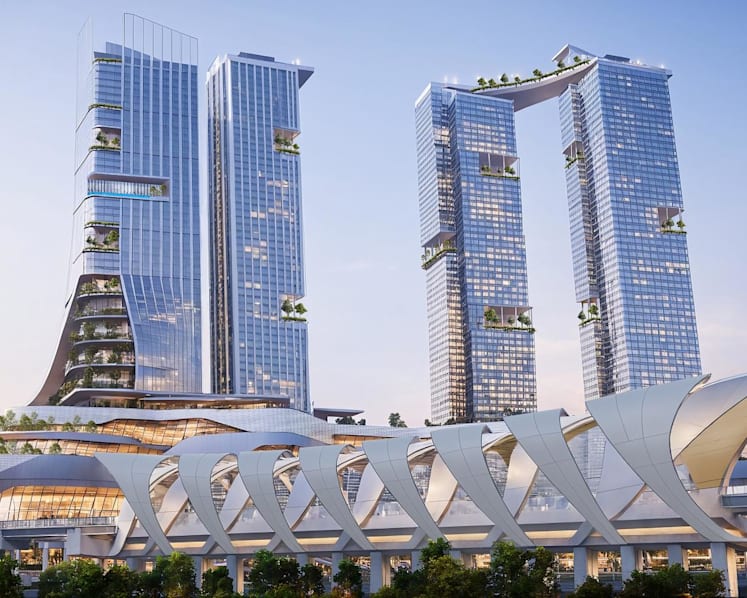
Every weekday morning, a stream of motorcycles, cars and buses crawls across one of the busiest land border crossings on the planet. Roughly 300,000 people shuffle between Johor Bahru and Singapore — most of them Malaysians heading to jobs in Singapore, alongside Singaporeans heading north for petrol, groceries and weekend space. What should be a one-kilometre hop across the Straits can take two hours in peak traffic.
The RTS Link at Bukit Chagar promises to rewrite that daily ordeal. The Rapid Transit System (RTS) Link is a four-kilometre rail shuttle that will carry passengers between Johor Bahru and Singapore's Woodlands North in about six minutes, with customs clearance for both countries completed before boarding. For a generation of young Singaporeans watching private property prices drift further out of reach, the question isn't just whether the train will run — it's what that six-minute ride does to the property gap that has separated the two sides of the Causeway for decades.
This article looks at what the RTS Link actually delivers, what Singapore's own MRT history tells us about rail and property values, and where the ripple effects are most likely to land.
The Shortest Distance That Took the Longest Time
Johor Bahru and Singapore share one of the world's most economically lopsided borders. Singapore's GDP per capita is roughly four to five times Malaysia's, and the wage differential pulls hundreds of thousands of Malaysians north-to-south every day. That daily flow has kept the Causeway — built in 1923 — straining at the seams for years. Traffic jams on the Causeway are so routine they have their own cultural shorthand: the "jam" is a noun, a verb and an excuse for being late.
The idea of a rail link across the Straits is old. The RTS was revived in earnest in the 2010s as both governments looked for a structural fix. In 2018, Singapore and Malaysia signed a bilateral agreement to build the RTS Link. Then came the political turbulence: the project was suspended after Malaysia's 2018 change of government, revived in 2019, and formally restarted with construction beginning in 2021. The target completion date has shifted more than once — the current publicly stated goal is end-2026.
That history of delay matters for property investors, because infrastructure announcements create price expectations years before the first train runs. Singaporeans have seen this play out many times at home. When the government draws a new MRT line on a map, nearby property prices respond almost immediately — sometimes before a single tunnel boring machine is lowered into the ground. The RTS Link is following the same script, with Johor property prices reportedly firming since construction began, and further excitement building after the Malaysia–Singapore Johor-Singapore Special Economic Zone (JS-SEZ) agreement was signed in January 2025.
But before projecting what the RTS will do to Johor Bahru property prices, it's worth looking at what the project actually is — and what it is not.
What the RTS Link Actually Is (And What It Isn't)
The RTS Link is a 4-kilometre electrified rail shuttle connecting two purpose-built stations: Bukit Chagar in Johor Bahru and Woodlands North in Singapore. It is operated as a joint venture between Malaysia's Prasarana and Singapore's SMRT.
| RTS Link Fact Sheet | Details |
|---|---|
| Route length | ~4 km, crossing the Straits of Johor |
| Journey time | ~5–6 minutes end-to-end |
| Peak capacity | 10,000 passengers per hour per direction (expandable) |
| Terminals | Bukit Chagar (JB) ↔ Woodlands North (SG) |
| Singapore connection | Thomson–East Coast Line (TEL) at Woodlands North |
| Customs model | Clearance for both countries at point of departure |
| Project cost | ~RM 3.4 billion |
| Target opening | End of 2026 (as currently stated) |
The cleverest part of the design is the customs arrangement. Instead of clearing Singapore immigration at one end and Malaysian immigration at the other, passengers clear both jurisdictions before boarding. In practice, you arrive at Bukit Chagar, pass through Malaysian and Singaporean controls, then step onto the train. On arrival at Woodlands North, you simply exit — already stamped into Singapore. This "departure-point clearance" model is the same approach used at Kuala Lumpur's KL Sentral for the KL–Singapore high-speed rail that never happened, and it is the single biggest factor in making a cross-border commute tolerable.
Causeway Crossing: Typical Journey Times (minutes)
The contrast above is the whole story in one chart. A bus crossing at peak hours can consume 90 minutes or more with no reliable schedule. The RTS Link shrinks the rail portion to six minutes, and even with boarding, queuing and clearance, a realistic door-to-station journey is in the 20–30 minute range. That is the difference between a commute that eats your morning and one that barely counts as a commute.
But the RTS Link is not a replacement for the Causeway. Its initial capacity of 10,000 passengers per hour per direction works out to perhaps 40,000 to 50,000 passengers a day — a meaningful slice of the roughly 300,000 daily crossings, but nowhere near all of them. The vehicle traffic stays. The RTS Link is better understood as a high-frequency, high-reliability supplement that creates a predictable crossing option where none has existed.
This connectivity is the property story. Bukit Chagar doesn't just sit at the Malaysian end of a shuttle — it plugs into Singapore's wider MRT network via the Thomson–East Coast Line, and into Johor Bahru's existing transport hub at JB Sentral. A resident of the JB city centre could theoretically walk to Bukit Chagar, clear both borders, ride six minutes to Woodlands North, and join Singapore's rail network without ever touching a road. For property on the Malaysian side, that changes the catchment of "commutable to Singapore" from a stressful bus ride into a scheduled rail journey.
The Singapore MRT Precedent: What Rail Lines Did to Property Values
Singaporeans don't need to look across the Causeway to understand how rail transforms property. Singapore's MRT network has been a price engine for decades, and the academic and consultancy research on it is extensive.
When the North East Line opened in 2003 — Singapore's first fully underground, driverless line — properties near its stations outperformed the wider market in the years around its opening, according to analyses published at the time. The Circle Line (opened in stages from 2009 to 2012) did something even more interesting: it created an urban ring that tied together previously disconnected neighbourhoods, giving a second wind to locations like Holland Village, Serangoon and Marymount. The Downtown Line stages (2013–2017) pushed value into areas such as Bugis, Rochor and Bukit Panjang, with property consultants reporting notable price uplifts along the corridor.
Government data and academic studies have repeatedly pointed in the same direction: proximity to a station commands a measurable premium. Research from NUS and other institutions has suggested that homes within roughly 400 metres of an MRT station carry a premium in the range of 5–10% over otherwise comparable homes further away, with the effect decaying as distance increases.
Estimated Home Price Premium Near MRT Stations (Singapore Studies)
The chart above shows the typical shape of what researchers call the "distance decay" effect — the closer to the station, the larger the premium. It's not a Hiva projection; it's a pattern documented across multiple published studies and market analyses. The key mechanics behind the premium:
- Rentability: tenants pay more for rail access, so investors bid more for the asset
- Time savings: every minute saved on commuting is capitalised into the price
- Certainty: a scheduled train beats a jam-dependent bus, so banks and buyers underwrite the location more confidently
- Supply of convenience: retail, F&B and services cluster around stations, making the neighbourhood itself more desirable
There's also an announcement effect. In Singapore, property prices around future MRT stations have been observed to move upwards before the line opens, because buyers price in expectations. The market front-runs the infrastructure. By the time the station opens, much of the uplift may already be reflected — which is why investors who wait for completion often pay a premium for the news, not the train.
Still, a caveat: not all stations deliver equal uplifts. Interchanges, stations with strong retail integration, and lines that open in underserved corridors tend to outperform. A station in an area already saturated with transport options adds less. This is a useful lens for the RTS Link question: Bukit Chagar is not an ordinary station. It is a cross-border terminal, which puts it in a category closer to an airport rail link or a customs checkpoint than a neighbourhood MRT stop.
The Johor Bahru Price Gap, In Numbers
Now bring both sides of the Causeway into a single frame. The price differential between Johor and Singapore is one of the steepest property cliffs in the world, separated by a body of water narrower than many city rivers.
The table below shows indicative mid-2020s price levels for typical homes on both sides, converted to a common currency. These are broad market ranges, not Hiva point estimates — property prices vary by project, tenure and condition — but they capture the scale of the gap.
| Market | Typical Price Per Sq Ft | Approximate in S$ psf |
|---|---|---|
| Johor Bahru city centre condos | RM 800 – RM 1,100 | S$ 240 – S$ 330 |
| Iskandar Puteri condos | RM 600 – RM 850 | S$ 180 – S$ 260 |
| Johor landed homes | RM 350 – RM 600 | S$ 105 – S$ 180 |
| Singapore OCR resale condos | S$ 1,300 – S$ 1,600 | S$ 1,300 – S$ 1,600 |
| Singapore RCR condos | S$ 1,900 – S$ 2,400 | S$ 1,900 – S$ 2,400 |
| Singapore CCR condos | S$ 2,500 – S$ 3,500 | S$ 2,500 – S$ 3,500 |
Typical Price Per Sq Ft: Causeway Comparison (S$, Indicative)
The takeaway is stark: a typical JB city-centre condominium trades at roughly one-fifth to one-sixth the per-square-foot price of a resale flat in Singapore's Outside Central Region. At the extreme, you could buy five or even six Johor condos for the price of a single Singapore OCR condo. One Singapore city-centre unit could theoretically trade for more than ten JB units.
Why has this gap persisted for so long, despite the obvious geographic proximity? The answer is friction — and friction has multiple layers:
- Time friction: crossing the Causeway is unpredictable. A commute that takes 40 minutes one day and two hours the next is a lottery ticket, not a routine
- Border friction: visas, clearance queues, and the historical experience of border closures — the COVID-19 period shut the Causeway for nearly two years, devastating anyone whose property thesis depended on cross-border movement
- Currency friction: the ringgit's long-term weakness against the Singapore dollar means Malaysian assets priced in MYR carry currency risk for Singapore-based investors
- Market friction: Johor's resale market is thinner than Singapore's, with slower transactions and less price transparency
- Legal friction: foreign buyers in Malaysia face state-level purchase thresholds, ownership restrictions and lower financing limits
The RTS Link attacks the first two layers directly. It does nothing for currency or legal friction — which is why a rational property forecast must be careful not to extrapolate a full convergence of the two markets. But by attacking the most painful friction — the daily crossing — it unlocks value that was previously trapped on the Malaysian side.
Closing the Gap: The RTS Link Property Impact by Catchment
The most useful way to think about the RTS Link's property effect is not "will Johor go up?" but "which Johor?" Rail infrastructure creates a gradient of impact that decays with distance — the same pattern shown in the Singapore MRT data, but scaled to the walkable catchment of a single terminal.
The core ring: Bukit Chagar's 400–800 metre radius
The strongest effect will concentrate within walking distance of the station. Properties within roughly 800 metres of Bukit Chagar — the area around Danga Bay, the old JB city centre, CIQ and the upcoming transit-oriented developments — become what agents might call "true transit properties." For a Singapore-bound commuter, living here means leaving home on foot, boarding a six-minute train, and emerging at Woodlands North already cleared for entry. The time cost collapses from a gruelling bus slog to something shorter than many cross-island MRT trips within Singapore.
This is also where the supply constraint is tightest. The land right around Bukit Chagar is not unlimited, and much of it is being reorganised around the station. Transit-oriented development at the station site itself is planned, with commercial and residential components that will anchor the area. Historically, the most durable price uplifts around rail terminals occur in this tight core where land is scarce and demand is concentrated.
The middle ring: JB city centre up to 1–2 km
Stretching north and east from Bukit Chagar, the broader JB city centre benefits from feeder connections — buses, the existing KTM station at JB Sentral, and the planned pedestrian linkages. Properties here gain a "one-transfer-to-Singapore" commute. This is a big deal for rental demand: thousands of Malaysians who currently endure the Causeway by bus or motorcycle could shift to the train, and many would prefer to live closer to the station if rents stay affordable.
The outer ring: Iskandar Puteri and the SEZ corridor
Further out — Iskandar Puteri, Medini, Puteri Harbour, and the wider SEZ zone — the effect is real but indirect. These areas are not walkable to Bukit Chagar. They depend on feeder transport, which historically is the weak link in Malaysian rail projects. Their primary property driver is the JS-SEZ itself: the 30-year economic zone with incentives for businesses, data centres and knowledge workers. The RTS Link is the transport backbone that makes the SEZ plausible; without it, a "special economic zone" on the Malaysian side lacks the commuter spine to feed Singapore-linked businesses.
Which ring benefits first? In Singapore's experience, the announcement effect front-runs the construction — but the durable uplift consolidates closer to opening, when the commute becomes testable and banks start integrating the rail link into their valuation assumptions. That suggests the ordering is: Bukit Chagar core first, JB city centre second, Iskandar Puteri third — but with the SEZ providing an independent boost to the outer ring that rail proximity alone wouldn't create.
The journey-time compression that drives all of this is worth restating:
RTS Link Effect: Crossing the Causeway
The difference between 90 minutes of jam-dependent uncertainty and 25 minutes of scheduled rail travel is not merely time — it's certainty. Certainty is what residential markets price. A location where a Singapore job is reliably commuteable is a different asset class from a location where the commute depends on the moods of the Causeway.
Who Benefits First? The Order of the Ripple
Property ripple effects don't hit everyone at once. The RTS Link will change the calculus for several distinct buyer groups, and they will move at different speeds.
Malaysians working in Singapore. This is the largest demand pool. Estimates suggest hundreds of thousands of Malaysians commute daily across the Causeway to work in Singapore, many on wages in Singapore dollars. For this group, living near Bukit Chagar and taking the train is a quality-of-life leap: no motorcycle accident risk on the Causeway, no 5am bus queuing, no unpredictable customs crushes. Their purchasing power — earning in SGD and spending in MYR — is the strongest driver of rental and purchase demand near the station. Historically, many of these workers choose to buy in Johor precisely because Singapore private housing is out of reach. The RTS makes that sacrifice far smaller.
Singaporean investors seeking yield. Singapore rents and prices are high, but so are entry costs. A JB city-centre condo at S$250–330 psf offers gross rental yields that Singapore owners can only dream of — commonly cited figures in the 5–7% range for well-located Johor units, versus 2.5–4% for Singapore private property. The RTS Link doesn't change the rental math directly, but it changes the risk around it. A tenant pool anchored by cross-border commuters is more resilient if the crossing is reliable. For yield-focused investors, the RTS Link is a de-risking event.
Singaporean second-home and retirement buyers. The "drive up for durian and dim sum" crowd is already large. But the RTS makes JB a plausible weekend residence without a car — or even a second base for partial work-from-home arrangements. This group cares less about yield and more about capital appreciation and lifestyle arbitrage.
Speculators and developers. They arrived early. Construction and SEZ news have reportedly boosted interest in Johor launches since 2023–2024, with several projects marketed directly at Singaporean buyers via show galleries in Singapore. As with all infrastructure cycles, the earliest money usually captures the announcement effect; late money captures the "opening premium"; the post-opening market reverts to fundamentals like rent, vacancy and resale liquidity.
The Fine Print: RTS Link Risks and Reality Checks
Every infrastructure-neighbourhood story has a flip side. Before treating the RTS Link as a guaranteed property catalyst, consider the risks that could mute the ripple.
Timeline risk
The RTS Link has a documented history of delays. It was suspended once, revived, and its opening slipped from initial targets to the current end-2026 date. For property buyers, a one- to two-year delay isn't fatal — the announcement effect still holds — but anyone pricing in "opening next year" should stress-test their carrying costs.
Currency risk
The ringgit is the wildcard under every Johor property return. A Singapore-based investor buys in MYR and eventually sells in MYR. If the ringgit weakens against the Singapore dollar over the holding period, even a decent capital gain in MYR can shrink or vanish in SGD terms when repatriated. Conversely, if the SEZ attracts real investment and the ringgit stabilises or strengthens, the currency could amplify returns. Directionally, the currency adds a layer of volatility that a Singapore property purchase never carries.
Liquidity risk
Johor's resale market is far thinner than Singapore's. Developers sell thousands of units in large launches, but the secondary market for those units is slower — selling can take months, and prices are less transparent. The RTS Link will improve liquidity near the station, but it won't transform Johor into a deep, liquid market overnight.
Oversupply risk
Iskandar Malaysia has been through more than one oversupply cycle. High-rise residential supply in the corridor has at times outstripped demand, with reports of vacant towers and price stagnation in the mid-2010s. The RTS Link increases demand, but it also increases developer confidence to build — and new supply could arrive faster than the tenant pool grows.
Regulatory risk
Foreign buyers in Johor face a minimum purchase price threshold — reportedly around RM 1 million for most of the state — which excludes the cheaper entry-level units from the Singapore investor market entirely. Malaysian banks typically lend less to foreign buyers, and state approval is required for many purchases. On the Singapore side, the government has shown it will deploy cooling measures when cross-border capital flows distort markets; no one should assume the regulatory environment in either country will remain static.
The COVID lesson
The RTS Link's demand thesis rests on the free movement of people between Malaysia and Singapore. The 2020–2022 border closure — during which the Causeway was effectively shut — demonstrated how quickly that freedom can vanish in a crisis. Property bought on a cross-border commute thesis carries a tail risk that is hard to hedge.
None of these risks invalidate the RTS Link thesis. They do mean the thesis should be held with patience and sized appropriately. Infrastructure-driven property cycles typically play out over several years — often 5 to 10 — rather than months.
Food for Thought
-
Which side of the Causeway would you rather own if the RTS opens with full capacity on day one? The Malaysian side offers cheaper entry and higher yield; the Singapore side offers liquidity and stability. Does a six-minute train change your answer?
-
The announcement effect front-runs rail. Singapore's MRT history shows prices move before opening. If the RTS Link has already been reported and talked about for years, how much of the "good news" is already in Johor prices — and what new catalyst would move them further?
-
Friction determines convergence. The RTS Link removes time friction but leaves currency and legal friction untouched. If the ringgit remained weak for a decade, would a SGD-based investor still come out ahead on a JB purchase? Run the numbers before falling in love with the yield.
-
Where would you draw the walkable catchment? Two people standing 600 metres from Bukit Chagar could have very different commutes depending on the pedestrian path. When you evaluate a specific project, do you check the actual walking route — or just the straight-line distance the brochure quotes?
-
Would you live in JB and work in Singapore? If your honest answer is no — perhaps because of schools, community or lifestyle — that tells you something about which buyer segments will actually sustain rental demand, versus which segments are just speculating on future buyers.
The Bottom Line
The RTS Link at Bukit Chagar is the most significant cross-border infrastructure project in Singapore's property memory. It attacks the deepest source of friction between the two markets — the unpredictable daily crossing — and in doing so, it repositions Johor Bahru from "the place across the water" to "the station after Woodlands." Singapore's own MRT history provides robust evidence that rail proximity creates durable price premiums, and the size of the current price gap between JB and Singapore suggests scope for meaningful convergence in the catchment around the station.
But the ripple is not a rising tide that lifts every Johor project equally. It is a gradient: strongest within walking distance of Bukit Chagar, solid through the JB city centre, and conditional on feeder transport and the SEZ's job engine further out. The investors who do best will be the ones who treat the RTS Link as a de-risking event — one that makes an already cheap market more credible — rather than a lottery ticket.