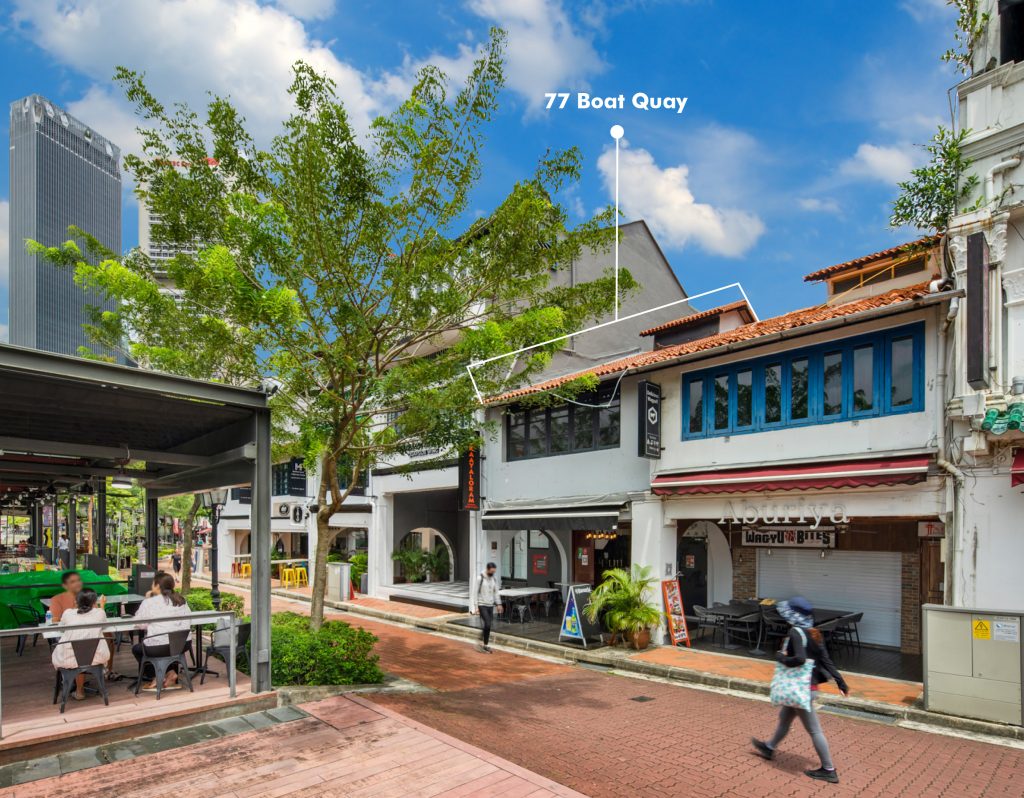
At 7pm on a Thursday, the bend in the Singapore River that the old maps call Boat Quay begins to hum. Lanterns flicker on over rows of pastel-painted shophouses, the smell of satay and chilli crab drifts across the granite pavement, and a bumboAT loaded with tourists glides past, its commentary echoing off three-storey facades. Office workers from Raffles Place spill out of riverside bars, couples pose for photos against the skyline, and somewhere in the crowd a live band starts up.
Most people look at this scene and see a postcard. Investors should see something far rarer: a tightly constrained pocket of heritage commercial property in one of the most expensive cities on earth. Boat Quay is simultaneously a conservation area, a working office-and-dining precinct, a national landmark, and — with the revival of tourism and the city's new push for a night-time economy — a property market in the middle of a second act.
This guide looks at what's actually happening at Boat Quay: the footfall patterns, the tenant mix, the revitalisation efforts, and what all of it means for rental yields and capital values. Then it walks through the practical steps of investing in conservation shophouses — because buying one of these buildings is very different from buying a condo or even a standard commercial unit. It's romantic. It's complicated. And for the patient investor, it can be genuinely rewarding.
From Godowns to Glamour: The Accidental Asset Class
To understand why Boat Quay behaves differently from every other commercial street in Singapore, you need its origin story. When Sir Stamford Raffles landed in 1819, the Singapore River became the island's commercial artery. The stretch of riverbank we now call Boat Quay — the "quay" where boats would pull up directly alongside trading houses — was effectively Singapore's original central business district. Chinese, Indian, Arab, Armenian and European merchants set up shop in godowns and shophouses, trading spices, coffee, tea, textiles, tin and rubber. Goods moved straight from bumboAT to warehouse to counting house, often within a single three-storey building.
For more than a century, this was where money changed hands. But as the port expanded, first to Tanjong Pagar and later to container terminals, the river economy decayed. By the 1960s and 1970s, Boat Quay was a dilapidated backwater, its buildings neglected and its water so polluted that the river was effectively an open sewer. In 1977, the government launched a decade-long, nine-figure cleanup of the Singapore River and its tributaries — a project that relocated thousands of squatters, hawkers and boat operators, and which by the late 1980s had brought the water back to life.
The decisive moment for investors came in 1989, when the Urban Redevelopment Authority (URA) gazetted Boat Quay as a conservation area under its Master Plan, alongside Chinatown, Kampong Glam and Little India. That single decision froze the built form of Boat Quay in time. The shophouses could be restored, repainted and reimagined — but they could not be demolished for a tower, and their facades could not be fundamentally altered.
What followed was one of Singapore's most famous urban transformations. Through the 1990s, Boat Quay became the nightlife strip — bars like Harry's (which opened its first outlet on the riverfront in 1992), live music joints, and wall-to-wall restaurants. It was the place to be after dark. Then came competition: Clarke Quay's flashy redevelopment, One Fullerton, the Marina Bay waterfront and a dozen newer lifestyle malls pulled away the crowds. By the 2010s, Boat Quay still did solid business, but it felt like a nightlife brand of a certain vintage.
Then 2020 happened. The riverfront went silent. Dine-in bans, border closures and empty offices in the CBD turned the precinct overnight from party central to a ghost town.
The revival you see today, then, is not a new invention. It is a return to form — with one crucial difference. The pandemic-era shock, followed by the sharp recovery in tourism, has forced everyone from landlords to policymakers to rethink what Boat Quay is for. And that rethink is precisely where the investment opportunity lies.
The Conservation Premium: Why Scarcity Is the Whole Game
Every property market runs on supply and demand, but at Boat Quay the supply curve is literally frozen. You cannot build a new Boat Quay shophouse. You cannot buy a plot of land there and replicate the streetscape. The conservation framework that saved the precinct in 1989 is the same framework that caps its upside — and, paradoxically, creates its value.
What "Conservation" Actually Means
A conserved shophouse is not merely an old building with a nice facade. It is a legally protected building whose external appearance, building height, and often its structural envelope are controlled by URA. At Boat Quay, that means:
- **No demolition and reconstruction.</strong> The three-storey typology is locked in. You can restore, adapt and internally upgrade, but you cannot add a fifth floor.
- **Facade controls.</strong> Paint colours, window styles, door frames and even signage are subject to conservation guidelines. Your right to "brand" the building is limited.
- **Approved use matters.</strong> A shophouse unit is approved for specific uses — ground floors historically for commercial (retail, F&B, offices), upper floors for offices or residential in some cases. Changing use requires a URA application and is not guaranteed.
- **Mandatory maintenance.</strong> As a conservation building owner, you are expected to keep the property in a state befitting its heritage status, which can make renovation and repair more expensive than in a conventional building.
The result is a stock that is not only finite but non-replicable. There are only a few thousand conserved shophouses in all of Singapore, and only a small fraction of those line the river at Boat Quay. Every investor who wants a waterfront heritage asset must buy one of these units from an existing owner. There is no new launch, no developer sale, no secondary pipeline.
Tenure: Freehold vs Leasehold Along the River
One of the most common misunderstandings about Boat Quay is the assumption that all shophouses are freehold. In reality, the tenure story is mixed — and getting it wrong can cost you millions.
A substantial share of Boat Quay's shophouses stand on land where the state retains ownership, with the buildings held on long leases (commonly 99-year terms). Others are freehold, typically where the original titles trace back to private ownership of the land in the 19th century. Some are on 99-year leases that have already run for decades, and when the lease approaches expiry, owners typically need to negotiate a lease upgrade or top-up premium with the state — a costly and uncertain process.
The lease-decay discount is the single most important variable in shophouse pricing. A freehold unit can command tens of percentage points of premium over an equivalent leasehold unit. But leasehold units, for that same reason, often offer better entry yields and a clear path to "repairing" value if the land tenure can be successfully extended. This is not a beginner's game: it requires legal, valuation and land-tenure expertise.
The Tax Asymmetry That Draws Investors In
Here is where Boat Quay commercial property gets genuinely exciting for the sophisticated buyer. The Singapore Government's property cooling measures — the Additional Buyer's Stamp Duty (ABSD) that hits second homes, the Seller's Stamp Duty (SSD) that punishes quick flips, and the Loan-to-Value limits that restrict residential borrowing — apply overwhelmingly to residential property. Purely commercial properties, including commercial-zoned conservation shophouses, sit outside most of these measures.
That means:
- No ABSD, even if you already own several residential properties. A foreign buyer of a commercial shophouse pays the same stamp duty as a Singaporean.
- No SSD on resale, so there is no penalty for selling after, say, two years if the market moves in your favour.
- Buyer's Stamp Duty (BSD) still applies on a progressive scale, reaching the top marginal band of 6% on the portion above S$3 million — so it's not tax-free, but it is structurally cheaper to trade than residential.
One important caveat: the tax treatment depends on how IRAS classifies the specific unit. A shophouse with an approved residential component may be treated as partly residential for stamp-duty purposes, which could bring ABSD into play. If the unit is purely non-residential, it sits in the commercial bucket. Always verify this before committing.
| Attribute | Boat Quay conserved shophouse | Newer commercial strata unit | Residential condo |
|---|---|---|---|
| Supply | Finite, cannot be rebuilt | Plentiful, ongoing launches | Continual new supply |
| ABSD on purchase | Not applicable (pure commercial) | Not applicable | Up to 60% for foreigners, 20% for Singaporeans on 2nd home |
| Seller's Stamp Duty | Not applicable | Not applicable | Applies within holding period |
| Typical buyer profile | Family offices, HNWIs, corporates | Individual investors, SMEs | Homeowners, investors |
| Income driver | Rental yield + scarcity | Market rents | Rents + potential en-bloc |
| Upside cap | Conservation rules cap redevelopment | Zoning can change | En-bloc potential |
The investor's equation at Boat Quay is therefore simple to state but hard to execute: buy a scarce, tax-advantaged, income-producing heritage asset, hold it patiently, and let the scarcity of the land do the heavy lifting. The difficulty is in the execution — which brings us to the messy, human reality of what actually goes on inside these buildings.
Foot Traffic, Floors, and the Science of the Tenant Mix
Location is a cliché in property, but at Boat Quay it is a daily, measurable reality. The precinct sits at the mouth of the Singapore River, wedged between Raffles Place — the heart of the CBD — and the commercial corridors of Telok Ayer and Cecil Street. Within a 10-minute walk you have four MRT lines: Raffles Place (North-South and East-West), Telok Ayer (Downtown Line), Clarke Quay (North-East Line) and Maxwell (Thomson-East Coast Line). The buses that crawl along the riverfront carry office workers from across the island.
What makes Boat Quay's foot traffic distinctive is not just volume but composition, and it changes hour by hour.
The Daily Rhythms of Boat Quay
Lunch (11am–2pm). The riverfront's first wave comes from the office towers of Raffles Place — tens of thousands of workers on short, hungry lunch breaks. Restaurants along the quay lean heavily on set lunches and group bookings. If you own the asset, the lunch crowd is your weekday income floor.
After-work (5pm–9pm). This is Boat Quay's classic golden window — the "5-to-9" happy-hour economy. The shaded western side of the quay fills first; bars offer two-for-one deals to capture the financial-district crowd. For ground-floor F&B tenants, this is the difference between profit and loss.
Evening dinner (7pm–10pm). The tourist buses and river cruises arrive, and the crowd shifts from suits to sandals. Long dinners, celebration groups, and the famous riverside seats facing the skyline.
Weekends (all day). Boat Quay is quieter at weekends than Orchard Road, but the tourist flow is steady — especially with river cruises landing and departing, and with the nearby Asian Civilisations Museum and the Cavenagh Bridge photo spot drawing visitors. Weekend revenue is a bonus layer, not the core.
The tourist factor. Singapore welcomed 16.5 million international visitors in 2024, up sharply from the pandemic trough of just 2.7 million in 2020 and 0.3 million in 2021, according to the Singapore Tourism Board. That recovery has flowed directly into riverside spending.
Singapore International Visitor Arrivals (millions)
Reading the Shophouse Like a Stack of Assets
Here's the part of Boat Quay investing that most newcomers get wrong: a single shophouse is not one asset, it's three or four. The ground floor, the upper floors and the attic have completely different economics.
Ground-floor units at Boat Quay are the crown jewels. They capture the footfall, the river views, the al-fresco licenses, and therefore the highest rents. In F&B terms, a ground-floor riverside unit with outdoor seating entitlement is arguably the strongest retail location in the entire Singapore River precinct. Upper floors, by contrast, operate in a completely different market — typically offices, co-working spaces, studios and even small showrooms. They rent for a fraction of the ground-floor rate, but they are also cheaper to buy per square foot and can offer more reliable, longer-tenured tenants.
This vertical stacking means the blended yield of a whole shophouse depends heavily on how many floors are income-producing and what they are being used for. A common investor play is to buy a whole building, lock in a ground-floor F&B tenant on a strong lease, and fill the upper floors with flexible office tenants at lower but steadier rents.
| Floor | Typical use | Rent profile | Tenant risk |
|---|---|---|---|
| Ground floor | F&B, retail, cafe, bar | Highest — riverside frontage commands a premium | High turnover; F&B mortality is real |
| First floor | Offices, co-working, clinics | Moderate — accessible, suitable for walk-in trades | Medium; longer leases |
| Second floor | Offices, studios, showrooms | Lower — no street frontage | Low-medium; stable |
| Attic / rear | Storage, staff quarters, studio | Minimal | Low |
F&B Tenants: The Engine and the Risk
There is no way to talk about Boat Quay without talking about food. F&B is the engine of the precinct — but it is also the riskiest tenant category in Singapore commercial real estate. Restaurants fail. Concepts tire. A tenant who was a darling at last year's awards can be shuttered by year-end because of a bad lease renewal, a health rating, or simply the brutal economics of manpower and rent.
Experienced Boat Quay landlords manage this by:
- Diversifying exposure — preferring buildings where more than one tenant operates, so a single failure doesn't zero out the income.
- Insisting on bank guarantees or security deposits for new F&B entrants.
- Structuring rents with a base component and a variable component tied to the tenant's revenue, so you share the upside without absorbing all the downside.
- Keeping approval in mind — a renewal or a new tenant always requires the approved use to match the unit's zoning. Do not sign a tenant that URA won't approve.
The bottom line: the tenant mix is the difference between a heritage asset that pays and a heritage asset that bleeds. The revival has brought stronger, more professional F&B operators back to the riverfront — but that also means rents are rising again, which is good for owners and a warning sign for tenants.
The Revitalisation Effect: What's Actually Changing
The pandemic was brutal for Boat Quay, but the recovery has been remarkable — and it's not just about tourists coming back. Several structural forces are converging to change the economics of the riverfront.
First, the tourism rebound. Visitor arrivals went from 2.7 million in 2020 to 16.5 million in 2024 — and tourism receipts recovered even faster, reaching S$31.5 billion in 2024, comfortably above the pre-pandemic level of S$27.7 billion in 2019, according to the Singapore Tourism Board. Tourists spend more per person than they did before, and a big share of that spending happens in exactly the kind of experiential, riverside settings that Boat Quay offers.
Singapore Tourism Receipts (S$ billion)
Second, the al-fresco revolution. COVID-19 forced Singapore to embrace outdoor dining. What began as a survival mechanism — tables on the street, partitions along the quay — became a permanent feature of the riverside experience. A ground-floor unit at Boat Quay that can seat diners outdoors is now significantly more valuable than an identical unit that cannot. The al-fresco entitlement is a function of both URA approval and the specific layout of the conservation building, which is why one restaurant succeeds while its next-door neighbour struggles.
Third, placemaking. The Government and precinct groups have invested heavily in activations along the Singapore River. The Singapore River Festival, organised by the Singapore River One precinct association, draws tens of thousands of visitors with light installations, night markets and riverfront performances. The i Light Singapore festival illuminates the river and surrounding facades. During the annual New Year's Eve countdown, the riverfront becomes one of the island's most-watched vantage points. Each of these events is, in effect, free marketing for the property owners along the quay.
Fourth, the master plan tailwind. The URA's Draft Master Plan 2025 identifies the Singapore River as a key lifestyle and recreation corridor, with proposals for better pedestrian and cycling connections, more public spaces, and continued support for the waterfront's mix of tourism, dining and workspaces. The broader downtown plan also targets more residential population in the CBD — more bodies living within walking distance of the river means more dinner traffic on weeknights, not just weekends.
Fifth, the night-time economy push. After years of watching nightlife drift to downtown clubs, the Government has signalled support for a more vibrant night-time economy — reviewing liquor-licensing rules, supporting late-night F&B, and working with precinct associations to extend the operating window of the riverfront. For Boat Quay, which was built for the after-dark economy, this is a direct policy tailwind.
What Revival Does to Rents and Values
The combined effect of these forces is visible in market behaviour. Property consultancies tracking Singapore's shophouse market have reported record transactions and rising prices for conservation shophouses, particularly in District 1 where Boat Quay sits. Scarcity is the base driver: with no new supply, every recovery in tenant demand translates directly into higher achievable rents, and every rise in rent translates into higher capital values when buyers capitalise that income.
There is also a substitution effect. With residential property cooling measures pushing wealthy buyers out of the mainstream condo market, more capital is flowing into commercial assets. Commercial shophouses offer the ownership experience of a "landed" property — you own the building, you control the facade, you can put your brand on it — without the residential tax penalties. For family offices and high-net-worth individuals, a Boat Quay shophouse is a trophy that also earns rent.
That said, the yields remain modest. Industry observers typically cite gross rental yields for conservation shophouses in the low-to-mid single digits — generally between 2% and 4% depending on tenure, location within the precinct, and condition. You are not buying Boat Quay for cash-flow yield; you are buying it for capital appreciation driven by scarcity, and for the durability of the income once the asset is stabilised.
The Buyer's Playbook: Investing in Boat Quay Commercial Property
If you've read this far, you're probably imagining what it would be like to own a slice of the river. Here's how the process actually works — and the traps to avoid.
Step 1: Know the Building Before You Love It
Boat Quay shophouses are old. Very old. Some were built in the 1840s. That charm is the point — but it is also a maintenance liability. Before you commit, commission:
- A structural engineer's report to check the condition of the timber beams, the brick party walls and the roof. Conservation buildings were not built for modern air-conditioning, plumbing loads and kitchen grease traps.
- A title search to establish tenure, any encumbrances, and any outstanding charges.
- A URA check on the approved use of the unit. If you want to run F&B on the ground floor, confirm the unit is approved for that use, and check whether al-fresco seating is permitted along your section of the quay.
- A visit at three different times of day — lunch, after-work and weekend — to feel the actual footfall in front of the specific unit, not just the precinct average.
Step 2: The Legal Structure
Commercial property can be bought in your own name or through a company. Family offices and investors frequently purchase shophouses through a corporate vehicle for liability and estate-planning reasons. But be aware: if you buy personally, TDSR applies to the loan; if you buy through a company, lenders will underwrite based on the vehicle's financials, which can be friendlier for high-income borrowers but often requires a larger cash equity.
Step 3: Financing the Deal
Commercial mortgages are priced differently from residential ones. Expect:
- Loan-to-value ratios around 70–75% for a well-valued commercial property, depending on the lender and your relationship.
- Higher interest rates than residential mortgages, reflecting the lower liquidity of the asset.
- Shorter tenors — typically up to 25 years, and sometimes limited by the remaining land lease.
- Interest-only structures are sometimes available for investment vehicles, but they defer the debt repayment and add risk.
Step 4: The Tax and Duty Stack
There are four major cost items to budget:
- Buyer's Stamp Duty — progressive, reaching 6% on the portion above S$3 million.
- GST — the sale of a commercial property by a GST-registered seller is typically subject to 9% GST (since January 2024), which can be a large cash-flow item at completion. A GST-registered buyer can generally claim this back; a non-GST-registered buyer cannot.
- Legal and valuation fees — modest relative to the total, but non-trivial on an asset priced in the millions.
- Repair and restoration costs — if the building has been passed over by previous owners, the restoration bill can easily run into six or seven figures.
Step 5: Valuing the Yield
Because there are no comparable "new launches" at Boat Quay, valuation is an art. Most valuers rely on the income approach: capitalise the net rent at a market cap rate for conservation shophouses, then adjust for tenure, location within the precinct, and any restoration deficit. If the price on the table is significantly above what the income stream alone justifies, you are paying for the scarcity premium — which may be justified, but only if you can hold the asset long enough for that scarcity to compound.
The Risks, Honestly Priced
Boat Quay is not a passive, set-and-forget investment. The risks are real:
| Risk | What it looks like | How to manage it |
|---|---|---|
| F&B tenant failure | Empty ground floor, months of lost rent | Require deposits, diversify tenants, lease to established operators |
| Lease decay | 99-year lease runs down, value erodes | Price it correctly at entry; explore lease top-up early |
| Interest rate shock | Floating-rate commercial loans bite | Fix rates; hold a cash buffer |
| Tourism downturn | Another pandemic, or geopolitical shock | Structure rent with stronger base on offices; avoid over-reliance on tourist spend |
| Conservation restrictions | Can't renovate as you wish | Buy with approved use; plan renovations around URA guidelines |
| Illiquidity | Shophouses take months to sell | Treat it as a long-term holding, not a trade |
The successful Boat Quay investor treats the asset the way a museum treats a masterpiece: acquire it carefully, maintain it lovingly, and never confuse a temporary dip in visitor numbers with the permanent destruction of value.
Food for Thought
Before you call a real estate agent or fire up the mortgage calculator, ask yourself these questions:
-
How do you price the lease? A freehold Boat Quay shophouse and a 99-year leasehold unit just one street apart are entirely different investments. Are you willing to underwrite the uncertainty of a lease top-up, or do you pay the freehold premium for certainty?
-
What happens to the CBD office crowd over the next decade? Boat Quay's weekday economics depend on Raffles Place being full. If hybrid work continues to thin out the 9-to-5 population, can the weekend tourist economy carry the building?
-
Are you a landlord or a collector? If you need a 4% gross yield to satisfy your return targets, a riverside shophouse at record prices may disappoint. If you want a finite, historical, tax-advantaged asset that compounds over 10 to 20 years, Boat Quay has few equals in Singapore.
-
What would a commercial cooling measure do? The Government has repeatedly said it is watching the commercial market. If ABSD-style measures were ever extended to non-residential property, the record prices of conservation shophouses could soften quickly. Are you buying at a price that survives that scenario?
-
Who will manage the building when you're not around? Heritage restoration, F&B tenant management and conservation compliance are specialist skills. If you have no team, your yield will bleed through management fees. Is the asset worth the effort?
The Bottom Line
Boat Quay's revival is real. The tourists have returned, the al-fresco tables are full again, and the policy winds — from master plan placemaking to the night-time economy push — are blowing in the direction of the riverfront. For investors, the appeal of heritage commercial property here has never been about flashy headline yields. It is about the quiet compounding of scarcity: a limited stock of conservation shophouses on one of the world's most recognisable waterfronts, held by patient owners who understand that you can't mint more history.
The evening crowd at Boat Quay may not think about leases, cap rates and conservation guidelines as they watch the river turn gold. But every one of those factors is visible in the lantern light, the restored facades and the queue forming at the riverside tables.