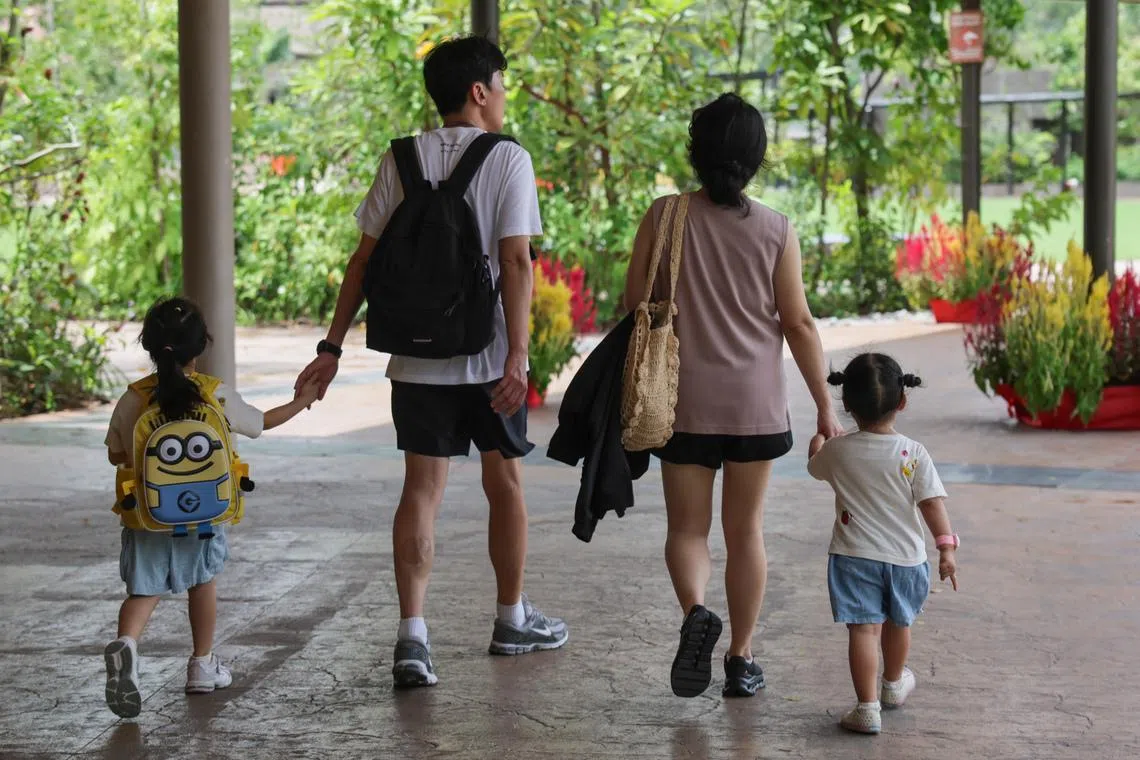
You know the conversation. It usually starts between the second and third year of marriage, over dinner with friends who are already parents: "So... are we trying soon?" And then comes the quieter question nobody quite says out loud: "Where would we even live?"
In Singapore, family planning and housing planning have become the same conversation. The BTO ballot decides not just where you live, but when you can start your family with some semblance of stability. So when Prime Minister Lawrence Wong announced a "national reset" on marriage and parenthood — and set up a dedicated workgroup to study the barriers holding young families back — an entire generation of 30-somethings started paying very close attention.
The wishlist is already taking shape: BTO priority for couples trying to conceive, bigger flats for families with children, and grants for upgrading when your family outgrows your first home. The reset workgroup is expected to address housing concerns for young families as one of its first priorities. Here's what we know so far, what we're hoping for, and what it could mean for HDB demand and prices in the next few years.
Why Housing Has Become a Family-Planning Issue
Let's start with the demographic picture, because it explains why the government is treating this as an urgent problem.
Singapore's resident total fertility rate has been falling for years, but the last stretch has been especially stark.
Singapore's Resident Total Fertility Rate (2019-2024)
In 2023, the TFR dipped below 1.0 for the first time on record, according to the Department of Statistics. The 2024 estimate of about 0.96 shows no meaningful rebound. For context, a TFR of about 2.1 is what a population needs to replace itself without migration. Singapore is at less than half of that.
Housing is not the only reason couples delay or forgo children — work hours, childcare costs, and changing social attitudes all play a role. But housing is the most concrete, the most policy-sensitive, and the most expensive piece of the puzzle. A couple cannot easily commit to a family if they are still waiting out a 4-year BTO construction timeline or paying market rent while saving for a downpayment.
The government seems to have heard this loud and clear. In his New Year message at the end of December 2024, PM Wong described the need for a "national reset" in how Singapore approaches marriage and parenthood — and signalled that housing support would be a core part of it. A workgroup, reportedly coordinated by Minister Indranee Rajah, has been studying measures across housing, work-life harmony, and financial support.
What the Reset Workgroup Is (Reportedly) Considering
The workgroup's full recommendations have not been published, and the government has been careful not to over-promise. But based on public statements and reporting, several housing measures are understood to be on the table:
- BTO priority for couples trying to conceive, including those undergoing fertility treatment
- Priority or larger flat types for families with children, so that having kids does not mean outgrowing your home
- Grants or support for upgrading from smaller flats to bigger ones as your family grows
- Extended interim housing support, such as broadening the Parenthood Provisional Housing Scheme (PPHS) for couples waiting for their BTOs
- Reviewing flat allocation rules so that families are not penalised for timing their children around a 4-year build-and-wait cycle
None of these are confirmed policies yet. They are the shape of the discussion — and they matter because they tell us where policy is heading.
The timeline is important. Even if the workgroup's recommendations are announced in 2025, policy changes take time to legislate, implement, and flow through to the ballot system. But markets are forward-looking — and the anticipation alone can shift behaviour. Couples who might have bought a resale flat in 2025 may hold off if they believe BTO priority for parents is coming. That kind of demand-side reaction is one of the most interesting dynamics to watch.
BTO Priority for Couples Trying to Conceive: The Ballot Wishlist
Let's talk about the headline item: BTO priority for couples trying to conceive.
This would be a significant extension of the existing priority framework. Today, BTO balloting already gives extra weight to certain groups. First-time applicants get priority over second-timers. Couples applying near their parents under the Married Child Priority Scheme (MCPS) get a boost. And families with children — or those expecting a child — can qualify for the Parenthood Priority Scheme (PG), which gives additional ballot chances.
Here's how the current system broadly works:
The current logic rewards couples who already have children. The proposed change would extend that logic earlier in the family timeline — to couples who are trying to have children but have not yet succeeded, including those undergoing fertility treatment.
Why this matters: for couples facing fertility challenges, the stress of a failed BTO ballot is not just financial. Every waiting year is a year lost on the biological clock. Giving them priority acknowledges that time is the one resource they cannot get back.
But it also raises questions:
- How do you verify "trying to conceive"? Fertility treatment records are one option, but not every couple trying to conceive is in active treatment.
- What happens to everyone else's odds? All priority schemes are a zero-sum game within any given BTO exercise. More priority for some groups means slightly lower odds for everyone else.
- Should the priority apply repeatedly? If a couple gets priority once and fails to secure a flat, should they keep the advantage in subsequent exercises?
If this measure is implemented, expect demand to become even more concentrated in family-friendly estates. Towns like Tengah, Punggol, Sengkang, and Bidadari — already popular with young families — could see application rates climb further. Mature estates near grandparents, such as Kallang/Whampoa, Queenstown, and Tampines, would likely see even more competition from couples who want childcare support from extended family.
| If BTO priority expands to... | Expect higher demand in... | Likely price effect |
|---|---|---|
| Couples trying to conceive | Non-mature estates with faster completion times | Mild upward pressure on BTO application rates |
| Families with 2+ children | 4-room and 5-room flats everywhere | Stronger resale prices for larger units |
| Couples near parents (existing MCPS) | Mature estates, central towns | Continued premium on proximity |
Grants for the Family Upgrade: From 2-Room to 4-Room Hopes
The second big item on the wishlist is grants for upgrading to bigger flats.
This one is personal for a lot of young couples. Here's a scenario many will recognise: you ballot for a BTO as a young couple, and because you are competing against families with priority, you take what you can get — a 2-room flexi or a 3-room in a non-mature estate. Then the kids arrive, your parents come to stay for childcare, and the flat that felt like a first step now feels like a trap.
Today, the grant system is heavily skewed toward helping first-timers get onto the ladder. That is by design — the priority is entry. But the "grow with your family" stage is underserved.
The Grant Stack You Can Already Claim
First, let's be clear about what already exists. An eligible first-timer family buying a resale flat can stack multiple grants:
| Grant | Purpose | Maximum Amount |
|---|---|---|
| Enhanced Housing Grant (EHG) | Households earning up to S$9,000/month | Up to S$80,000 |
| CPF Housing Grant (resale) | First-timer families buying resale | Up to S$60,000 |
| Family Grant (resale) | First-timer families, income ceiling S$14,000 | Up to S$50,000 |
| Proximity Housing Grant | Buying a resale flat to live with/near parents | Up to S$30,000 |
Combined, eligible first-timer families can receive up to S$190,000 in grants on a resale flat — and up to about S$220,000 if the Proximity Housing Grant applies. That's substantial. But note that these grants largely target first-timers buying — not existing owners upgrading.
There are upgrade support schemes, such as the Fresh Start Housing Scheme, but they are narrowly targeted at specific groups like second-timer families who had to sell their flats. A broader, more generous family upgrade grant — for example, helping a family in a 2-room or 3-room flat move to a 4-room or 5-room when their household grows — is the kind of measure the workgroup is reportedly considering.
The Upgrade Grant That Could Be Next
Imagine a policy that works like this: you bought a BTO as a childless couple, had two kids, and now need more space. Under current rules, you're a second-timer — which means you get lower ballot priority if you try for another BTO, and any grant support is reduced. Moving to a bigger resale flat would mean absorbing the full market uplift between your current flat and the next one up — a gap that has widened dramatically in recent years.
A family upgrade grant would narrow that gap. It could take the form of:
- A direct cash/CPF grant for families with children upgrading from smaller to larger flats
- Priority BTO access for second-timer families with kids, so they don't have to fight the second-timer queue
- Subsidised loans or deferred payments to smooth the transition between selling and buying
If this materialises, the demand implications are significant. The most obvious effect: stronger demand for 4-room and 5-room flats, both BTO and resale, in family-oriented towns. In resale terms, that means the price gap between 3-room and 4-room units — already substantial — could widen further.
For young couples, the strategic question is whether to buy the biggest flat you can afford now, or buy smaller and bet on an upgrade grant later. The workgroup's decisions will help answer that.
What This Means for HDB Demand and Prices
Let's step back and look at the market the workgroup is operating in. HDB resale prices have had an extraordinary run in recent years.
HDB Resale Price Growth, Approximate Year-on-Year (%)
According to HDB's resale price index, prices rose roughly 12.7% in 2021 and 10.3% in 2022 — the sharpest increases in over a decade. Growth slowed to about 4.9% in 2023, only to reaccelerate to around 8.9% in 2024. The cumulative effect: resale prices are significantly higher than they were in 2019, and the gap between BTO prices and resale prices has become a chasm for many families.
A few data points worth sitting with:
- The median resale price of a 4-room HDB flat crossed S$610,000 in 2024, up from roughly S$430,000–S$450,000 in 2019.
- 3-room resale flats have been hovering around S$420,000–S$440,000, while 5-room flats have pushed toward S$750,000–S$770,000.
- In 2024, more than 1,000 HDB resale flats reportedly changed hands for at least S$1 million — including, for the first time, 4-room flats in some mature estates.
Approximate Median HDB Resale Prices in 2024 (S$)
Against this backdrop, any policy that makes families bigger buyers of HDB flats — whether through priority, grants, or both — will add demand at the margin. Here's how the scenarios could play out:
Scenario 1: BTO priority expands to more family groups
More priority groups mean more couples holding BTO applications. For non-mature estates, where application rates for 4-room flats have hovered around 1.5 to 2.5 times oversubscription in recent exercises, rates could climb back toward the 3 to 5 range seen during the 2019-2021 peak. Mature estates like Kallang/Whampoa and Queenstown, which already see 5 to 8 applicants per flat, could become even more competitive.
Scenario 2: Upgrade grants support family "right-sizing"
This is arguably the more significant price driver. If families with children get financial help to move from 3-room to 4-room or 5-room flats, demand for larger resale flats could strengthen — especially in estates with good schools, MRT access, and proximity to grandparents. The 4-room and 5-room segments would likely see the most price support.
Scenario 3: Supply keeps meeting demand
The counterweight is supply. HDB has been ramping up BTO launches, with on the order of 100,000 flats launched or planned across the early 2020s and a significant pipeline through 2027. More BTO supply in family-friendly towns could absorb some of the demand pressure. But BTOs take 3 to 5 years to build, and the supply response is inherently lagged.
The honest summary: the workgroup's policies will not crash the resale market, and they will not dramatically cool it either. What they are more likely to do is redirect demand — towards larger flat types, towards family-friendly towns, and towards resale for families who cannot afford the wait.
What to Watch — and How to Prepare
Policy moves in stages. Here's what to track over the coming months:
- HDB sales exercises: With roughly four BTO launches per year, the composition of the 2025-2026 exercise pipeline — estate mix, flat-type mix, and any new priority schemes — will be the clearest signal of where policy is heading.
- Workgroup announcements: Look out for parliamentary updates or ministerial statements on the workgroup's recommendations, likely to land in phases rather than as one grand package.
- PPHS changes: If the Parenthood Provisional Housing Scheme is broadened or subsidised further, it will ease rental pressure for young couples and reduce the desperation component of resale buying.
- Grant adjustments in the Budget: Upcoming Budget statements are the natural vehicle for any new financial support measures.
In the meantime, practical moves for young couples:
- Know your grant stack before you shop. A first-timer family buying resale can access up to S$190,000 in combined grants — plus S$30,000 more if living near parents. That changes the BTO-vs-resale maths substantially.
- Factor in the wait, not just the price. A BTO might cost S$100,000 less than an equivalent resale flat, but 4 years of rental at S$2,500 a month is S$120,000. For some couples, resale is not the expensive option — it's the rational one.
- Consider the "second-timer trap." If you buy a 2-room or 3-room BTO now and your family grows, your upgrade options are constrained by your second-timer status. Buying a slightly larger flat today could be cheaper than upgrading later.
- Watch the family-friendly towns. Districts with schools, parks, and parental proximity — think Tengah, Bidadari, Punggol, Kallang/Whampoa, and Queenstown — are where demand concentration will show up first in application rates and resale prices.
Food for Thought
-
Should BTO priority hinge on proof of trying to conceive? If you support priority for couples undergoing fertility treatment, where do you draw the line — and how would you verify eligibility without making an emotionally difficult process even more clinical?
-
Would you buy smaller now, betting on an upgrade grant later? If the government signals that a family upgrade grant is coming, does that make a 2-room or 3-room starter flat more attractive — or is that too risky a bet for something as important as your home?
-
What happens to singles and second-timers? Every new priority group for first-timer families shifts the queue. Is the trade-off acceptable, and how should the government balance family formation goals against fairness for other groups?
-
Is demand or supply the real problem? Priority and grants make flats more accessible, but if the ultimate issue is a shortage of 4-room and 5-room flats in well-located estates, should policy focus more on the supply pipeline than on shuffling the queue?
-
If prices are expected to keep rising 5-8% a year, does your strategy change? The families who bought resale in 2021, despite the "high prices," are now sitting on significant equity. Is timing the market possible for HDB flats, or is time-in-market the only real strategy?
The Bottom Line
The reset workgroup is the most significant attempt in years to align Singapore's housing system with the realities of family life. From BTO priority for couples trying to conceive to grants for upgrading into bigger flats, the anticipated measures would not just make housing more affordable — they would make the timeline of family formation more humane. The days of "wait for the BTO, then think about kids" could slowly give way to a system that supports growing households at every stage.
What is clear is that HDB demand is not going anywhere. Prices have momentum, family formation is a national priority, and the policy direction is toward helping more families own more suitable homes. For young couples, the window to plan — before new priorities reshape the ballot and before the next wave of price growth — is now.