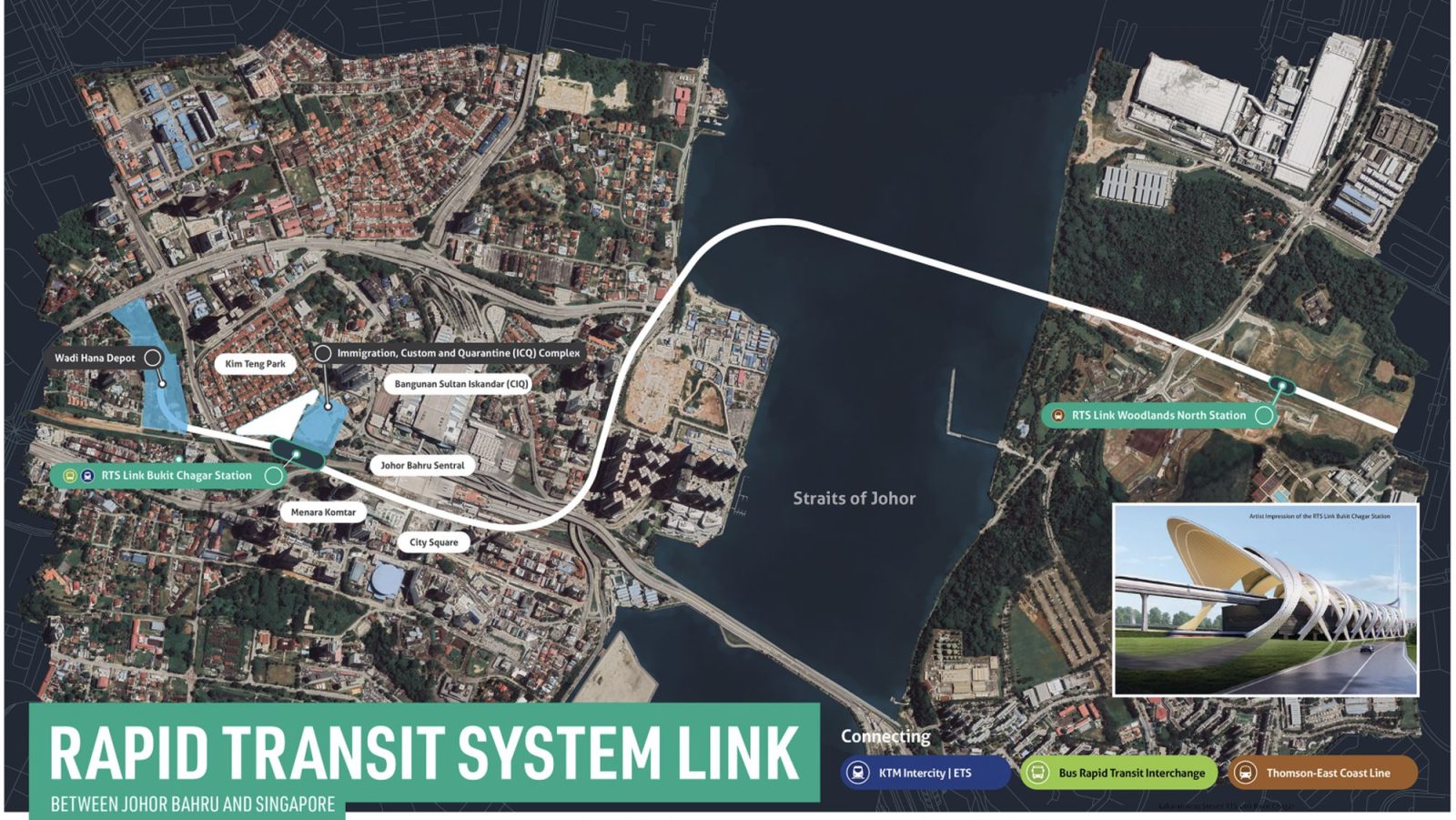
Every morning, more than 350,000 people squeeze across one of the busiest land borders on Earth. They queue in cars, on buses, and on motorcycles, often burning an hour or two of their lives just to get from Johor Bahru to a job in Singapore — or the other way. By early 2027, a four-kilometre railway is scheduled to quietly gut that daily grind. The RTS Link Bukit Chagar Station — the Malaysian terminal of the Rapid Transit System (RTS) Link — is the anchor of the most consequential cross-border infrastructure project between the two countries in a generation. For anyone holding, or hunting for, Johor and Singapore property, the real question is not whether the line changes the market. It is which properties get repriced, how much, and whether you are positioned before the market figures it out.
The RTS Link is not a glamorous mega-project. It has no underwater tunnel, no record-breaking bridge, no high-speed rail drama. It is a short shuttle train between two cities that are already practically touching. But short connections, as property history keeps showing, can produce outsized price effects — especially across a border where land prices on one side are a fraction of the other.
The 4-Kilometre Line That Turns the Causeway Inside Out
Let's start with the basics. The RTS Link is a dedicated, two-station commuter rail line connecting Bukit Chagar in Johor Bahru to Woodlands North in Singapore. The distance between the terminals is just 4 kilometres — shorter than some single MRT stretches in Singapore. The train ride itself will take roughly five minutes, and including immigration clearance at both ends, the full journey from train to train is expected to take around 15 minutes.
The numbers that matter most, according to publicly reported project specifications:
| Metric | Figure |
|---|---|
| Route length | ~4 km |
| Stations | 2 — Bukit Chagar (JB) and Woodlands North (SG) |
| Journey time | ~5 minutes on the shuttle |
| Full trip incl. clearance | ~15 minutes |
| Peak-hour capacity | Up to 10,000 passengers per hour per direction |
| Peak frequency | A train every few minutes |
| Target completion | End-2026, with passenger service reported for January 2027 |
| Operator | A joint venture of Malaysia's Prasarana and Singapore's SMRT |
The geography matters as much as the engineering. On the Malaysian side, Bukit Chagar Station sits next to the Sultan Iskandar Building — the main customs and immigration complex — and is within walking distance of JB Sentral and the Johor Bahru city centre. On the Singapore side, Woodlands North was purpose-built as an integrated station housing both the Thomson-East Coast Line (TEL), which opened in January 2020, and the future RTS terminal. You will not need to exit a station and re-enter another; the transfer happens under one roof.
The project has had a long and bumpy road. It was first mooted in the early 2010s, with a bilateral agreement in 2016, then suspended in 2018 when Malaysia's new government reviewed major infrastructure deals. It was revived in 2019, and construction finally began in November 2020. By late 2026, the civil works are targeted for completion, with passenger service expected to start in January 2027 — about a decade after the project was first formally agreed.
The RTS Link also lands in a much bigger policy moment. In January 2025, Singapore and Malaysia signed the Johor-Singapore Special Economic Zone (SEZ) agreement — a package of tax incentives, digital trade initiatives, and streamlined customs processes designed to pull investment into Johor. The RTS is effectively the transport backbone of that economic experiment. A train that moves 10,000 people per hour in each direction is the difference between an SEZ that is theoretically close to Singapore and one that is practically attached to it.
A Property Thesis Built on the Five-Minute Commute
To understand why this matters for property, you have to feel the pain of the current cross-border commute. The Causeway is a phenomenally inefficient artery. Public reporting consistently describes daily crossings in the hundreds of thousands — roughly 350,000 people — moving across the world's busiest land border. Most of them endure long queues during peak hours. A car journey from the JB city centre to Woodlands that would take 10 minutes at midnight can take an hour or more at 7 a.m. Buses are faster but still crawl through checkpoint queues. Motorcycles have their own lanes and get through faster, which is why tens of thousands of riders brave the rain every day.
The RTS Link changes the arithmetic at a stroke.
Peak-Hour Cross-Border Travel: Indicative Time in Minutes
The figures above are indicative — traffic varies by the day, the weather, and the season — but the shape of the story is not in dispute. A 90-minute queue collapses to a 5-minute train ride. Door-to-door, a worker living near Bukit Chagar and working in Singapore's city centre could go from "unrealistic daily commute" to "roughly an hour, reliably" — comparable to commuting from Pasir Ris or Jurong West into the CBD.
This is the threshold effect that property markets obsess over. Transport research has repeatedly found that when a commute drops below a psychological threshold — around 60 to 75 minutes door-to-door — a whole new pool of buyers and renters enters the market. People do not make life decisions based on a 5-minute train ride in isolation; they make them based on a reliable train ride. The 350,000 people already crossing the Causeway every day are the revealed demand. Many of them would prefer a seat on a train to a seat on a motorcycle.
For Johor and Singapore property, the implications run in both directions. On the Singapore side, Woodlands stops being the end of the line and becomes a gateway node — the first stop for tens of thousands of cross-border travellers who need services, homes, and eventually, maybe, a place to settle. On the Malaysian side, Bukit Chagar becomes the front door of a city whose most expensive homes still cost a fraction of a comparable Singapore condo. That price gap is the fuel for everything that follows.
What History Says About Rail Links and Property Values
Before projecting what the RTS will do to prices, it is worth asking what rail links have historically done to property. The evidence, drawn from transit research around the world, is remarkably consistent. Homes within walking distance of a new station tend to command a premium over otherwise comparable homes farther away. The effect is strongest within roughly 400 to 800 metres of the station, decays quickly with distance, and often shows up twice: once when the line is announced, and again when it opens.
Studies of Singapore's own MRT system — from the North-East Line in the early 2000s to the Circle Line and the more recent Downtown and Thomson-East Coast Lines — have repeatedly documented this pattern. Properties near new stations do not necessarily explode overnight; instead, they see a durable uplift in price relative to the rest of the town, and that premium tends to persist. The shape of the effect is the most replicated finding in transit-property research:
Typical Rail Station Premium by Distance (Illustrative Pattern)
This chart shows a stylised pattern, not a forecast for any specific project. But the curve — steep near the station, almost flat beyond a kilometre or two — has been observed in city after city. The practical takeaway for buyers: distance to the platform is the single most important locational variable.
Cross-border rail adds another layer. The Hong Kong–Shenzhen experience is the most instructive analogue. When the East Rail line was extended to Lok Ma Chau in 2007, it did not merely speed up trips; it converted Shenzhen's side of the border from a zone of awkward, one-off crossings into a genuine daily-commute market. Towns near the Hong Kong border crossing saw rental demand and prices firm up as cross-border workers anchored their lives on the cheaper side. Something similar has been playing out, more slowly, around Johor — but the RTS Link compresses the timeline.
There is also a more local lesson from the Causeway itself. The existing KTM shuttle train from JB Sentral to Woodlands CIQ already takes about five minutes — but with limited frequency and capacity, it moves only a sliver of daily crossings. The RTS Link multiplies that capacity many times over. At full utilisation in one direction, the line could theoretically move around 190,000 people a day — more than half of the Causeway's current total traffic — although realistic early ridership projections cited in public reporting are far lower, in the tens of thousands per day.
Daily Cross-Border Volume: Current Scale vs RTS Potential (Indicative)
The bigger point is the mode shift. Every passenger who swaps a car or motorcycle for the RTS is not just saving time; they are re-anchoring their daily life to a fixed point on the map. And property values follow daily life.
The historical pattern suggests two asymmetries worth remembering. First, the cheaper side of the border usually gains more in percentage terms — because the absolute price gap is so wide, small improvements in accessibility translate into larger proportional repricing. Second, the better-regulated side gains stability rather than frenzy — prices move less dramatically but hold their value through downturns. Both sides of the Causeway stand to benefit, but they will benefit in different ways.
Woodlands: Singapore's Northern Gateway Gets a Direct Line
Woodlands has long struggled with a branding problem. It is one of Singapore's largest HDB towns — home to roughly a quarter of a million residents — and it has been a Regional Centre in the Master Plan for years. Yet for many Singaporeans, it still reads as the last stop before a long queue at the checkpoint. The RTS Link changes that narrative.
The critical asset is Woodlands North station. Opened in January 2020 as the northern terminus of the Thomson-East Coast Line, it was always designed to be more than an MRT station. The RTS terminal is integrated into the same complex, making it one of the only places in Singapore where you can step off a domestic MRT train and board a cross-border train without leaving the building. That integration is rare and valuable.
Around the station, the Urban Redevelopment Authority has earmarked the surrounding North Coast area for a new waterfront residential and commercial precinct. The combination — an international rail terminal, a TEL interchange, and a master-planned new district — is the kind of package that typically produces a durable locational premium.
How might this play out for prices? Let's be disciplined about this. The table below shows illustrative scenario bands, based on the general transit-premium patterns in published research — not a forecast, and definitely not the kind of precision anyone should use to bid at auction:
| Location | Illustrative uplift band | Time horizon | Main driver |
|---|---|---|---|
| HDB resale within ~1.5 km of Woodlands North | ~2–6% | 3–5 years | Commuter rental demand, interchange effect |
| Private condos within ~1.5 km | ~3–8% | 3–5 years | Travel-time savings, North Coast master plan |
| Commercial / retail near the interchange | ~5–12% | 5–10 years | Footfall from RTS + TEL |
| Wider Woodlands (beyond ~2 km) | ~0–3% | 3–5 years | Town-wide sentiment, spillover |
The hedges matter. Woodlands is a mature town with a large stock of older HDB flats and a wide range of lease tenures. Not every block near the town centre is near the station. The honest version of the Woodlands story is selective, not broad-based. A flat five minutes by bus from Woodlands North is not the same proposition as one that is actually walkable to the interchange.
The rental channel deserves special attention. Cross-border workers who prefer Singapore's regulatory environment — or who have children in Singapore schools — may not move to Johor at all. But they would strongly prefer a flat within a short ride of the RTS terminal. Woodlands could therefore see disproportionate rental demand for compact, near-station units, especially from tenants who previously lived deeper in the island and commuted across the city to reach the Causeway. In property terms, this is a classic gateway-town rental play: the area that is the first convenient stop after a border crossing tends to capture premium rents from people who value their time.
There are also reasons for caution. Singapore's cooling measures, including the Additional Buyer's Stamp Duty (ABSD), remain firmly in place, and foreign demand for Singapore private property is heavily taxed. Any RTS-driven demand from foreigners looking to buy on the Singapore side will be blunted by policy. The more realistic channel is domestic demand — Singaporeans and PRs who want a well-connected, reasonably priced HDB town that suddenly sits on an international rail line. That is a slower-burn effect, but also a more sustainable one.
Bukit Chagar and Johor Bahru: The Repricing on the Other Side
If Woodlands is the stable, slow-moving half of this story, Johor Bahru is the speculative half. And the RTS Link Bukit Chagar Station is squarely in the middle of it.
Bukit Chagar's location is the whole point. It sits immediately beside the Sultan Iskandar Building — the same CIQ complex that every car and bus currently funnels through. Every person who uses the RTS will pass through the station's doorstep. That kind of guaranteed footfall is what transit-oriented development (TOD) dreams are made of, and the Malaysian authorities have plans for mixed-use development around the station, according to public announcements.
The JB property market starts from a very different base than Singapore's. City-centre condominiums in Johor Bahru have historically traded at prices that are a fraction of comparable Singapore homes — often a third to a half, even after the years of recovery since the pandemic. Gross rental yields in JB city centre are commonly cited in the 5–7% range before costs, far above what most Singapore residential yields offer. The trade-off is the usual menu of cross-border risks: ringgit currency exposure, less liquid resale markets, and a chronic tendency toward oversupply in Johor's condominium sector.
Foreign ownership rules add a filter. Malaysia requires foreigners to meet a minimum purchase price — in Johor, reportedly around RM1 million — which effectively excludes the cheap-entry tier of the market for non-Malaysians. That means the RTS-driven demand from Singapore-based investors will land mainly in the mid-to-upper segment of the JB market, which is precisely the segment where new supply has historically been heaviest.
The pricing-in question is the most interesting one. Public reporting suggests that JB city-centre prices firmed notably after the RTS revival in 2019 and again after the SEZ agreement in 2025. Market watchers have argued for years that the easiest speculative money on the RTS story has already been made. But "already priced in" is a dangerously vague phrase. What tends to happen with major infrastructure is a two-stage repricing: the announcement compresses the speculative premium into the market, and then the opening triggers a second, more fundamentals-driven adjustment as actual commuting behaviour changes.
| JB location | Illustrative uplift band | Time horizon | Main risk |
|---|---|---|---|
| Within ~1 km of Bukit Chagar | ~8–20% | 5–10 years | Liquidity, FX, overhang |
| Wider JB city centre | ~5–12% | 5–10 years | New supply competition |
| Iskandar Puteri corridor | ~3–8% | 5–10 years | Car-dependent, distance from RTS |
Again, these are illustrative scenario bands, not predictions. The spread between the top and bottom of each band is deliberately wide, because the outcome depends on factors that have nothing to do with the train — the pace of SEZ implementation, the strength of the ringgit, how quickly Johor absorbs its existing condo overhang, and whether Malaysia adjusts foreign-ownership thresholds.
The strongest argument for JB exposure is the structural wage gap: as long as Singapore employers need workers and Johor provides them, the daily flow across the border is a physical constant. The RTS Link does not create that flow; it organises it. Every organised flow of people eventually becomes an organised flow of rents and prices.
For anyone weighing the two sides, the decision tree is fairly intuitive:
The cleanest way to think about it: Johor offers the upside, Singapore offers the downside protection. The RTS Link makes both more attractive, but they are different investments with different risk profiles.
How to Track This With Data, Not Vibes
Cross-border property stories attract more than their fair share of hype. Real estate agents on both sides have a natural incentive to tell you the train has already transformed the market, or is about to. The antidote is to watch specific, measurable signals instead of narratives.
Here are five indicators worth tracking from now until the RTS opens — and beyond:
| Signal | Why it matters | Where it shows up |
|---|---|---|
| Official RTS completion updates | Each percentage point of progress reduces delivery risk | Malaysian and Singapore transport ministry announcements |
| Resale transactions within ~1.5 km of Woodlands North | Early price discovery in the most exposed Singapore corridor | HDB resale records, caveats lodged |
| JB city-centre sales volume and psf trends | Whether repricing is broad-based or confined to new launches | Malaysia's property valuation office data, industry reports |
| SEZ implementation details | Tax incentives and relocation decisions drive job-led demand | SEZ announcements, company registrations in Johor |
| Rental absorption near both stations | Real occupancy beats speculative price talk | Listing platforms, leasing agents, vacancy data |
The discipline of watching transactions and rentals rather than asking prices is what separates analysis from anecdote. Asking prices are hopes; caveats and lease contracts are facts.
This is also where data analytics earns its keep. Sorting out which districts and projects genuinely stand to benefit — rather than which ones simply hug a station name — is exactly the kind of question that benefits from systematic, structured analysis. On the Singapore side, that means weighing accessibility and pricing alongside broader market momentum; on the Johor side, it means separating yield stories from liquidity traps. A good property data platform, one that scores districts and projects on factors validated out-of-sample, can help you cut through the cross-border noise.
Food for Thought
-
If you could reliably cross the Causeway in five minutes, would you live in Johor? Be honest — the answer determines whether the RTS creates a genuine commuter culture or just a slightly more comfortable tourist day-trip.
-
How much of the RTS premium is already priced in? The announcement effect has been working since 2019, and the SEZ since 2025. The real question is whether the opening of the line triggers a second repricing wave — history suggests it often does.
-
Which side offers better asymmetry? A HDB flat near Woodlands North with a modest but stable uplift, or a JB city-centre condo with larger upside but thinner liquidity? There is no wrong answer, but there is definitely a wrong answer for your risk tolerance.
-
How should currency risk shape the decision? A ringgit recovery would supercharge JB returns for Singapore-dollar investors; a further decline would erode them. Are you being paid enough yield to carry that volatility?
-
Would you rather own near the station or near the SEZ's industrial zones? The train moves people, but the SEZ moves jobs. In the medium term, job locations may matter as much as transport nodes.
The Bottom Line
The RTS Link Bukit Chagar Station is a rare thing in the Singapore property market: a genuinely structural change with a known date. The line will open, passenger service will begin, and daily life across the Causeway will reorganise around a reliable five-minute crossing. The property effects will not be uniform, and they will not be instantaneous. But the direction — a durable uplift for walkable properties near both terminals, a bigger proportional repricing on the cheaper Johor side, and a stabilisation of Woodlands as a genuine gateway node — is about as close to a consensus as property analysis gets.