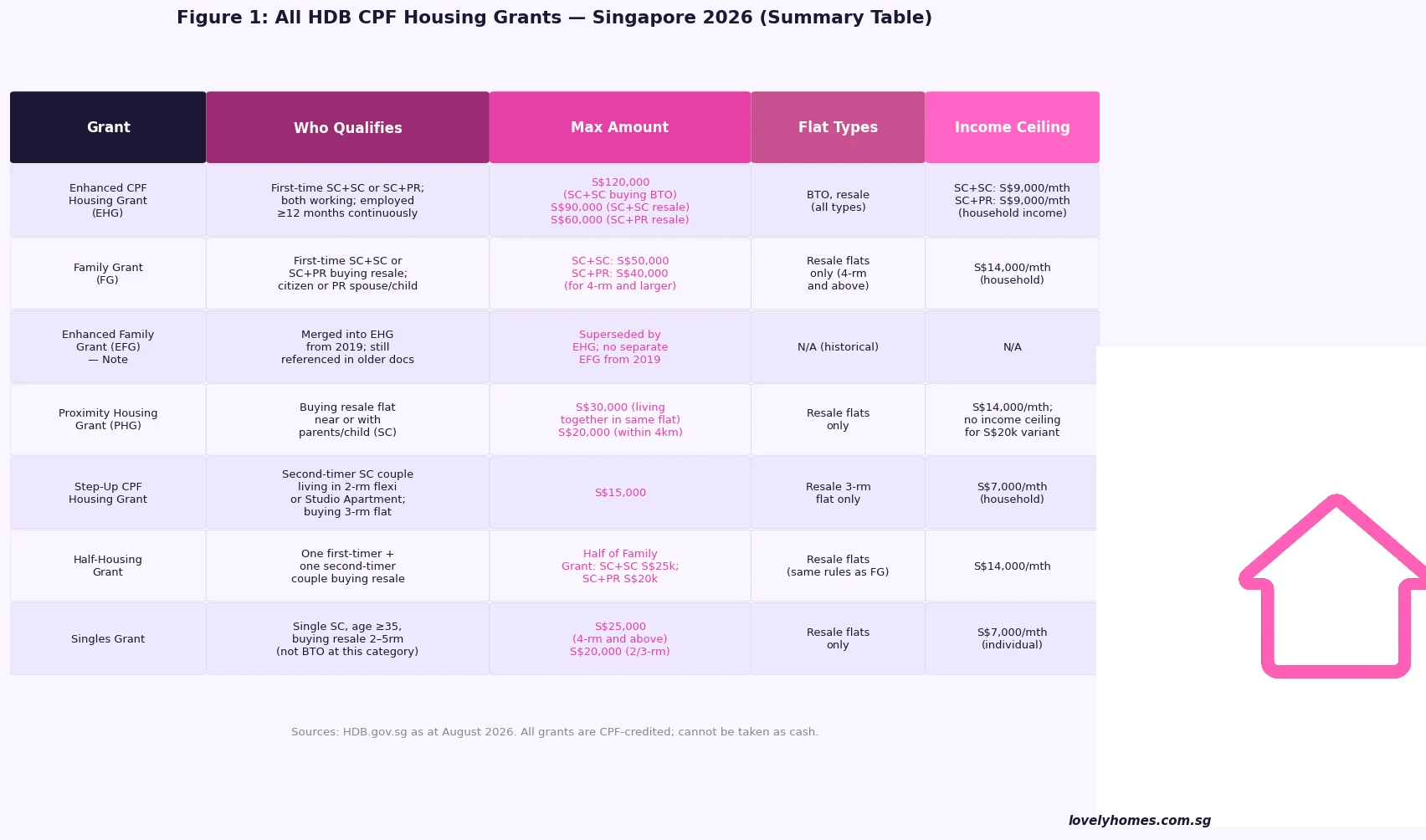
Imagine two young families at the same BTO launch. Same income band, same town, same 4-room flat on their wish list. One couple has a toddler on their hip; the other has none. Today, the parents already enjoy a quiet edge — extra ballot chances and priority schemes that tilt the odds in their favour. But if the Marriage and Parenthood Reset Workgroup gets its way, that edge could widen into a chasm.
That is the stakes behind Singapore's most consequential housing conversation of 2026. Announced by Prime Minister Lawrence Wong at the 2025 National Day Rally with an unusually blunt "whatever it takes" framing, the workgroup is studying the full arc of family formation — dating, marriage, parenthood, and the financial architecture around all three. Housing sits at the centre of that architecture. And the signals from the workgroup so far point squarely at enhanced HDB grants and stronger priority schemes for young families.
The numbers explain why housing has become a family-formation issue at all. Singapore's resident total fertility rate fell to 0.94 in 2024 — the first time it has dipped below 1.0, according to the Department of Statistics. A shrinking pool of young families means the entire housing ecosystem — BTO demand, resale volumes, and new launch take-up — depends on whether policy can make family formation more affordable. The Parenthood Reset is therefore not just a social policy story. It is a property market story.
This article examines what the workgroup could recommend, how enhanced grants would reshape the affordability math for young families, and what that would mean for BTO application rates, resale prices, and new launch take-up across Singapore.
The Baby Equation: Why Housing Is Now a Family-Formation Issue
Every population policy conversation in Singapore eventually collides with a HDB flat. You need a home before you start a family. You need space before you expand one. You need financial headroom before you commit to a second or third child — and for most households, the mortgage is the single biggest line item on that balance sheet.
Singapore's fertility decline has been decades in the making, but the recent slide has been sharp. After hovering around 1.1 in the early 2020s, the resident TFR dropped to 0.97 in 2023 and then 0.94 in 2024. Policy responses have so far focused on direct cash transfers — the Baby Support Grant added $3,000 per child in August 2024, and paternity leave was doubled to four weeks — but housing is widely seen as the next domino to fall.
The logic is straightforward. Surveys and government consultations consistently rank housing costs and financial security among the top barriers to having children. Young couples look at a BTO waiting time of three to four years, a resale market where four-room flats in mature estates routinely cross $700,000 to $850,000, and the cost of raising a child through the education system, and they make a calculation. The Parenthood Reset is designed to change that calculation.
At the 2025 National Day Rally, PM Wong said no issue would be off the table — a phrase that electrified the property market. The workgroup is expected to report around the middle of 2026, with recommendations likely phased in from 2026 into 2027. Notably, PM Wong explicitly named housing, education, and careers as areas where the government would be prepared to do "whatever it takes" to support marriage and parenthood.
For property watchers, the question is not whether the workgroup will touch housing — it almost certainly will. The question is which levers it pulls, how hard, and what happens to prices and demand when it does.
The Current Toolkit: What Young Families Can Stack Today
Before projecting what the Parenthood Reset might add, it helps to map what already exists. Singapore already tilts its housing system heavily toward families. A young couple with children can stack several layers of support:
| Scheme | What you get | Key condition |
|---|---|---|
| Enhanced CPF Housing Grant (EHG) | Up to $80,000 | Married couple / family nucleus, monthly household income ≤ $9,000; applies to BTO and resale |
| Proximity Housing Grant (PHG) | Up to $30,000 | Buying a resale flat within 4 km of parents' or child's home (since Feb 2023, raised from $20,000) |
| Parenthood Priority Scheme (PPS) | +1 ballot chance | Married couple with children, or expecting |
| Married Child Priority Scheme (MCPS) | +1 ballot chance, proximity priority | Married couple buying within 4 km of parents |
| Third Child Priority Scheme (TCPS) | +1 ballot chance | Family with three or more children |
| First-timer base chance | 2 ballot chances | First-timer family nucleus |
The EHG itself is a sliding scale that tapers as income rises. The full brackets are publicly available on HDB's website, but the shape of the taper tells the story:
| Monthly household income | EHG amount |
|---|---|
| $1,500 and below | $80,000 |
| $3,001 – $3,500 | $60,000 |
| $5,001 – $5,500 | $40,000 |
| $7,001 – $7,500 | $20,000 |
| $8,501 – $9,000 | $5,000 |
Beyond grants, families get better loan terms than most investors will ever see. The HDB concessionary loan rate sits at 2.6 per cent, pegged at 0.1 percentage point above the CPF Ordinary Account rate. The Mortgage Servicing Ratio (MSR) caps monthly housing loan repayments at 30 per cent of gross monthly income. And an HDB loan can cover up to 75 per cent of the purchase price — with no minimum cash downpayment required, unlike bank loans.
Stack it all together and a lower-income family with two children buying a resale flat near their parents could receive more than $110,000 in grants on top of priority ballot treatment. That is already a substantial subsidy package.
Yet the fertility rate still fell below 1.0. Which tells you how much headwind young families face — and how much further policy may need to go.
Four Levers the Parenthood Reset Could Pull on HDB Grants
No official recommendations have been published, so anything beyond the current framework is scenario analysis. But based on the workgroup's stated scope, public remarks from ministers, and the direction set by PM Wong's rally speech, four levers are the most likely candidates.
Lever 1: Bigger grant quantum
The most direct option is raising the EHG cap from $80,000 to $100,000 or beyond for families with children. Another possibility is a new, stackable "Parenthood Housing Grant" that applies specifically to couples with children — distinct from the EHG so it can be layered on top. In an extreme version, a family with two or more children buying a flat near their parents could stack a parenthood grant with the EHG and PHG to reach $130,000 to $150,000 in total support.
Lever 2: Higher income ceilings
The EHG's $9,000 income ceiling excludes a large slice of young professional couples — precisely the demographic whose fertility decisions the government is most anxious about. Raising the ceiling to $11,000 or $12,000 would bring many more households into grant eligibility overnight. Note that the EC income ceiling already sits at $16,000, so a raise in the HDB ceiling would align the two tiers more closely.
Lever 3: Stronger priority and allocation
Grants make flats cheaper, but priority determines who actually gets one. The workgroup could push for dedicated parenthood queues in every BTO exercise — reserved units that only families with children can ballot for — or additional ballot chances on top of the current PPS/MCPS/TCPS stack. Another possibility is MOP flexibility: allowing families with young children to sell and upgrade before the standard five-year Minimum Occupation Period, so they aren't trapped in a flat that has become too small.
Lever 4: Cost relief beyond grants
Stamp duties, moving costs, and renovation bills add up quickly. A buyer's stamp duty rebate for first-time families, an interest-rate subsidy on HDB loans, or a resale-specific top-up for families buying larger flats would all reduce the all-in cost of starting a family home. A BSD rebate alone could save a family $12,000 or more on a $600,000 resale purchase.
To see how all these levers could stack together for a young family, follow the decision tree:
The crucial insight is that these levers are not mutually exclusive. A "grand reset" package would likely combine all four — bigger grants, a higher ceiling, stronger priority, and cost relief — because the stated goal is nothing less than reversing a demographic decline.
The Affordability Math: What an Extra $50,000 to $100,000 Buys
To understand the market impact of enhanced grants, you need to understand how grant money actually moves the needle on a mortgage.
At the current HDB concessionary rate of 2.6 per cent over a 25-year loan, every $100,000 of loan translates to roughly $454 per month in repayments. Here's the schedule:
Monthly Instalment on a 25-Year HDB Loan at 2.6% (S$)
Now apply the MSR. A household earning $8,000 a month can service at most $2,400 in monthly housing loan repayments — which, at 2.6 per cent over 25 years, supports a loan of about $529,000. Add a $100,000 grant and the same monthly payment now supports a flat that costs $100,000 more. That is the difference between a 4-room flat in a non-mature town and a 4-room flat in a mature town, or between a 4-room and a 5-room in the same estate.
The downpayment story is even more powerful. On a $600,000 resale flat, a 75 per cent loan means a $150,000 downpayment. A family stacking an elevated parenthood grant, the EHG, and the PHG could see most of that hurdle disappear — with CPF funds covering the rest. For a $400,000 BTO, the downpayment arithmetic is even friendlier: a top-tier EHG of $80,000 or more covers nearly the entire requirement.
| Flat price | Loan amount (75% LTV) | Monthly instalment (25 yrs @ 2.6%) | With $100,000 grant |
|---|---|---|---|
| $400,000 | $300,000 | $1,361 | Loan shrinks to $200,000 — saves $454/month |
| $600,000 | $450,000 | $2,041 | Loan shrinks to $350,000 — saves $454/month |
| $700,000 | $525,000 | $2,382 | Loan shrinks to $425,000 — saves $454/month |
This is the real significance of a grant increase. It does not merely lower a sticker price. It lowers the savings hurdle for the downpayment, reduces the monthly debt load to a level that passes the MSR, and frees up CPF headroom for other life goals. For a couple deciding whether a second child is financially feasible, that combination is exactly the kind of signal policy can send.
Reading the Market: BTO Application Rates, Resale Prices and New Launch Take-Up
To estimate what enhanced grants would do to demand, we need a baseline of where the market stands today.
HDB resale prices: post-surge moderation
Resale prices have had a volatile half-decade. After a modest 5.0 per cent rise in 2020, the market surged 12.7 per cent in 2021 and 10.3 per cent in 2022, before cooling to 4.8 per cent in 2023. Prices re-accelerated to 8.7 per cent in 2024, then moderated again to roughly 4.4 per cent in 2025, according to HDB's flash estimates.
HDB Resale Price Growth by Year (%)
The market is clearly sensitive to affordability interventions. The 2021-2022 surge coincided with record-low interest rates and a wave of delayed family formation. The moderation in 2023 followed the cooling measures introduced in late 2022 and a ramp-up in BTO supply. A fresh injection of grant money would run directly against the grain of the current moderation.
BTO application rates: from frenzy to near-normal
BTO demand has normalised significantly from its pandemic peak. During 2021-2022, first-timer family application rates for 4-room flats in non-mature estates routinely hit 4 to 6 times supply. By 2024-2025, those rates have eased to roughly 1.5 to 2.5 times — approaching the range HDB considers healthy. That normalisation is precisely why the Parenthood Reset could have an outsized impact: there is now spare capacity in the demand pipeline for a well-targeted grant boost to refill.
The composition of demand matters too. Million-dollar HDB resale transactions — once a curiosity — hit record levels in 2024, with property agencies tallying over 1,000 deals, nearly double the 2023 count. These are concentrated in mature estates like Toa Payoh, Bishan, and Queenstown, where families pay a premium for location, schools, and remaining lease.
Where prices stand by town
A snapshot of indicative median resale prices for 4-room flats, based on public transaction data in 2025, shows the gap families navigate:
| Town | Indicative median resale price (4-room) |
|---|---|
| Toa Payoh | ~$830,000 |
| Ang Mo Kio | ~$720,000 |
| Sengkang | ~$620,000 |
| Punggol | ~$600,000 |
| Woodlands | ~$560,000 |
| Jurong West | ~$540,000 |
The gap between a mature and a non-mature 4-room flat is often $150,000 to $250,000 — roughly the same magnitude as the grant packages the Parenthood Reset is reportedly considering. That coincidence is not accidental. If the workgroup wants grants to be meaningful, the quantum has to move the price gap between "the flat you can afford" and "the flat where you want to raise your kids."
Three Scenarios: What Enhanced Grants Would Do to Demand
Let's put this together into three concrete scenarios. These are illustrative projections, not forecasts — they assume the policy changes take effect in 2026-2027 against the current supply pipeline.
Scenario 1: The modest top-up
The workgroup raises the EHG cap moderately (from $80,000 to around $90,000), nudges the income ceiling up to $10,000, and adds one more ballot chance for families with two or more children.
- BTO application rates: first-timer family rates could rise 10 to 20 per cent from the current baseline, pushing 4-room non-mature application rates from around 2.0x toward 2.3x.
- Resale prices: a small but measurable bump of 0.5 to 1.5 per cent over the 12 months following implementation, concentrated in mature estates near good schools.
- New launch take-up: minimal impact; EC and private buyers are mostly above the income bands affected.
Scenario 2: The bold package
The workgroup introduces a new stackable parenthood grant of $30,000 to $50,000, raises the EHG ceiling to $12,000, and reserves a dedicated share of units in every BTO exercise for families with children.
- BTO application rates: first-timer family rates could jump 25 to 40 per cent — to roughly 2.6x to 2.8x.
- Resale prices: expect 2 to 4 per cent additional growth over 12-18 months, as some families who fail at BTO switch to resale, and as grant money gets partially capitalised into asking prices in mature estates.
- New launch take-up: EC demand could soften 5 to 10 per cent as upper-middle families reconsider staying in the HDB segment. Mass-market private launches could see a mild dip in first-time buyer interest.
Scenario 3: The grand reset
The bold package plus structural changes: accelerated BTO supply, MOP flexibility for families, BSD rebates, and an HDB interest-rate subsidy for households with young children.
- BTO application rates: up strongly, but the supply response would temper queue lengths. Expect 20 to 30 per cent higher demand with shorter effective wait times because more units are reserved for families.
- Resale prices: a more muted 1 to 2 per cent lift, because the supply valve is open.
- New launch take-up: neutral to positive over two to three years — higher resale prices give upgraders more equity, which historically feeds through to EC and private demand.
Illustrative First-Timer Family Application Rate (4-Room, Non-Mature Estates)
The spillover mechanics deserve a diagram of their own, because they explain why a HDB-focused policy rarely stays contained to the HDB market:
The two forces heading into the private market — near-term competition from a stronger HDB segment, and delayed upgraders with fatter equity — are the reason analysts expect a jagged, not linear, response in new launch take-up.
Who Wins, Who Waits Longer
Every policy reshuffles queues. Enhanced parenthood grants would be no exception.
The winners:
- Families with children — the obvious beneficiaries, especially those with two or more children, who could see total grant support exceed $100,000 when stacked with the EHG and PHG.
- Lower-income families — a higher EHG cap gives the greatest proportional relief at the bottom of the income ladder.
- Families buying near parents — the PHG + MCPS combo already rewards proximity for childcare support; a parenthood grant would deepen that advantage.
- Resale sellers in mature estates — indirectly, as grant-enhanced demand meets constrained supply in established towns near schools and transport nodes.
Those who wait longer:
- Singles — already at the back of the BTO queue; a bigger family priority would push them further back in popular exercises.
- Childless couples — the relative penalty of not having children grows larger.
- Seniors right-sizing — competing for smaller flats in mature estates where family demand is strongest.
- Higher-income families above the income ceiling — unless the ceiling rises enough to include them, they gain nothing while watching prices move.
This distributional tension is the most politically delicate part of the Parenthood Reset. The government has been explicit that the goal is to support families — which inherently means prioritising them over other groups. But the scale of that priority is a policy choice, and every additional ballot chance given to parents is a chance removed from someone else's odds.
There are also market risks to consider. The first is grant capitalisation: when subsidies are targeted at a constrained asset, part of the benefit tends to flow into higher prices rather than lower costs for buyers. The second is the anticipation effect: if young couples believe bigger grants are coming in 2027, some may delay purchases now, temporarily softening demand before a bounce. The third is sequencing risk — if grants arrive faster than BTO supply, the short-term price signal could be inflationary.
Food for Thought
As the workgroup's recommendations take shape, these are the questions worth mulling over:
-
Should family-sized grants be universal or targeted? A $100,000 grant for every family with children would be enormously expensive — and largely capitalised into prices. A means-tested version is fairer but politically harder to sell as "whatever it takes."
-
Is the income ceiling the real bottleneck? The median household income of first-time BTO applicants has been creeping upward. If the ceiling stays at $9,000 while the boldest grants target lower-income families, does the policy miss the demographic — young professionals — most likely to delay parenthood?
-
What happens to singles and seniors? The BTO system already prioritises families heavily. At what point does family-first policy price other groups out of the dream of homeownership entirely?
-
Would you wait? If you knew a $40,000 parenthood grant was coming in 2027, would you delay your resale purchase or BTO application by a year? If enough couples answer "yes," the anticipation effect alone could reshape 2026 transaction volumes.
-
Is the flat the problem, or everything around it? A bigger grant helps with the downpayment, but childcare costs, education, and lost wages are the other half of the fertility equation. Housing policy can open the door — it cannot carry the family.
The Bottom Line
The Marriage and Parenthood Reset Workgroup will not be remembered for its survey methodology or its consultation process. It will be remembered for what it changes — and housing is the most expensive item on its table. Enhanced HDB grants, higher income ceilings, and stronger family priority would not just put a few thousand dollars into young couples' CPF accounts. They would reset the affordability calculus for a generation deciding whether Singapore is a country where they can afford to become parents.
The direction of travel is clear: policy is preparing to tilt further toward families. The open questions are how far the tilt goes, how fast, and who ends up paying the price in a market where every subsidy has a shadow.