There's a moment that decides whether you'll ever seriously consider a home near an airport. You're at a Saturday condo viewing in the east. The agent slides open the balcony door, the sea breeze comes in, the kitchen is renovated, the price is surprisingly reasonable. Then you hear it — the rising roar of a wide-body climbing out of Changi, shaking the glass for a few long seconds before the sky goes quiet again.
"Aircraft noise can shape home prices in Singapore in ways that are invisible in a listing photo. Planes overhead drive some buyers away entirely, which is exactly why the same flight path can hand determined buyers a discount on an otherwise pricey home."
This is the story of that trade-off. It's about the east, where Changi Airport's two runways direct a near-constant stream of jets over residential heartlands. It's about the northeast, where Seletar Airport sends smaller planes — turboprops, business jets, and training aircraft — buzzing over landed estates and new HDB towns. And it's about how the market quietly prices the noise into every transaction.
The Geography of Noise: Changi, Seletar, and Everything Underneath
Before we talk dollars and cents, it helps to know exactly where Singapore's aircraft noise lives. The Republic has two airports, and they produce very different noise footprints.
Changi Airport sits on the eastern tip of the island. It's one of Asia's busiest aviation hubs, operating around the clock, and in a normal year it handles more than 350,000 aircraft movements — that's nearly 1,000 take-offs and landings a day. Under standard operations, Changi's runways are configured so that planes approach from the east over the sea and depart eastward over the sea. That's the arrangement that keeps the loudest noise offshore.
But Singapore's weather doesn't always cooperate. During the northeast monsoon, and whenever thunderstorms or strong winds shift the wind direction, the airport switches to what's known as west operations. In that configuration, arrivals cross the eastern coastline and departures climb out over the mainland. The result: aircraft noise spreads across Tampines, Pasir Ris, Simei, Bedok, Tanah Merah, and occasionally as far west as Geylang and Katong, depending on the runway and the vector.
This isn't a theoretical concern. If you stand in a HDB block in Tampines on any given weekday morning, you'll see a queue of arrivals descending over the estate. In Pasir Ris, the flight path sits close enough to some beachfront and riverside blocks that residents can read the airline names on the fuselages. The noise is frequent, it's loud, and it's entirely predictable.
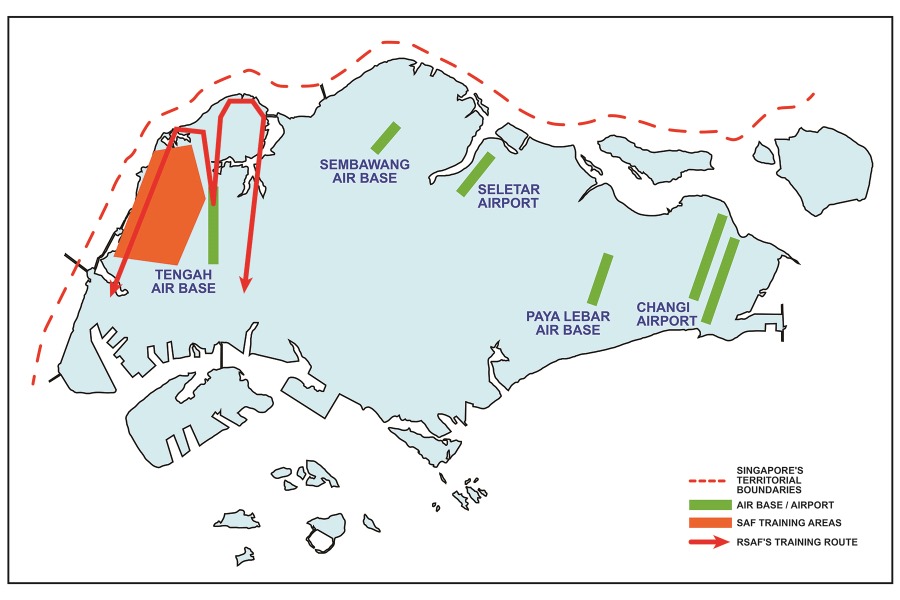
Seletar Airport is a very different beast. Located in the northeast, it was redeveloped in the 2010s into a business aviation hub, anchored by the Seletar Aerospace Park. Scheduled turboprop services that once used the airport have since shifted to Changi; today, Seletar primarily handles private jets, charter flights, and general aviation. The aircraft are smaller, the movements are fewer — but the flight paths are often lower and closer to homes.
Seletar's single runway sits just a few kilometres from some of Singapore's most sought-after landed housing in the Upper Thomson, Florence, and Seletar Hills areas. Its traffic also passes over parts of Sengkang, Punggol, Yishun, and Ang Mo Kio depending on the circuit pattern. Residents there deal with a different kind of noise: not the deep rumble of a heavy jet, but the higher-pitched buzz of turboprops and light jets at lower altitudes.
| Airport | Primary Traffic | Aircraft Types | Operating Pattern | Main Noise Footprint |
|---|---|---|---|---|
| Changi | Commercial passenger airlines | Wide-bodies, narrow-bodies, regional turboprops | 24 hours, ~1,000 movements/day at full recovery | Eastern estate: Tampines, Pasir Ris, Bedok, Simei, Tanah Merah; offshore during east ops |
| Seletar | Business aviation, charters, training | Business jets, turboprops, general aviation | Largely daylight hours, far fewer movements | Northeast: Sengkang, Punggol, Yishun, Ang Mo Kio; landed estates near the runway |
The two airports also differ in how the noise arrives. Changi produces relentless rhythms — a wave every few minutes during peak banks. Seletar produces random interruptions — a quiet hour, then a jet suddenly spooling up. For homebuyers, the distinction matters, because the two noise profiles test tolerance in completely different ways.
The Flight Path Discount: How Aircraft Noise Affects Home Prices
Here's the central economic fact: all else being equal, a home under a flight path should cost less than the identical home a few streets away. The mechanism is simple. When a listing has planes overhead, the number of people willing to buy it shrinks. Sellers who want to move on have to price the home to attract the smaller pool — and that gap is what property analysts call the noise discount.
International studies of large airports repeatedly find that homes in high-noise zones sell for measurably less than comparable homes elsewhere. Research around major hubs — Frankfurt, Heathrow, Schiphol and others — has documented discounts of a few percent in moderately exposed areas and double-digit gaps in the noisiest zones, especially when noise exposure is both loud and persistent. The exact figures vary by airport, by how noise is measured, and by how strong the local housing market is, but the direction of the effect is one of the most consistent findings in property economics.
Singapore is no exception. Look closely at transaction data in eastern districts, and you'll see the pattern: two similar condos, similar age, similar size and finishes, but one faces the flight vector while the other sits behind a block or a ridge. The one under the path almost always changes hands at a lower price per square foot, and it typically stays on the market longer before finding a buyer.
The visible effects of the flight path discount include:
- Lower psf prices for units whose balconies or bedrooms face the approach/departure vector, compared with same-project units shielded by the building itself.
- Longer marketing times for exposed units, especially down-facing units without sea views to compensate.
- Sharp price psychology at peak noise hours — a unit that is "fine" at 10 a.m. on a Sunday showing may feel like a different product at 6 a.m. on a weekday.
- Wider negotiation margins — buyers who are willing to tolerate noise have unusual leverage, because most competitors have already filtered themselves out.
But here's the nuance: the discount isn't a straight line. It depends on a mix of factors that interact with the noise itself:
- Amenity offsets. A unit under the flight path in Pasir Ris might also face the sea or the park. The noise is paid down, but the view adds back some value. The net price depends on which effect is stronger.
- Building design. Newer developments near airports are often built with double-glazed windows, heavier external walls, and air-conditioning that allows residents to seal themselves off. Ten metres of good glazing can do more for a bedroom than 50 metres of distance.
- Micro-location. An exposed unit on the 12th floor hears more than an exposed unit on the 4th floor, because elevation catches the direct line of sound. But the 4th floor pays for it in other ways — lower light, street noise. The noise discount is embedded in a bundle of trade-offs.
- Market conditions. In a hot seller's market, discounts shrink because every buyer is less picky. In a slow market, they widen, because the small pool of tolerant buyers can haggle harder.
To see what this means in dollar terms, run a simple mental model. Suppose two comparable three-bedroom condos sit a kilometre apart, one under the flight path and one not. If the "quiet" unit sells for $1.5 million and the flight-path unit carries a noise discount of around 10 percent, the exposed unit trades near $1.35 million. That's a $150,000 difference — enough to cover stamp duty, a full renovation, or a large chunk of a down payment. That is the appeal of the flight path: for buyers who can tolerate the noise, the sky is literally the limit on how much value they can unlock.
Who Buys Under the Flight Path?
If the noise discount is so predictable, why would anyone sell into it — and who is buying? The answer to the first question is simple: life happens. Families outgrow a three-bedder, relocations force moves, and some owners simply decide they've had a decade of roaring skies and want the quiet side of the block. The discount is the cost of that exit.
The buyers who step in are a diverse group, but they tend to fall into a few clusters:
- Budget-conscious first-timers. For young couples stretching into their first condo, a 10 percent discount can be the difference between a 99-year leasehold unit in an out-of-centre location and a slightly older unit in a better location, or between a smaller floor plan and a genuinely spacious one. The flight path lets them buy "up" in terms of space and age, and the willingness to tolerate noise is effectively sweat equity.
- Investors and landlords. Properties near Changi enjoy a consistent stream of rental demand from aviation professionals — pilots, cabin crew, airport staff, and Changi Business Park workers. A unit that rents well but costs less to acquire translates to a higher rental yield. For this group, noise is simply a line item, not a dealbreaker.
- Sea-view hunters on a budget. The eastern coastline has some of the best sea views in Singapore, and a meaningful share of those views sit under the flight path. Buyers who want a sunrise over the water but can't stretch to a quiet, unobstructed view accept the trade-off.
- Landed house buyers near Seletar. In districts 26 and 28, the landed enclaves around Seletar Aerospace Park offer large plots and greenery at prices that sometimes undercut comparable landed areas farther west. The occasional buzz of a business jet is the price of a garden and a driveway in an increasingly landed-scarce market.
What unites these buyers is a single trait: they've priced the noise, rather than merely reacting to it. They visit the unit at multiple times of day. They check the runway configuration. They close the windows and listen. And critically, they plan to hold the property long enough for the discount to compound into equity.
There's also a psychological factor worth naming: habituation. Singaporeans who grew up in the east — in Tampines, Bedok, or Pasir Ris — often literally stop hearing the planes. A child raised under a flight path learns to sleep through the 7 a.m. departure bank. For those buyers, the discount is pure upside because the nuisance was never really there in the first place.
Changi vs Seletar: Two Versions of the Same Trade-Off
If you're comparing homes near the two airports, it's worth understanding how their noise profiles differ in practice. The words "near the airport" hide two completely different experiences.
Living under the Changi flight path means living with the sound of a major international hub. The planes are large — A350s, 777s, 787s, and A380s — and their engines dominate the soundscape. But because most operations take off and land over the sea, the noise near residential areas is often intermittent rather than constant. The worst spots are the ones that sit right at the end of the runway or directly under the departure track during west operations. There, the noise is loud enough to interrupt conversation if the window is open, and the low-frequency thrum of wide-body engines travels through walls more easily than you'd expect.
Living near Seletar is a different sensory experience entirely. Business jets and turboprops are quieter in absolute terms, but they fly lower and their flight paths are more variable. A turboprop can sound like a persistent lawnmower; a business jet doing circuits for training can pass over the same landed estate every few minutes for an afternoon. The movements are fewer, which can make each one more noticeable — an unpredictable noise intrudes on attention more than a predictable rhythm. And because Seletar's runway is close to residential land, the noise starts and ends abruptly rather than building from a distance.
| Factor | Changi Flight Path | Seletar Flight Path |
|---|---|---|
| Typical aircraft | Wide-body and narrow-body jets | Business jets, turboprops, light aircraft |
| Frequency | Very high — every few minutes at peak | Low to moderate — random interruptions |
| Altitude over homes | Higher, but long-duration engine noise | Lower, engines working hard to climb |
| Time of day | 24 hours, with overnight cargo and red-eye arrivals | Largely daylight hours, few night movements |
| Worst residential touchpoints | Tampines, Pasir Ris, Simei, Bedok, Tanah Merah | Sengkang, Punggol, Yishun, Ang Mo Kio, landed estates near the runway |
| Typical buyer reaction | "I'll get used to it" — or instant dealbreaker | "It's not that loud" — until the circuit training starts |
The different operational rhythms also correlate with a difference in market behaviour. Changi-adjacent homes have a larger potential owner pool, because commercial aviation noise is a familiar, widely understood fact — and because Changi is essential to Singapore's economy, the noise is unlikely to go away. Seletar-adjacent homes, by contrast, exist with a quieter state of affairs that could change as the aerospace park grows — which raises a question we'll come back to: what if the noise gets worse?
What the Next Decade Brings: Quieter Skies or More Planes?
Buying near an airport is a wager on the future, and Singapore's next decade is full of both directions of that wager.
Begin with the most obvious driver: traffic recovery and growth. Changi handled a record 68.3 million passengers in 2019, collapsed to a pandemic-era low of just 3.0 million in 2021, and then roared back to 67.7 million in 2024 — essentially pre-pandemic levels. More passengers mean more planes, and more planes mean more noise.
Changi Airport Passenger Traffic (Millions)
The recovery isn't just a return to normal — it's a prelude to expansion. Changi's Terminal 5 and the wider Changi East mega-development are under construction, and when T5 opens in the mid-2030s, capacity will grow again. Newer generation aircraft are individually quieter, which helps at the margin, but airports don't grow quieter by adding flights — they grow louder, with the noise spread across more hours and more vectors. Anyone buying a "discounted" flight-path home today should assume that flight movements in 2035 will be near the top of historical ranges, not the bottom.
Offsetting that growth is one of Singapore's most interesting property stories: the relocation of Paya Lebar Airbase. For decades, the military airbase in the eastern-central region has produced its own noise footprint and, just as importantly, imposed height restrictions on buildings across a wide swath of the surrounding neighbourhoods. The long-planned plan is to shift the airbase's operations to Changi East around 2030, freeing up land and, in time, loosening the height limits that have capped redevelopment potential in areas like Paya Lebar, Geylang, and parts of the eastern corridor.
The implications for flight-path property are double-edged:
- On the west side, the closure of Paya Lebar Airbase means quieter skies over parts of the east and northeast that currently share the noise load. If the height limits are also relaxed, sites that were once capped at low-rise densities could be unlocked for taller, higher-value redevelopment. That's a potential long-term upside for owners in those areas.
- On the east side, Changi East absorbs more traffic, so the noise concentration at the eastern tip of Singapore — and along the approaches to the new runways — will likely persist, even if newer aircraft are quieter.
- Seletar, meanwhile, sits in its own world. Seletar Aerospace Park is a strategic industry cluster, and business aviation has quietly grown over the years. If the park continues to expand, the frequency of movements over the northeast could rise — but the aircraft involved are small enough that the noise never approaches Changi's scale.
What does this mean for buyers making the trade-off today? It sharpens the importance of location within the noise map. A unit near the former Paya Lebar airbase has a genuinely different long-term trajectory from a unit sitting right at Changi's runway threshold. The former may converge toward "regular city home" pricing as the airbase closes and redevelopment unlocks; the latter will always carry a flight-path premium discount, because the runways are not moving.
Smart Ways to Buy Property Near a Flight Path
If you're comfortable with the trade-off — and the sections above have made clear that plenty of rational buyers are — here's how to buy a flight-path home like an analyst rather than a gambler.
1. Visit at the wrong times. The most important viewings are the inconvenient ones: weekday mornings between 6 a.m. and 9 a.m., and weekday evenings between 5 p.m. and 8 p.m. Those are the peak departure banks. If the unit is bearable at 7 a.m., it's bearable, period.
2. Learn the runway configuration. Understand that Singapore's wind patterns mean west operations are more common during the northeast monsoon (roughly November to March). Ask to visit during a period of west operations, or check an aviation app to see the live arrival/departure direction. A unit that's quiet in June may be loud in January.
3. Check the unit's orientation against the flight vector. Two units in the same block aren't equally exposed. A unit whose bedrooms face away from the approach path, or whose service yard and kitchen absorb the noise, can be dramatically more liveable than a "matching" unit whose master bedroom balcony points straight at the vector. The discount may be identical while the actual quality of life is very different — that difference is where the value is hidden.
4. Inspect the windows and air-conditioning. Double-glazed windows and a functioning air-con system are the two most powerful noise mitigations in a tropical city. Open a window, close it, count the difference. If the unit has single-glazed frames slated for replacement, factor that cost into your offer.
5. Talk to the neighbours — and the agent. Ask residents how the noise changes across the year. Ask the agent which direction the planes take off in the current season. A few minutes of conversation will teach you more than an hour of data analysis.
6. Stress-test the resale bed. The flight-path discount is only a bargain if you can eventually exit. Ask: who would buy this unit in ten years? If the answer is "more people like me," the discount is structural and you'll recover it on the way out. If the answer involves an uncertain redevelopment story, treat the discount as money earned now, not guaranteed later.
Here's a decision flow that captures the core of the analysis:
7. Read the future flight plan. Before committing, check whether the area sits near a planned expansion, a new runway, or a reallocation of traffic. A unit near Changi East will probably not get quieter; a unit near a closing airbase very well might.
8. Negotiate, but don't gloat. Sellers know the noise is there; that's why the asking price already carries a discount. Use the technical details — the orientation, the seasonal runway changes, the glazing quality — to justify your offer, but don't pretend you've discovered something the seller hasn't already priced in. The negotiation is about the size of the discount, not its existence.
Food for Thought
Before you decide whether a flight path is your dealbreaker or your golden ticket, consider these questions:
-
How do you actually react to noise? Some people genuinely don't hear consistent background noise once they're absorbed in a film, a conversation, or a deadline. Others mentally count every overflight. Which one are you, and is your partner or family the same? The discount is worthless if the person sleeping in the master bedroom resents it every day.
-
Is the discount real, structural, or just temporary? Ask yourself what the noise discount is worth in your target area today — and what it will be worth after the next cycle. A temporary discount in a soft market can evaporate when demand returns; a structural discount under a permanent runway stays with you until you sell.
-
Could the noise trajectory change direction? The closure of Paya Lebar Airbase is a reminder that noise maps aren't permanent. Would you still feel good about your "cheap" purchase if the noise got quieter — and the discount slowly disappeared? Conversely, what if Changi's next expansion makes the planes louder, thicker, and more frequent?
-
What is your time horizon? The flight-path trade-off works best for buyers who plan to hold for five to ten years. If you're likely to move in two or three years, the transaction costs of buying and selling can eat the entire discount — and you'll be exposed to whatever the market thinks of noise at that exact moment.
-
Is the discounted price a bargain, or is the quiet unit actually the bargain? In a city where property is this expensive, paying full price for a peaceful home may be the smarter long-term play — peace is also a form of yield.
The flight path is one of those features of Singapore property that never stops dividing buyers. For every family that walks out of a Tampines viewing because a 777 banked overhead, there's a buyer who hears the same sound and sees a 10 percent price advantage, a sea view they could never otherwise afford, or a rental yield that pencils out just a little more sweetly.
Neither position is wrong. What matters is making the decision with eyes open — understanding which runways will be busy and when, which units are truly exposed and which are merely near the noise, and what the next decade of aviation growth will do to the home you're buying today.