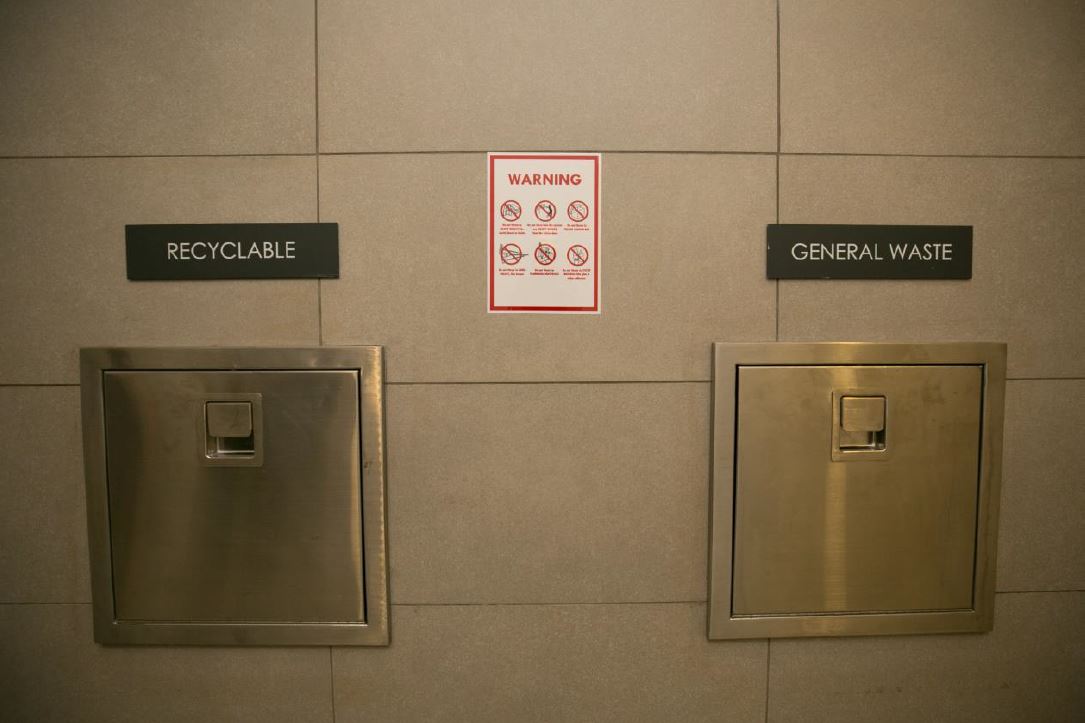
It’s 11pm on a Tuesday. The kids are finally asleep, you’ve just finished the last episode of your show, and there it is — a slightly damp bag of food waste sitting in the kitchen sink. In Singapore’s heat, it cannot wait until morning. For some households, this is a 20-second ritual: open the little metal door in the wall, drop the bag, done. For others, it means pulling on slippers, grabbing the keys, stepping out into the common corridor, and hoping you’re decent enough for a neighbour sighting at that hour.
That single difference — where the rubbish chute sits and how well it works — is one of the most under-appreciated quality-of-life variables in Singapore housing. We obsess over floor plans, square footage, resale value, and the distance to the MRT, yet the humble rubbish chute quietly shapes your daily routine, your war against cockroaches, your kitchen’s hygiene, and even your experience of living in a flat day after day.
This guide breaks down what every Singaporean buyer, renter, and homeowner should know about rubbish chute designs — from the corridor hoppers of 1970s HDB blocks to the no-chute luxury condos in the Core Central Region — and exactly what to inspect before you commit to a home.
Before we get to the checklists, though, it’s worth understanding the scale of the matter. Roughly eight in ten resident households in Singapore live in HDB flats, and there are more than a million HDB units spread across the island. Add condominiums and private apartments, and you have a country where almost everyone interacts with some form of shared waste infrastructure every single day.
Where Singapore's Resident Households Live (%)
The rubbish chute is one of the few features in a home that you cannot change easily, no matter how much renovation budget you have. You can hack the kitchen, knock down a wall, or redo the bathrooms. But unless the block is undergoing a major upgrading programme, the chute is going to stay exactly where the original designers put it — which is why getting it right at the viewing stage matters so much.
Why the Rubbish Chute Deserves More Than a Glance
Most viewing checklists don’t include the rubbish chute. It’s easy to ignore, because it’s small, utilitarian, and frankly a little unpleasant. But consider everything it actually determines.
First, there’s the convenience tax — the invisible cost of every trip you make to dispose of waste. If the chute is inside your unit, throwing away a bag of rubbish takes seconds and requires zero social interaction. If the chute is in a common corridor, you need to unlock your door, step out, and potentially bump into neighbours while clutching last night’s fish bones. If the chute is at the end of a long corridor in a condo, you may find yourself planning your rubbish runs around your outfits.
Second, there’s hygiene. In-unit chutes keep waste out of common living spaces and away from your front door. But a chute that is poorly sealed, rusted, or located right in your kitchen can also become the weakest link in your home’s hygiene story.
Third, there’s pest control. Chutes are essentially vertical highways for cockroaches, flies, and occasionally rats. The design of the chute — where the hopper is, how well it seals, where the bin chamber sits — determines how likely you are to welcome uninvited guests.
To understand all this, it helps to know what exactly a rubbish chute is and how it works. The basic anatomy is simple:
Every chute system has the same skeleton: a hopper door where you drop waste, a vertical shaft that carries it down, and a bin chamber where the refuse collects for removal. The variations — where the hopper is, who shares it, and how well the system is maintained — are what separate a pleasant home from a pest-filled nightmare.
A Short History of Throwing Things Away
The story of the rubbish chute in Singapore is really the story of how the country’s public housing evolved from basic shelter to one of the most sophisticated housing systems in the world.
In the earliest HDB blocks of the 1960s, there were no chutes at all. Residents carried their refuse down to communal collection points, often in buckets and pails. If you lived on the 10th floor, that meant a lot of stairs or a long wait for a lift. This was the "bucket system," and it was as inconvenient and unhygienic as it sounds.
As HDB ramped up construction in the 1970s, the refuse chute became a standard feature of new blocks. In these older flats — the classic Model A designs of the 1970s and 1980s — the chute hopper was placed along the common corridor, often in a recessed niche between two units or near the lift lobby. Residents would step out of their flat to dispose of waste. This was a huge improvement over carrying rubbish downstairs, but it had downsides: corridors could smell, hoppers were shared, and there was always the awkward moment of meeting a neighbour while holding a bag of rubbish.
Then came a significant design shift. From the late 1980s and through the 1990s, HDB began to move the chute inside the flat, usually into the kitchen or the service yard. The "Improved" and "New Generation" flats of that era were the first to popularise this layout, and by the 2000s it had become the default for new BTO flats. The reasoning was straightforward: residents should not have to leave the security and comfort of their home to dispose of waste. This was a major upgrade in convenience, though it created a new set of challenges — namely, having a waste-disposal opening in one of the busiest, most food-heavy areas of the home.
Meanwhile, the private condo market took its own path. Many mass-market condos built from the 1990s onward installed in-unit chutes in the kitchen or utility yard, similar to HDB flats. Others, particularly mid-range developments, adopted the per-floor chute room — a small communal room on each level with a common hopper for four to eight units. And many high-end, luxury developments in prime districts abandoned the chute entirely, requiring residents to bag their waste and bring it to a central bin centre on the ground floor, or to leave it for daily housekeeping collection. Some ultra-luxury projects treat waste disposal almost as a concierge service.
The evolution continues. In HDB’s newest town, Tengah, the "Forest Town" has been built with a pneumatic waste conveyance system — a centralised network of underground pipes that sucks rubbish from collection points to a central plant, doing away with the conventional per-floor chute. It’s a glimpse of a future where the rubbish chute as we know it might disappear altogether.
The Four Chute Designs You’ll Meet in Singapore
If you’re looking at a range of properties — an older resale HDB, a newer BTO, a suburban condo, and a premium freehold development — you will encounter four main chute architectures. Each has its own trade-offs, and none is universally "best." It all depends on your lifestyle.
| Design | Where You’ll Find It | How It Works | Pros | Cons |
|---|---|---|---|---|
| Common corridor chute | HDB flats from the 1970s–1980s | Hopper recessed in the common corridor, often shared between two units | Keeps waste out of the home; no smell inside the flat; simple design | Must step outside to dispose; shared with neighbours; corridor can smell; pest risk in common areas |
| In-unit chute | Newer HDB flats (1990s+), many mass-market condos | Hopper inside the kitchen or service yard, shaft descends through the block | Maximum convenience; private; ideal for late-night disposal; great for families with young children | Takes up wall space; can attract cockroaches near food prep; smell can enter the kitchen if seal fails |
| Per-floor chute room | Many condos, especially mid-range and older private developments | A small common room on each floor with a hopper for a cluster of units | No chute inside your home; walk is short; often better maintained than HDB corridor chutes | Shared risk of misuse; if a neighbour dumps wet waste, the whole floor suffers; need to remember keys or a code |
| No chute / central bin centre | Luxury condos, some boutique projects, latest eco designs | Residents bag waste and bring it to a central bin centre or pneumatic inlet point; some have daily collection | No pests in the building shaft; no smell near the unit; premium feel; encourages recycling | The walk can be long; no "2am drop" convenience; you must plan waste disposal; a real chore for daily cooks |
The Common Corridor Chute: Old School but Functional
If you’ve viewed 1980s HDB flats, you’ve seen this design. The hopper is usually a metal door set into the corridor wall, often located between two units. In many blocks, the chute is positioned near the lift or stairwell landing, which means residents in adjacent units share the same hopper.
The biggest advantage of this design is that waste never enters your living space. The smell, the flies, and the visual unpleasantness stay outside your front door. That’s a genuine benefit that many younger buyers overlook when they insist on "modern" layouts.
The disadvantages are equally real. You need to leave your flat every time you dispose of rubbish — which, for a family with young children, can be a nightly negotiation. The corridor hoppers in older blocks are often rusted, poorly sealed, or chipped. And because they’re shared, the level of cleanliness depends on your neighbours. One person who dumps liquid waste into the chute can make the corridor smell for days.
From a security perspective, corridor chutes also mean frequent trips outside, which is something single residents and elderly homeowners have flagged over the years. And if you are on a higher floor, the shaft is shared by all the units above you, which increases the potential for clogs and odour.
The In-Unit Chute: Maximum Convenience, With a Catch
From the 1990s onward, HDB designers moved the chute into the home, usually placing the hopper in the kitchen or service yard. In many newer BTO floor plans, you’ll see the chute tucked into the yard or utility area, sometimes behind the kitchen cabinet. The convenience is unmatched: you can dispose of a bag of rubbish while the kettle boils, and you never have to worry about what you look like in your pyjamas.
But the in-unit chute creates a different set of issues. First, it’s located where you prepare and consume food. If the rubber gasket on the hopper is worn, you will feel a faint draft of warm air from the shaft — and so will the cockroaches. Second, the chute shaft is common property. You can scrub your own hopper until it gleams, but if the shaft itself is dirty or clogged, the smell will seep into your unit.
Third, there’s the space question. The chute and its surrounding wall take up useful cabinet or yard space. In some flats, the chute is positioned in the service yard, which means you lose about half a metre of wall along a narrow space that already has to accommodate your washing machine and dryer. Some homeowners have chosen to seal off a disused in-unit chute during renovations — though you should always check with the town council or MCST before doing so, as the shaft remains common property.
The Per-Floor Chute Room: A Middle Path
Many condominiums — particularly those built in the 1990s and 2000s — adopted a design where the chute is not inside your unit but is not in the open corridor either. Instead, there’s a small chute room on each floor, usually tucked near the lift lobby or service staircase. Each room typically has a hopper or a bin point for a small cluster of units.
This design offers a reasonable balance. Waste stays out of your home, but the disposal point is close enough that a quick trip feels manageable. Because the room is enclosed, smells are contained, and the MCST can keep it cleaner than an open corridor hopper.
The downside is that you’re still dependent on the behaviour of your floor-mates. A chute room can turn into a mini dump if residents dispose of bulky items, construction debris, or unbagged waste. And if the room is positioned far from your unit — say, at the opposite end of a long corridor — the convenience quickly evaporates.
No Chute at All: The Premium Approach
In many luxury condominiums, especially in the Core Central Region, you simply won’t find a rubbish chute. Residents bag their waste and bring it down to a central bin centre, often located near the loading bay or basement. In some premium projects, a housekeeping team visits each unit daily to collect waste placed at the door — a service that aligns with the hotel-like positioning of these developments.
This no-chute approach is arguably the most hygienic. There is no vertical shaft running through the building for pests to travel. There is no hopper in your kitchen to leak odours. Waste leaves your home in sealed bags and is handled by management.
The trade-off is discipline. You cannot dispose of a small bag of rubbish at 2am without leaving your unit and walking to the bin centre. For daily cooks, families, and people who produce a lot of packaging, the walk becomes part of the routine. Some buyers genuinely love it — they say it feels cleaner and more controlled. Others find it a deal-breaker, especially those coming from HDB flats where the chute was always five steps away.
The Pest and Hygiene Factor: Why Chutes Can Be Cockroach Expressways
If you ask any pest-control operator in Singapore what the most common breeding route in a high-rise flat is, the rubbish chute will be near the top of the list. The vertical shaft is dark, warm, humid, and frequently contains food residue. It is, in other words, a cockroach’s idea of a five-star highway.
Pests enter units in three ways through a chute. First, through gaps in the hopper seal — if the rubber gasket is cracked or missing, cockroaches can slip out at floor level. Second, through the shaft itself, particularly if the chute has openings or access panels on other floors. Third, through rooted pests from the bin chamber — if the bin chamber is not cleaned regularly, flies and cockroaches can migrate upward through the shaft over time.
Rat problems, though less common, are also linked to poorly maintained chutes. Rats can enter the bin chamber from outside and, if there are maintenance-access doors within the shaft, they can climb several floors. The risk is elevated in older blocks where the chute system has deteriorated.
Maintenance is the dividing line between a well-behaved chute and a problem child. For HDB flats, the town council is responsible for the common chute and bin chamber. Chute hoppers in older blocks are often replaced during the Home Improvement Programme (HIP), which targets flats that are around 30 to 40 years old. That is why you’ll sometimes see a block from the 1980s with gleaming new hoppers — definitely a positive sign.
For condos, the MCST (management corporation) is responsible for the chute system, and the quality of maintenance varies dramatically between developments. A well-managed condo will clean the chute rooms daily and inspect the shaft regularly. A poorly managed one will ignore the chute until residents complain about smells.
Signs that a chute is not being maintained properly include:
- Visible rust, chipped paint, or dents on the hopper door
- A hopper that does not close fully or lacks a functioning spring
- A worn or missing rubber gasket around the hopper opening
- Stains or residue around the hopper frame
- A persistent smell even when the hopper is closed
- Flies or ants near the hopper, inside or out
- Signs of liquid leakage down the wall below the hopper
- Clogged chute notices or lidded bins placed nearby due to repeated blockages
| Red Flag | What It Means | How Serious Is It? |
|---|---|---|
| Rusted or dented hopper | Ageing chute, possibly nearing replacement | Moderate — easily fixed with a new hopper |
| Worn rubber gasket | Pests can enter; smells may escape | High — directly affects hygiene |
| Hopper doesn’t shut properly | Same as above, plus potential safety issue | High |
| Stains around the frame | Liquid waste being dumped into the chute | Moderate — behaviour issue among residents |
| Persistent smell when closed | Worse seal, dirty shaft, or debris stuck in the shaft | High — investigation needed |
| Clogging notices | The shaft is regularly blocked, indicating heavy misuse | High — likely a long-term problem |
The golden rule of chute hygiene is simple: only bagged, dry, compact waste should go down the chute. Liquids, bulky items, glass, and anything with strong odours should be disposed of elsewhere. The challenge is that you can’t control what your neighbours do — which is why the overall condition of the chute system is a better predictor of future problems than the condition of your own hopper alone.
Rubbish Chute Checklist: What to Inspect Before You Buy
When you visit a flat, spend five minutes on the chute. It could save you months of frustration later. Here’s a practical, room-by-room checklist.
1. Locate the Chute Early
During a viewing, ask the agent exactly where the chute is before you even look at the kitchen. If it’s outside the unit, measure the walking distance from your front door. If it’s inside, note which room it’s in and whether it’s near the cooking area, the washing machine, or a sitting area.
The chute’s location matters more than most buyers think. A chute inside the service yard is convenient but can make a narrow yard feel cramped. A chute in the dry kitchen keeps waste far from the wet areas but introduces a small odour risk into a space where you entertain guests.
2. Do the Seal Test
Open the hopper slowly and observe how it moves. Does it glide, or does it scrape? When you release it, does the spring pull it shut firmly, or does it hang slightly open?
Then check the gasket. Run your finger along the rubber seal (yes, it’s slightly gross, but it’s worth it). If the seal is brittle, cracked, or missing chunks, the chute will leak odours and admit pests. Replacing a hopper gasket is a cheap fix, but if the entire hopper is rusted, you may need to budget for a full replacement — and in some older blocks, that could involve the town council.
3. Sniff Test
This is the most revealing test you’ll do. Stand near the hopper with it closed. If you smell anything more than a faint, neutral scent, the seal is compromised or the shaft is dirty. Then open the hopper and sniff again. A well-maintained chute should smell of nothing much at all. A chute that smells like last week’s curry has a problem that will not go away with a lick of paint.
4. The Dry Run Test
Rip a small piece of tissue paper (a few centimetres square is enough) and drop it down the chute. Listen as it falls. You want to hear a clean, uninterrupted drop to the bottom. A thud, a pause, or no sound at all could indicate a partial clog. A faster, resonant drop suggests the shaft is clear and in good condition. This tiny test takes ten seconds and tells you more about the chute than any amount of staring at the hopper will.
5. Inspect the Surrounding Area
Look at the walls and floor around the chute. Are there stains, streaks, or peeling paint? Is the area unusually clean compared to the rest of the block? That could indicate recent maintenance work — generally a good sign. Conversely, if the area is sticky or littered, it suggests the system is not well cared for.
If the chute is in the corridor, check the corridor itself. Are there rubbish bags left outside units? That is a red flag — it means neighbours treat the chute as an optional convenience. Also check whether the chute hopper is recessed into the wall or protruding. Recessed designs are less likely to be knocked by passers-by and generally age better.
6. Find the Bin Chamber
Ask where the bin chamber is located. On the ground floor, it’s usually a small room at the base of the chute shaft. If you can, take a look at the outside of the chamber door. Is the area around it clean? Does it smell? The bin chamber is where waste sits until collection, and its condition tells you a lot about the town council or MCST’s priorities.
For condos, also ask how often the chute system is cleaned and whether the MCST has had recent pest-control treatments. This is a fair question during due diligence, and the answer will tell you how the management views the building’s health.
7. Check for Recycling Provisions
Some newer BTO projects and condos have introduced separate recycling arrangements — either a dedicated recycling chute, a central recycling bin room on each floor, or a larger recycling centre at the ground level. If recycling matters to you, check whether the design encourages it. A unit with a chute but no nearby recycling point will quietly erode your good intentions every single week.
8. Ask About Upgrades
For older HDB flats, ask whether the block has undergone HIP or the Enhanced HIP. These programmes renew ageing components, often including the replacement of pipes and chute-related fittings. A block that has been through HIP recently is likely to have a much healthier chute system than one that hasn’t.
How the Chute Fits Into Your Lifestyle (and Resale Value)
The "best" chute design depends heavily on who you are. Let’s match designs to lifestyles.
Families with young children. For parents, the in-unit chute is usually the winner. Disposable diapers, half-eaten meals, and food scraps need to disappear immediately, ideally without leaving the flat and risking a wake-up call. Many parents we’ve spoken to describe the in-unit chute as a genuine sanity-saver during the early years. Conversely, a corridor chute means one more reason to leave the safe confines of the home with a baby monitor in hand.
Elderly homeowners and those with mobility issues. The in-unit chute is also a strong preference here. Trips to a corridor hopper, or worse, a central bin centre, present fall risks and physical strain. If a senior is buying or ageing in place, the chute location is not a trivial detail — it’s a safety feature.
Daily cooks. If you cook most meals at home, you produce wet, pungent waste on a daily basis. The convenience of an in-unit chute is appealing, but the hygiene risk matters more. You’ll want a chute with a strong seal, ideally positioned away from your main food-prep zone. Some cooks prefer the corridor chute precisely because it keeps food waste out of the kitchen entirely.
People who are rarely home. If you eat out most of the time and produce minimal waste, the chute design barely matters. A central bin centre or chute room in a condo is perfectly fine, since you’ll only visit it twice a week at most. This is a case where you can let the surrounding building amenities, rather than the chute, drive your decision.
Pest-sensitive buyers. If the sight of a cockroach sends you running, prioritise a sealed in-unit hopper in good condition, or a no-chute condo design with a strong maintenance regime. The chute shaft is the single biggest pest corridor in a high-rise building, so a clean, modern, well-sealed system is non-negotiable.
Does the Chute Affect Resale Value?
In direct valuation terms, the condition of the rubbish chute rarely moves the price of a unit on its own. But it plays a supporting role in two ways.
First, a visibly unhealthy chute tips buyers into a broader distrust of the block’s maintenance. If the chute looks neglected, buyers will assume the town council or MCST neglects other things too — lifts, corridors, lighting, landscaping. In resale negotiations, this can shave a meaningful amount off your asking price, or at least give the buyer leverage for a discount.
Second, chute design influences which buyers your unit appeals to. A corridor-chute 1980s flat in an otherwise excellent location might be passed over by families who insist on in-unit disposal. Conversely, a no-chute luxury condo unit will appeal to buyers who value cleanliness and premium service over midnight convenience. The chute effectively filters the buyer pool, which matters when you list your home years down the line.
There is also the negotiation angle. If you’re the buyer and the hopper is rusted or the seal is failing, use it. A hopper replacement is not expensive, but getting the seller to either fix it or knock a small sum off the price sends a signal that you’ve done your due diligence. It tells the seller you’re not the kind of buyer who misses details — and that alone can be worth more than the repair cost.
One more thing to consider: for renters, the chute is a liveability factor that becomes obvious within a week. Landlords who want long-term tenants should make sure their chute is in good working order, because nothing accelerates a lease turnover faster than a tenant discovering that the chute smells or the hopper doesn’t close properly.
Food for Thought
-
The midnight test. When you view a flat, ask yourself: if you needed to dispose of a bag of rubbish at 11pm tonight, how would you feel about the walk? Would you do it in your sleep, or would you put it off until morning and regret it?
-
Imaginary neighbours. You can control your own waste habits, but not your neighbours’. If the chute is shared, how much do you trust the other households on your floor? A condominium chute room is only as clean as the messiest resident.
-
The renunciation question. If you found your dream flat in every other way — perfect layout, great price, ideal location — but the chute was in the corridor and slightly weathered, would you walk away? Or would you accept it as a quirk of an older block?
-
The future of waste. With pneumatic systems arriving in Tengah and more developments moving toward centralised collection, do you think the rubbish chute will eventually go the way of the telephone landline? How would that change your buying preferences?
-
The kitchen placement dilemma. If an in-unit chute guarantees convenience but sits close to where you cook and eat, does the hygiene trade-off bother you? Where, ideally, would you want the hopper in your own home?
These questions aren’t trivial. The answers shape how much friction you live with every single day — and that friction is exactly the kind of thing we tend to underestimate before moving in.