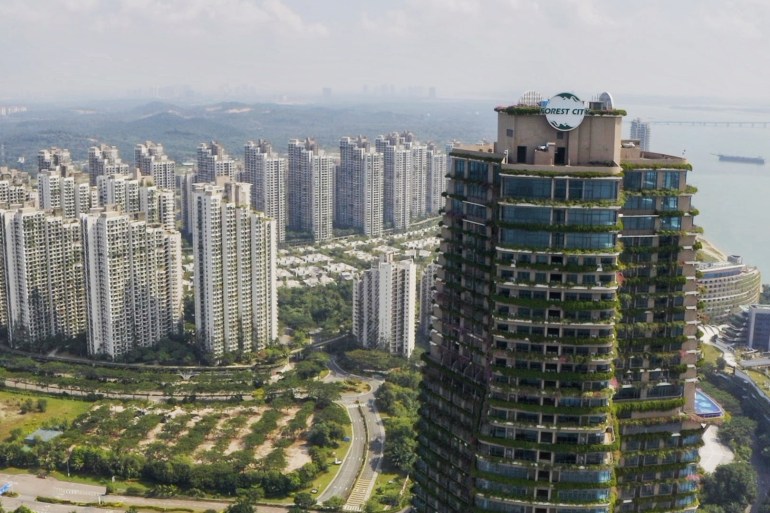
Drive across the Second Link from Singapore into Johor and you'll see it before you clear immigration: a cluster of gleaming towers rising out of the sea, a skyline that looks like it was airlifted onto the water and never quite finished. This is Forest City Johor — a project once billed as a "millionaire's paradise" and backed by a reportedly US$100 billion investment from Chinese developer Country Garden. A decade after construction began, the towers are real, but the city inside them remains half-empty. Empty corridors, shuttered retail bays and units resold at deep discounts have turned Forest City from an emblem of ambition into one of the most closely watched cautionary tales in Asian real estate.
This article revisits the project with fresh eyes: how it rose so fast, why it fell so hard, and whether its reinvention as a special financial zone — riding on the Johor-Singapore Special Economic Zone (JS-SEZ) — can finally fill the towers with life.
The Vision: A City Built on Water
Forest City was never meant to be a modest development. Announced in the early 2010s by Country Garden, one of China's largest private developers, the project's plan was breathtaking: four artificial islands reclaimed from the Johor Strait, totalling roughly 14 square kilometres — an area comparable to about 2,000 football pitches — connected by bridges and ringed by waterfront promenades. Positioned just two kilometres from Singapore's Tuas side, the project leaned heavily on its proximity to the city-state.
The masterplan was equally grand. A planned population of 700,000 residents, luxury condominiums, offices, hotels, an international school, a shopping mall and a marina were all drawn up in glossy renders. The project's signature "forest" branding promised green walls, sky gardens and a "city in a garden" concept that felt distinctly Singaporean — deliberately so, because the intended audience was partly Singaporean too.
| Key Fact | Details |
|---|---|
| Developer | Country Garden (Guangdong, China) |
| Total investment | Reportedly US$100 billion |
| Land area | ~14 km² across four artificial islands |
| Planned population | 700,000 |
| Distance from Singapore | ~2 km from Tuas, via the Second Link |
| First phase launched | 2016 |
| Current status | Phase 1 largely built; later phases uncertain |
The developer's timeline tells the story of a project that moved at extraordinary speed — and then collided with reality.
The Rise: Forest City, the Millionaire's Paradise
In its early years, Forest City sold like a financial product rather than a piece of real estate. Country Garden set up sales galleries across China — media reports suggested sales offices in dozens of cities — and dispatched armies of agents to court wealthy Chinese buyers with promises of an international, English-speaking enclave a stone's throw from Singapore.
The marketing was unapologetically aspirational. "Millionaire's paradise" was the tagline that stuck, and it worked. Reports from the period describe launch events where units were snapped up within hours. Early phases reportedly went for RM 1,500 to RM 2,500 per square foot — pricing that sat comfortably above many parts of Johor Bahru and closer to the lower end of Singapore's suburban condo market.
Who bought? Published accounts suggest the majority of early buyers were mainland Chinese nationals, followed by Singaporeans and Malaysians. For Chinese buyers, Forest City offered a rare combination: proximity to Singapore, no language barrier, and a lifestyle product that could be bought offshore. For Singaporean investors, the appeal was different. With Additional Buyer's Stamp Duty (ABSD) making second properties in Singapore punishingly expensive, Johor — and Iskandar Malaysia more broadly — became the default outlet for cross-border property bets. Forest City was the flashiest option in that outlet.
Even the broader economics seemed to support the story. Iskandar Malaysia, the regional economic corridor launched in 2006, had attracted billions in investment. Singaporeans were already commuting into Johor for cheaper goods, and a new rapid transit link was being discussed. Forest City positioned itself as the luxury apex of this cross-border boom — a city that would not just house commuters but create its own economy of wealthy residents, retirees and global talent.
At its peak, the project was reportedly generating billions in sales, and Country Garden's leadership spoke openly of building a "third Dubai" on the Johor Strait. For a few years, the future looked like the renders.
The Fall: What Went Wrong at Forest City
The fall was not a single event but a sequence of blows — some external, some self-inflicted. No single factor emptied Forest City; rather, its business model depended on a pipeline of foreign capital and cross-border movement that was severed from multiple directions.
China's Capital Controls (2017)
The first and arguably most damaging blow came from Beijing. In August 2017, China's government moved decisively to curb capital outflows, restricting how much money citizens could move out of the country and explicitly discouraging overseas property purchases. For Chinese buyers who had committed to Forest City units with staged payments, this was catastrophic. Many simply could not remit funds for their next instalment; some reportedly walked away from deposits, while others defaulted on payments already made.
Forest City's sales engine was built on Chinese demand. When that engine stalled, the project lost its primary market almost overnight.
Malaysia's Political U-Turn (2018)
The second blow came from the Malaysian side. In May 2018, Malaysia's opposition coalition won a historic election, ending six decades of Barisan Nasional rule and bringing Mahathir Mohamad back as Prime Minister. The new government took a hard look at Chinese mega-investments, and Forest City became a headline target.
Mahathir publicly expressed concern that the project would create a "foreign enclave" in Malaysian waters. Reports followed that his government would not grant long-term residency visas to Chinese buyers at Forest City — a policy that gutted the project's promise of a live-in community rather than a speculative one. Foreign purchase rules, which already required minimum prices for overseas buyers (RM 1 million in Johor), further complicated the picture.
The damage was as much psychological as regulatory. Forest City's brand had been built on certainty — a safe, luxurious home base for global Chinese capital. The new government's rhetoric shattered that certainty.
Oversupply and Location Realities
Even before the policy shocks, economists and property analysts had warned that Iskandar Malaysia was building far more homes than jobs. Tens of thousands of condominium units across Johor were completed around the same time as Forest City's first phases, creating a flood of supply. Forest City's specific location — beside the Second Link rather than in Johor Bahru's city centre — left it awkwardly positioned: too far from the amenities of JB, and not yet integrated with Singapore's economy.
Rental demand, which investors had assumed would come from expatriates and cross-border workers, never materialised at scale. The promised yields of 6-8% quickly looked impossible when actual rents were a fraction of projections.
COVID-19: The Final Nail (2020-2022)
If 2017 and 2018 wounded Forest City, the pandemic nearly killed it. When COVID-19 hit in March 2020, Malaysia closed its borders, and the Causeway — one of the world's busiest land crossings — became a wall. For two years, the Singapore-Johor economic corridor froze. The Chinese buyers who might have visited their units couldn't travel; Singaporean investors couldn't see their properties; service apartments sat empty.
The ghost-town narrative, which had been building since 2018, became universally known. International media ran helicopter shots of illuminated tower blocks with virtually no lights on in the windows. Forest City became a symbol of property speculation gone wrong.
Environmental and Reputational Damage
The project also carried heavy environmental baggage. Reclaiming 14 square kilometres of seabed in the Johor Strait destroyed mangrove forests and affected local fishermen's livelihoods, drawing protests and regulatory scrutiny. Reports of fines and stop-work orders further complicated the developer's position, while the endless cycle of negative press made it harder to attract even genuine end-users.
The Developer Crisis
Finally, the developer itself became a liability. Country Garden began missing debt payments in 2023, as China's property crisis engulfed even its largest builders. With the parent company fighting for survival, additional phases of Forest City were pushed into doubt. In early 2025, a Hong Kong court reportedly ordered the liquidation of Country Garden, leaving the project's long-term governance and maintenance uncertain.
The Numbers: Forest City Occupancy, Prices, and Rents
Behind the headlines, what does Forest City actually look like in data? The honest answer is that precise figures are hard to verify — there is no official census of residents, and estimates vary widely between the developer, the government and journalists. But a consistent picture emerges from published reports, property listings and agent interviews.
Occupancy
At its worst — around 2018 to 2019 — reports suggested that fewer than one in a hundred completed units were occupied. The "ghost town" label was not hyperbole; journalists documented entire floors without a single sign of life. By 2020 and 2021, the pandemic kept occupancy near negligible levels. A slow recovery began after borders reopened in 2022, and by 2024 some press reports and property agents estimated that roughly one in five units on the main island (Island 1) showed signs of habitation.
The chart below shows the trajectory as the midpoint of published estimates, from various news reports and property agent commentary.
Reported Occupancy at Forest City, Island 1 (%)
Even the higher recent estimates mean more than 80% of units on Island 1 are still unoccupied — a stark reminder of how far the project remains from its original vision.
Prices
The price story is equally brutal. Taking launch prices as an index of 100, typical resale values by 2023 were reportedly trading at roughly 40-50% below launch levels, with distressed sales and bank auctions going even deeper. Some units purchased at RM 1 million or more at launch were being offered at RM 500,000 to RM 600,000 by the early 2020s, according to property listings cited in the press.
Forest City Price Index: Reported Resale vs Launch (Launch = 100)
The pain is compounded by the structure of the purchase. Many early buyers paid in instalments over several years; by the time they completed, the market value of their unit was below the total amount they had paid. For investors with debt, forced sales at the bottom of the market locked in catastrophic losses.
Rents
Rents tell a similar story, though with a silver lining for tenants. At the pandemic trough, published listings showed two-bedroom units offered for as little as RM 1,500 per month, with some studios reportedly going for under RM 1,000. Those rents have since recovered somewhat as the SEZ narrative and modest occupancy gains returned, but they remain far below the levels needed to justify the purchase prices investors originally paid.
Reported Monthly Rent, 2-Bedroom Unit (RM)
For context, RM 1,500 a month is less than the mortgage on a shoebox unit in Singapore — and it buys a full-size two-bedroom apartment in a branded, waterfront, guard-gated development. The rental figures make Forest City an exceptional deal for tenants and a painful one for landlords.
| Year | Reported Occupancy | Reported Price vs Launch | Key Context |
|---|---|---|---|
| 2018 | ~1% | Near launch, but sales frozen | China capital controls; Malaysia policy shift |
| 2020 | ~3% | 20-30% below launch | COVID border closure; distressed listings |
| 2022 | ~8% | ~40% below launch | Borders reopen; ghost-town narrative peaks |
| 2024 | ~15-20% | 40-50% below launch | JS-SEZ momentum; financial zone incentives |
The Pivot: Forest City as a Financial Zone
Just as Forest City seemed destined to remain a cautionary tale, policy intervened. In January 2024, Malaysia and Singapore signed a memorandum of understanding on the Johor-Singapore Special Economic Zone (JS-SEZ), with the formal agreement following in January 2025. Forest City was named as one of the SEZ's designated nodes — alongside areas closer to the RTS Link, Johor Bahru city centre and the data-centre belt in Sedenak.
Then, in September 2024, Malaysia went further. The government announced a package of incentives for a new Forest City Financial Centre, reportedly including:
- 0% corporate tax for up to 10 years for qualifying businesses
- A 15% flat personal income tax rate for eligible knowledge workers
- Various stamp duty exemptions and fast-track approval processes
The strategy is transparent: turn the empty towers into a financial ecosystem that can attract family offices, fund managers and fintech companies — the same playbook other jurisdictions have used to create offshore finance hubs. The location, ironically, may finally work in Forest City's favour: it sits in a no-man's land between Malaysia and Singapore, close enough to the latter to serve as an overflow office, and now with the tax structure to justify the commute.
There are visible signs of life. Media visits in 2024 reported cafes and restaurants open on the ground floors, a running track in use, and more families in the lifts — a far cry from the empty corridors of 2019. Some international schools and healthcare operators have reportedly taken space. Residential occupancy, while still low, has drifted upward, and the remaining units for sale are being marketed not to Chinese speculators but to businesses and employees connected to the SEZ ecosystem.
Yet the pivot carries its own risks:
- Office oversupply is global. Even a 0% tax rate doesn't guarantee tenants if the building is in the wrong location.
- The developer is in liquidation. Maintenance, strata management and completion of promised amenities now depend on court-appointed liquidators and the Malaysian government's willingness to step in.
- Competition is fierce. Johor Bahru's central business district, the RTS Link precinct and other SEZ nodes are also courting the same investors.
- Habitability precedes office demand. Most knowledge workers want to live near amenities — schools, hospitals, restaurants — not just near a tax break.
The revival, in other words, is real but fragile. Forest City has gone from being a residential ghost town to a policy-backed experimental zone. Whether that experiment succeeds will depend on things no tax incentive alone can buy: jobs, connectivity and the slow accumulation of normal urban life.
Lessons for Singapore Buyers: What Forest City Teaches Us
Forest City is an extreme case, but its failure modes are instructive for anyone considering cross-border property — including Singaporeans who continue to watch Johor with renewed interest as the SEZ raises property prices across the causeway.
| What Went Wrong | Lesson for Buyers |
|---|---|
| Chinese capital controls stopped buyers' money | Policy risk exists on both sides of a cross-border purchase |
| Malaysia's 2018 government reversed visa policies | A host government's narrative can change overnight |
| Rents never matched sales projections | Verify current rental demand, not promises |
| Developer entered liquidation | Off-plan purchases carry developer solvency risk |
| Resale market was thin | Liquidity matters more than the "paper" price of your unit |
Each of these lessons is a checklist item for any overseas purchase:
- Never buy pre-sale at a premium. Launch prices tend to be the most expensive entry point; buyers are paying for the story, not the asset. Distressed resale, by contrast, prices reality.
- Stress-test policy risk. Ask what happens if the buyer's home country restricts capital, or if the host country restricts foreigners. If the answer breaks the investment case, the case was never sound.
- Demand is what rents, not what sells. A project can sell out and still be empty. Look for evidence of actual occupation, actual rents and actual transactions.
- Follow the developer's balance sheet. Grand showrooms can distract from leverage and liquidity.
- Know your exit. If every unit in the building is for sale and no one is buying, the "market value" on paper is imaginary.
The same discipline applies at home in Singapore. Data transparency is a luxury that Singapore property buyers often take for granted — transaction records, rental caveats and occupancy patterns are all available for scrutiny. Across the causeway, transparency is thinner, and the cost of learning that lesson is measured in tens of thousands of ringgit.
Food for Thought
-
Would a 10-year corporate tax holiday change your view of Forest City? If you were a fund manager, would you base a regional headquarters in a building where four out of five neighbouring units are empty — even at 0% tax?
-
If you had paid RM 1 million at launch and the market value was RM 500,000, would you sell or hold for the SEZ story? The answer says more about your time horizon than about the asset.
-
What would it take for you to live in a "20% occupied" city? A school, a grocery store, a clinic, a community? Or would the tax incentives of your employer be enough to move you there?
-
How much of Johor's current property recovery is real, and how much is narrative? The JS-SEZ, the RTS Link and the data-centre boom are genuine catalysts — but so were the promises of 2016.
-
Does Singapore's ABSD make you more or less likely to take on risk across the border? A tax saving at home should never be the reason to accept a poor investment abroad.
Conclusion
Forest City is not dead, but it is no longer the project its architects imagined. It is a monument to how quickly the world can change for a place built on borrowed capital and borrowed time — and a working laboratory for what it actually takes to build a city: not towers, but jobs; not renders, but residents; not tax breaks, but trust.