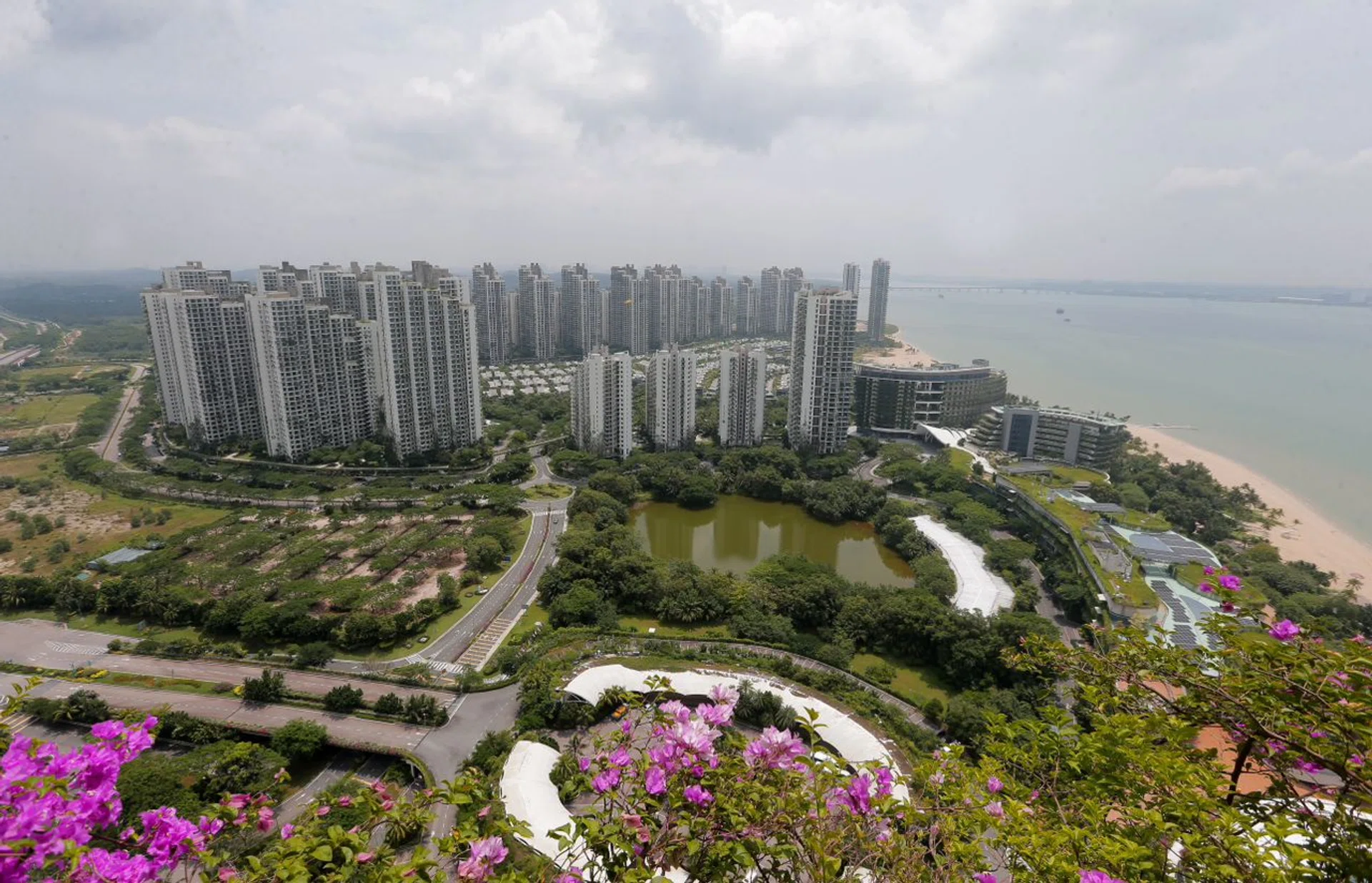
Free shuttle bus. A light lunch. A scale model the size of a tennis court, complete with tiny drones hovering over miniature towers. That was the Forest City sales experience in Singapore — an air-conditioned portal into a dream island city rising from the Johor Strait.
It worked. Through the late 2010s, thousands of Singaporeans put money down on one of the most aggressively marketed property projects Southeast Asia has ever seen: a reportedly US$100 billion, 30-square-kilometre "smart city" spread across four reclaimed islands, designed to house 700,000 people. To Singapore property investors, the pitch was almost irresistible — seaside condominiums a stone's throw from Tuas, at prices that could barely buy a studio flat in suburban Singapore.
Then the satellite photos came out. Row after row of dark towers, floating in the strait like a ghost fleet. The glossy renders met reality, and reality was empty. Forest City became the world's most famous property flop.
Since then, the project has begun a surprising second act as a data centre hub, backed by government incentives and Chinese tech giants. But the lessons it teaches have never been more relevant. What actually went wrong? What happened to the early buyers? And what should Singapore property investors learn before the next big overseas development comes calling?
The Dream: What Forest City Was Supposed to Be
When China's Country Garden Holdings — then one of China's largest developers by sales — announced Forest City in the mid-2010s, the ambition was comic-book scale. Shallow seas off Malaysia's southern coast, near Pontian, would be transformed into a city of petal-shaped towers, vertical gardens, water taxis, a golf course, and an artificial lagoon.
At full build-out, Forest City was planned to span roughly 30 square kilometres across four reclaimed islands — around four per cent of Singapore's total land area. It was designed to house up to 700,000 people, with total development costs reportedly projected to exceed US$100 billion across the full masterplan.
The location was the entire pitch. Forest City sits about two kilometres across the water from Singapore's Tuas industrial zone. For Singaporeans watching private property prices climb past S$2,000 psf in premium districts, Forest City's launch pricing — reportedly starting from around RM600,000 to RM800,000 (roughly S$200,000 to S$270,000 at prevailing exchange rates) — looked like a legitimate shortcut into a resort lifestyle.
The marketing machine matched the vision. Country Garden set up permanent sales galleries in Singapore and China, ran roadshows with free transport and meals, and paid agents aggressive commissions. In Singapore, the messaging was targeted with surgical precision: retirees were told they could downsize into a resort home; young couples were sold a "weekend condo" with sea views; investors were promised cheap land appreciation ahead of the much-touted — and since cancelled — Kuala Lumpur–Singapore High-Speed Rail.
| Planned attribute | Original target |
|---|---|
| Land area | ~30 sq km across four reclaimed islands |
| Target population | Up to 700,000 residents |
| Reported project value | Up to US$100 billion (full build-out) |
| Developer | Country Garden Holdings (via Malaysian unit) |
| Distance from Singapore | ~2 km from Tuas across the strait |
| Key selling points | Smart city, resort lifestyle, proximity to Singapore |
On paper, the economics made a kind of sense. Malaysia's property market was still riding a wave of Chinese and Singaporean demand. Johor had already absorbed billions in investment through the Iskandar Malaysia corridor. A world-class city floating next to Singapore felt like a sure thing.
It was anything but.
The Fall: Five Forces That Broke the Dream
Forest City's decline wasn't a single dramatic event. It was death by a thousand cuts — each one compounding the next until the project's core promise was broken.
1. Location Was the Killer — And the Marketing Was the Distraction
The "2 km from Singapore" statistic was technically true as the crow flies. But no one moves by crow. By road, Forest City is a 45-minute to over an hour drive from Singapore's CBD through the Tuas Second Link, with immigration queues at peak hours. There is no MRT, no LRT, no direct bridge. The nearest rail connectivity requires travelling into Johor Bahru, another 30 to 40 minutes away.
And once you arrived? The surrounding area was empty. Gelang Patah and Pontian are sparsely populated; the retail, medical, and educational anchors promised in the masterplan were years away — if they arrived at all. The glossy map showed proximity. The actual commute showed isolation.
2. Political Risk Arrived Before the Residents
In May 2018, Malaysia's general election ended six decades of uninterrupted Barisan Nasional rule. The new government under Mahathir Mohamad was openly hostile to Forest City. In the months that followed, ministers reportedly declared that foreigners would not be granted residency visas tied to the project, and reclamation work was paused amid environmental reviews.
Whether or not those statements were later softened, the damage was done. Chinese buyers — the project's core market — read the signals and retreated. Cross-border sentiment froze. A project that depended entirely on international demand suddenly had governments on both sides of the Strait questioning its existence.
3. The Developer Was Standing on Shifting Sand
Country Garden's global model was built on rapid presales, cheap Chinese credit, and relentless expansion. When Beijing began cracking down on property developers' leverage in the late 2010s, that model started to crack.
In 2018, Australia's Commonwealth Bank reportedly exited its financing arrangement with the project — a quiet but significant vote of no confidence. In 2023, Country Garden defaulted on its offshore dollar bonds, becoming one of the largest casualties of China's property crisis, with total liabilities reported in the hundreds of billions of dollars. A financially distressed developer is rarely able to deliver the amenities, maintenance, and masterplan pace that buyers were promised.
4. COVID-19 Slammed the Borders Shut
Even a perfect project would have struggled with what came next. When COVID-19 hit in 2020, Malaysia and Singapore closed their borders for more than two years. The Singaporean weekend visitors never came. The Chinese buyers couldn't fly in. Showrooms went quiet, handovers were delayed, and the project's financial model — which assumed a constant flow of new international buyers — stopped functioning.
It was during this window that the "ghost city" narrative became permanent. Satellite imagery of dark, empty towers went viral. Forest City became a meme, and memes, unlike marketing brochures, are impossible to buy back.
5. Oversupply on a Scale No Town Could Absorb
Underneath all those macro forces sat a plain microeconomic problem: the first phase alone added thousands of apartments into a location with no significant job base, no commuter rail, and no existing rental population. Nearby Johor had already been struggling with oversupply in the condominium market for years.
When supply vastly exceeds demand, arithmetic does the rest. Prices fell. Listings sat. Rents, where tenants could be found at all, came nowhere close to covering an owner's financing costs.
Looking at that timeline, one thing stands out: the problems were never secret. At every stage, the warning signs were public, documented, and reported. The challenge is that nobody at the sales gallery was handing out this timeline.
The Price Reality: What Early Buyers Are Facing Today
Between 2022 and 2024, media reports from outlets covering the Malaysian property market painted an unsparing picture of Forest City's resale market. Apartments that launched in the mid-to-high RM600,000 range were reportedly being listed for 50 to 60 per cent below their original launch prices. Some owners were simply trying to get out; others were attempting to cut their losses on properties they could no longer service.
The chart below is illustrative — it pairs the typical launch price index with the level of resale listings reported by 2023:
Typical Forest City Unit: Reported Value Decline (Index, Launch = 100)
The resale figures are painful enough, but the full picture is worse. Consider what an early buyer actually faces:
- Rental yields near zero. With a thin pool of tenants, gross yields on Forest City units have reportedly fallen to levels that would take many decades to recover the purchase price.
- Financing constraints. Foreign buyers in Malaysia typically face tighter loan-to-value limits and slightly higher interest rates. When valuations drop, refinancing becomes harder, and some owners have had to top up payments from their own pockets.
- Currency risk. Buyers from Singapore took on Ringgit exposure at purchase. A property that did not appreciate in Ringgit terms also faced the reality of a weaker MYR against SGD over the holding period.
- Exit costs. Selling in Malaysia involves legal fees, agent commissions, and a sales process that can stretch for many months when buyers are scarce.
- Carrying costs. Maintenance fees, sinking funds, insurance, and property taxes do not stop when a market is dead. They simply keep compounding.
| What early buyers expected | What reportedly happened |
|---|---|
| Capital appreciation of 8–10% a year | Resale listings at 50–60% below launch |
| Strong rental demand from expats and students | Thin tenant pool; yields far below projections |
| Easy resale within a growing city | Oversupply; listings sit for months or years |
| A one-of-a-kind smart city | Unfinished amenity promises, media "ghost town" label |
| Proximity to Singapore | A 2–3 hour round trip including immigration |
The most brutal part of the Forest City story is that these outcomes were not hidden. The oversupply statistics were public. The political statements were published. The developer's debt load was visible in its annual reports. None of it was proprietary information — it simply required buyers to look past the model flats and the buffet lunch.
The Plot Twist: Forest City's Data Centre Pivot
As of 2024, Forest City's narrative has shifted entirely. The Malaysian government, keen to revitalise the project, designated it a Special Financial Zone and granted the island duty-free status. The incentives are substantial: reportedly, eligible businesses enjoy a 0% corporate tax rate for the first decade (followed by a reduced rate for the next), and knowledge workers are offered a flat personal income tax rate that makes the island genuinely attractive to global tech and finance talent.
The anchor tenant of this new vision is ByteDance, parent company of TikTok, which has reportedly committed somewhere in the region of RM10 billion to build a data centre campus at Forest City. The project is being positioned not as a residential city, but as a digital economy hub.
This is not happening in a vacuum. Johor has become one of Southeast Asia's hottest data centre markets, with the state government reporting over RM100 billion in data centre investment commitments in recent years. Hyperscale cloud providers and AI companies are flocking to the region for three reasons: cheap land, available power and water, and proximity to Singapore's undersea cable infrastructure and business ecosystem.
Reported Data Centre Investment Commitments (RM billion)
On the surface, the pivot is brilliant: take a city that couldn't attract people and market it to machines instead. Data centres need exactly what Forest City has — flat land, large power allocations, and cooling water access. The infrastructure built for residents, such as power substations and fibre connectivity, is directly reusable.
But here is where the honest analysis matters. Data centres are land-hungry and people-light. A large data centre campus may employ a few hundred engineers and technicians — not the tens of thousands required to fill 700,000 homes. The pivot may stabilise the island's economy and create a more credible story for the units already sold, but it is not a return to the original dream.
What it does offer is a window. If the Special Financial Zone attracts finance firms, and if the digital ecosystem scales, some demand will eventually filter into the residential and commercial units sitting empty. That is real upside. But it will be measured in years, not quarters — and the supply overhang remains enormous.
Red Flags Every Singapore Property Investor Should Learn
The Forest City story is extreme, but the red flags it raised are ordinary. They appear, in milder form, in countless overseas property pitches marketed to Singaporeans — from Sihanoukville to London, from Ho Chi Minh City to Perth. Here is what the red flags look like, and how to spot them early.
Red Flag #1: Marketing Spectacle Replaces Transaction Data
A property that relies on roadshows, free meals, and celebrity endorsements is a property trying to generate its own demand. The question is never "how good does it look in a brochure?" but "what are the actual recent resale transactions in this project?"
In Forest City's case, the early years had almost no genuine resale market — because every unit was a launch unit sold to a newer investor. That is not a sign of demand. That is a chain letter.
Red Flag #2: Map Proximity Is Not Connectivity
"Two kilometres from Singapore" sounds incredible until you realise it's two kilometres of open sea. Always map the actual door-to-door journey: car, train, ferry, immigration, traffic at 7am and 11pm. If the project's connectivity depends on infrastructure that hasn't been built — the HSR, the new bridge, the MRT extension — ask what happens if that infrastructure is cancelled.
Red Flag #3: The Developer's Balance Sheet Matters More Than Its Renderings
A beautiful showroom is cheap to build. A financially sound developer is expensive to maintain. Before buying into any large-scale development, check the developer's debt levels, interest coverage, and track record of completed (not just announced) projects. Country Garden was one of China's biggest names, and its size did not protect its buyers.
Red Flag #4: Political Risk Can Change Everything Overnight
Foreign ownership laws, visa schemes, and property taxes are all set by governments. No sales contract can override the next election. In border-adjacent projects especially, cross-border politics can flip sentiment in weeks. Ask: Does this project depend on a current government's policy? What happens if it changes?
Red Flag #5: Liquidity Is a Function of Demand, Not Intention
Every buyer intends to sell for profit. That intention is irrelevant — what matters is the depth of the buyer pool behind you. In Singapore, a well-located executive condo in a mature town has thousands of potential buyers because demand is real. In Forest City, the buyer pool was other investors with the same exit plan. When they all tried to exit at once, the market simply did not clear.
Red Flag #6: Cheap Per Square Foot Is Not Cheap Per Unit of Risk
Forest City's pricing looked absurdly cheap next to Singapore. But price and value are different things. A RM600,000 unit that falls 50% and cannot be rented is far more expensive than a S$1.5 million Singapore HDB flat with genuine rental demand, a functioning exit market, and a legal system you understand.
Red Flag #7: Currency, Jurisdiction, and Legal Layers
Buying overseas means accepting foreign exchange risk, unfamiliar property law, different dispute resolution systems, and the very real possibility that local banks value the property far less than you paid. The true cost of an overseas unit includes the cost of protecting your interest in it.
| Red flag | Question to ask | What a green light looks like |
|---|---|---|
| Glossy roadshow, zero transaction data | "What have recent resales actually transacted at?" | Verifiable transaction history |
| "X minutes from Singapore/suburb" | "What's the commute at 8am on a Tuesday?" | Tested commute, existing public transport |
| Developer promises of future amenities | "What has the developer already completed?" | Delivered projects and cash-flow stability |
| Government-dependent incentives | "Could an election reverse this?" | Bipartisan support, contractual protections |
| "Guaranteed rental yield" | "Who pays the yield if no tenant is found?" | Third-party verified rental evidence |
| Cheap price per sq ft | "Cheap compared to what comparable?" | Transparent pricing against real comparables |
| Complicated cross-border purchase | "Can locals and foreigners resell freely?" | Clear, simple exit rules |
The decision tree above is deliberately harsh. It should be. The cost of being wrong in a large-scale overseas property investment is not just the deposit — it is years of carrying costs, the opportunity cost of capital that could have grown elsewhere, and the psychological weight of watching a dream asset become a vacancy.
What This Teaches Us About the Singapore Market
The Forest City lesson is not "never invest overseas." It is "never invest on a story when data is available."
In Singapore, that discipline matters even at home. New launch showrooms use the same toolkit — polished galleries, glamorous renderings, "one-time launch discounts," and the gentle nudge of a free shuttle. The same red flags apply, in milder form:
- A new launch priced at a premium to surrounding resale units is betting that future demand will validate the premium.
- A district with a huge incoming supply pipeline — but limited job growth — carries oversupply risk, just as Johor did.
- A development marketed heavily to investors (rather than genuine owner-occupiers) may face a crowded exit lane later.
Singapore is fortunate: our legal system, planning framework, and data transparency are world-class. But property cycles are property cycles. The towns that were once mocked — Punggol's early days are still remembered — matured because the government committed to transport, schools, and jobs before residents arrived. That guarantee is precisely what private mega-projects in foreign jurisdictions cannot offer.
The infrastructure, demand, and exit are not marketing features. They are the product. Forest City's true warning is that a building is not an investment until there is someone who will buy it, rent it, and live in it — and that reality should be quantified, not assumed.
Food for Thought
Before closing, here are four questions worth sitting with — whether you're eyeing an overseas project or a Singapore launch:
- If a project's only measurable advantage is that it's cheap, what happens to the price when demand disappears? Cheap is not a thesis; it's just a number.
- The Forest City sales gallery was one of the most polished in the region. Should marketing polish be treated as a cost the buyer pays for — rather than a sign of quality — in any property you purchase?
- "Guaranteed rental yields" are offered by the developer's own projections. What independent data would you need to verify that rental demand actually exists?
- A data centre pivot may stabilise Forest City. What would you need to see — jobs, schools, rents, or resale volumes — before believing a project's turnaround story is real?
These are the questions that separate investors who own assets from investors who own promises.
The Lesson Endures
Forest City's story isn't finished. The data centre pivot, the Special Financial Zone, and the billions flowing into Johor's digital economy may yet give the island a genuinely useful second life. Some early buyers may eventually see partial recovery. But the project will forever stand as the definitive example of what happens when marketing outruns fundamentals.
For Singapore property investors, the takeaway is simple: the next Forest City might not be in Malaysia. It could be an overseas launch promising "expat rental demand," a regional development with a "special economic zone" label, or even a Singapore new launch riding a wave of optimism. The geography changes; the red flags repeat.
The price is the visible surface. The value lives in demand, connectivity, and data — and the only reliable way to see it is to measure it.