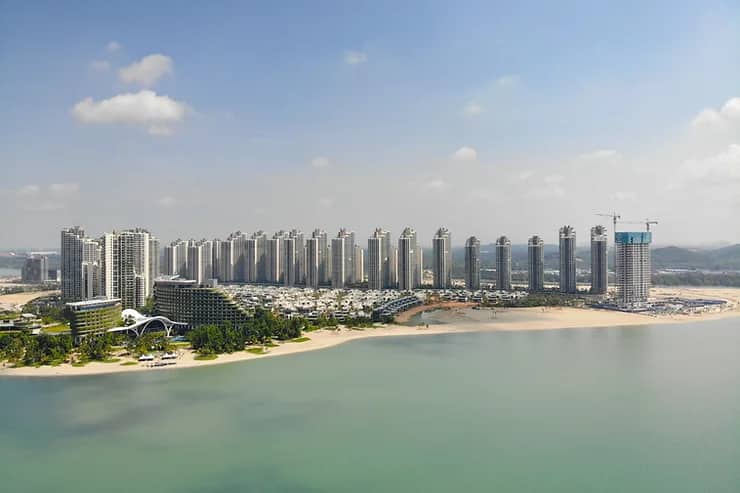
In 2016, a massive billboard appeared across Singapore's Causeway, promising a futuristic city rising from the sea off Johor's coast. Country Garden's Forest City was marketed to Singaporeans with glossy brochures, open-house viewing trips in luxury coaches, and the lure of properties priced at a fraction of HDB resale prices. The pitch was simple: own a piece of a $100 billion smart-city dream, just a 20-minute drive from Singapore.
A decade later, the picture is vastly different. What was once billed as Southeast Asia's most ambitious property project is now frequently labelled a ghost town, with windows dark, malls empty, and prices that have collapsed from their launch peaks. Yet this cautionary tale carries urgent lessons for Singaporean property investors — particularly at a moment when Johor is back in the spotlight thanks to the Johor-Singapore Special Economic Zone (JS-SEZ) and the Rapid Transit System (RTS) link.
This article examines the rise and fall of Forest City, the data behind its current predicament, and what the project's trajectory reveals about cross-border property strategies for Singapore investors.
The Dream That Rose From the Sea
Forest City was never meant to be a modest development. Conceived by Chinese developer Country Garden in partnership with Malaysia's Sultan of Johor, the project was a four-island artificial archipelago covering 1,386 hectares — roughly the size of Monaco.
The masterplan was audacious in every dimension:
- Four man-made islands in the Straits of Johor, connected by bridges and designed to house up to 700,000 residents
- A $100 billion budget, making it one of the largest real estate developments in Southeast Asian history
- On-site amenities including malls, schools, a hospital, a marina, and an international golf course
- A 15-20 minute drive to Singapore's Tuas Checkpoint, positioning it as a bedroom community for the Lion City
- Prices starting around RM 950 per square foot at launch — roughly S$300-350 PSF, a fraction of comparable Singapore property
Target buyers were primarily affluent Chinese nationals and Singaporeans seeking a second home or investment property. Country Garden's sales machinery was formidable: thousands of agents were deployed across China and Singapore, and prospective buyers were flown to Johor on sponsored weekend trips.
The project launched its first phase in 2016, and sales initially appeared robust. Reports suggested that tens of thousands of units were sold before construction completed, with Chinese buyers making up the bulk of purchasers. Between 2016 and 2018, Country Garden reported RM 15 billion in cumulative sales for Forest City.
For many Singaporean investors, the logic seemed sound. Singapore's property prices were among the world's most expensive, and Johor offered land, space, and a fraction of the entry cost. The project promised world-class amenities, a strong rental yield story, and proximity to Singapore. What could go wrong?
The short answer: a great deal.
The Fall: Policy, Politics, and Over-Supply
Forest City's decline is not attributable to a single cause, but rather a perfect storm of factors that compounded each other over several years.
The 2018 Cooling Measures Problem
The first major shock came in 2018 when Singapore introduced a new round of property cooling measures, raising the Additional Buyer's Stamp Duty (ABSD) rates for foreign and second-home buyers. While these measures applied directly to Singapore properties, they also had a psychological effect on cross-border buyers. Singaporeans who had been considering Forest City as an "extension" of their Singapore property portfolio suddenly faced a different calculus — if their primary residence was locked up in Singapore, could they afford to service a second mortgage overseas?
Simultaneously, Malaysia's government changed hands in a historic 2018 election. The new administration under Mahathir Mohamad took a markedly cooler stance toward Chinese mega-projects. These were the same years that Forest City needed regulatory approvals for office and commercial land, additional islands, and key infrastructure — approvals that were delayed or withheld.
Chinese Capital Controls and the Crackdown on Capital Flight
The single most significant driver of Forest City's collapse, however, was China's tightened controls on capital outflows. Beginning in 2017 and intensifying in subsequent years, Beijing made it far more difficult for Chinese nationals to move money out of the country. Property purchases abroad became a focus of regulatory attention.
This hit Forest City directly, as Chinese buyers had been its primary engine of demand. Thousands of buyers who had booked units were unable to complete payments. Some forfeited their deposits entirely. Sales ground to a halt.
The COVID-19 Border Closure
The pandemic delivered the decisive blow. Singapore's border closure with Malaysia in March 2020 severed the project's key selling proposition — proximity to Singapore. For two years, Forest City's infrastructure projects stalled, occupancy collapsed further, and maintenance budgets shrank. The project's golf course closed, and its malls briefly fell dark.
The Market Model
To understand why Forest City failed to self-correct, consider the market structure:
Once the demand pipeline from China dried up, there was no internal buyer base to absorb the supply. Malaysia's local market has a much lower price ceiling, and Johor's broader property market was simultaneously facing its own over-supply challenges.
The Data: What Forest City's Prices Tell Us Today
The most striking evidence of Forest City's decline is its resale pricing. Units that launched at approximately RM 950 PSF in 2016 now commonly appear on resale portals at prices between RM 400 and RM 550 PSF — a decline of roughly 50-60% from launch prices.
For a sense of scale, consider this comparison:
| Metric | Forest City (2016 Launch) | Forest City (2024 Resale) | Singapore OCR Condo (2024 avg) |
|---|---|---|---|
| Typical PSF price | RM 950 (~S$300) | RM 400-550 (~S$130-180) | S$1,800-2,200 |
| Typical 1-bedroom unit | ~RM 650,000 | ~RM 300,000-400,000 | ~S$1.2 million |
| Typical 3-bedroom unit | ~RM 1.3 million | ~RM 700,000-900,000 | ~S$2.8 million |
| Strata maintenance fee | RM 0.30-0.40 PSF | ~RM 0.30 PSF (increasing) | S$0.30-0.50 PSF |
| Occupancy | N/A (new launch) | 5-10% (estimate) | 94-96% |
Note: Singapore OCR (Outside Central Region) prices are from credible market reports; Forest City figures are based on reported resale listings and agent commentary.
The occupancy rate is arguably more concerning than the price decline because it tells you the project is failing as a living community, not just as an investment asset.
Estimated Occupancy
Industry observers and local media have repeatedly reported Forest City's occupancy rates at under 10%. Some accounts cite the residential towers as "largely dark at night," a visible reminder of the project's struggles.
The project has an estimated 200,000 to 250,000 completed residential units across its towers (with tens of thousands more never built), but actual residents are estimated to number only several thousand. There are two primary factors driving this:
- Incomplete sales pipeline: Many units were sold but never paid for; the developer legally retained them.
- Investment purchases: Many units were purchased as pure investments, with owners waiting to sell or rent — not live.
This dynamic creates a catch-22: low occupancy means poor amenities, maintenance issues, and weak rental demand; weak rental demand means landlords hold un-let units; and empty units mean more downward pressure on prices and rents.
Rental Market Reality
For the few that bought Forest City units as rental plays, the results are painfully instructive. According to a 2023 report, typical achieved rents at Forest City for a 1-bedroom unit were under RM 1,200 per month (approximately S$340). Over a year, this generates roughly RM 14,400 in gross rent — against a purchase price of, say, RM 600,000, the gross yield is about 2.4% before maintenance fees, property taxes, and any management charges.
That level of yield is far below what a buyer would need to cover a mortgage. For a 30-year mortgage at current Malaysian rates, the monthly payment would be roughly RM 2,800, nearly two and a half times the typical rent. Negative carry is the norm, and many owners have reportedly stopped servicing their mortgages and let the units go to foreclosure or auction.
The Price-Supply Pinch
The chart below shows the trajectory of Forest City's price and demand cycle relative to key external events:
Forest City Estimated Price Trend (RM PSF, 2016-2024)
The data shows a slow, grinding decline punctuated by sharp dips during the pandemic. A "ghost town" label may be colloquial, but the market data genuinely behaves like an asset with little residual demand.
The Singapore Investor's Dilemma: Lessons in Due Diligence
Forest City's fall is more than a tabloid headline — it is a case study of what happens when narrative outweighs fundamentals. For Singaporean property investors, the project offers a stark set of lessons about cross-border investing.
Lesson 1: "Affordable" Can Mean "Illiquid"
When you buy a below-market asset in a thin market, you may find it is below market because the market is thin. Forest City's prices seemed cheap relative to Singapore, but cheap was a reflection of the limited pool of genuine buyers. When you need to sell, you need a buyer; if the buyer pool is shallow and domestically constrained, your exit is at the mercy of their negotiation.
- In Singapore: The resale market is liquid; HDB flats transact in the tens of thousands annually.
- In Johor: The resale market for high-rise units is far thinner, particularly for projects in less dense locations.
Lesson 2: Rental Yield Is Not Guaranteed
The "rental yield" you see in a developer's glossy brochure is often a projected yield, not an achieved one. Forest City's projected yields were 6-8% at launch; achieved yields have been closer to 2-3% — and that is when units are occupied.
<table> <tr><th>Yield Scenario (1-bed unit at RM 600,000)</th><th>Rent (RM/mth)</th><th>Gross Yield</th></tr> <tr><td>Launch projection (2016)</td><td>3,200</td><td>6.4%</td></tr> <tr><td>Market peak (2019)</td><td>2,000</td><td>4.0%</td></tr> <tr><td>Current market (2024)</td><td>1,200</td><td>2.4%</td></tr> </table>Factor in maintenance fees (approximately RM 300-400/month on a typical unit), annual quit rent, and the opportunity cost of your capital, and the net yield is in the low single digits.
Lesson 3: Policy Risk Is Asset Risk
Singapore's ABSD and Malaysia's regulatory stance toward Chinese capital were external shocks that drastically affected Forest City's demand. But the influence goes both ways. When you buy overseas, you take on the policy risk of two countries — both your own (as a buyer, with capital controls and taxes) and the host country (with foreign-ownership rules, taxes, and political shifts).
A useful way to visualise this is as a chain of linked risks:
The chain is only as strong as its weakest link. In Forest City's case, several links snapped simultaneously.
Lesson 4: Understand the Developer's Business Model
Forest City was a mega-project built on pre-sales, overseas marketing, and a steady inflow of Chinese capital. When that inflow stopped, the developer faced profound cash flow issues. Country Garden suffered significant financial distress, with reports of missed debt payments globally. As of the project's current phase, the developer is pivoting from a residential sales model to an industrial park model, repurposing unbuilt land for data centres — a tacit admission that the residential dream has stalled.
For a buyer, the developer's health matters not just at the point of purchase, but for liquidity, maintenance, and the quality of common areas over the long term.
Johor's Second Act: Is the Ghost Town Being Revived?
The story does not end in 2024. Johor is in the midst of a significant policy push to attract investment, and Forest City sits at the centre of the new narrative — though in a different role than originally conceived.
The JS-SEZ Boost
The Johor-Singapore Special Economic Zone (JS-SEZ), formally announced in 2024, is a joint initiative aimed at boosting cross-border trade, investment, and people movement. Among its goals are streamlined customs procedures, a digital goods trade corridor, and a focus on electronics, health, and tourism.
Importantly, the JS-SEZ accepts Forest City as one of its flagship zones: a Forest City Special Financial Zone was announced, offering tax incentives for financial services, including a 0% corporate tax rate for up to 10 years and a concessionary income tax rate of 15% for knowledge workers.
Early signs of revival:
- Data centre mania: Forest City has attracted significant data centre investment, with companies repurposing what was intended as residential/commercial floor space into server hosting areas.
- RTS Link progress: The Rapid Transit System (RTS) connecting Johor Bahru's Bukit Chagar and Singapore's Woodlands North is scheduled for completion by end-2026, dramatically improving cross-border connectivity (though it terminates at JB Sentral, not Forest City).
- New (re)positioning: The developer has re-positioned Forest City as an "industrial and high-tech hub," shifting its orientation from residential to commercial and data infrastructure.
Yet, for individual property investors, the revival carries a critical caveat: the JS-SEZ incentives are aimed at businesses and employees, not necessarily at creating a resale market for the thousands of residential units already purchased.
What's the Current Price?
Resale prices have stabilised, but not recovered. Listings on Malaysian property portals show asking prices ranging from around RM 300,000 for studios to RM 1.4 million for larger seafacing units — but the gap between asking and transacted prices at Forest City has historically been wide. Reliable transaction data is scarce, but a 2024 survey by local property agents suggests true transacted prices are frequently 15-20% below asking.
At current prices, there is an emerging cohort of "vulture investors" — both local and Singaporean — who are buying at the bottom, betting on a long-term JS-SEZ uplift. Their reasoning:
- The entry price is now genuinely low, even by Johor standards.
- If the JS-SEZ succeeds and brings more businesses to the region, demand for affordable residential space near the causeway could eventually grow.
- RTS Link, when completed, will make Johor a more viable dual-country living arrangement.
But the counter-arguments are equally strong. The supply overhang is enormous. Maintenance of the vast common areas is costly, and the developer's financial position remains fragile. And the residential market itself is yet to show any meaningful rental or occupancy recovery.
What Forest City Teaches About Comparing Property Markets
For a young Singaporean adult watching this story unfold, there is a natural temptation to treat Forest City as an outlier — a uniquely mismanaged project that offers no lessons for the disciplined Singapore market. That would be a mistake.
Market Illiquidity Is a Spectrum, Not a Binary
Singapore's property market is liquid and regulated, but it also has its own illiquidity traps. The Executive Condominium (EC) market and certain small-format condo projects can face resale discounts during downturns. Foreign demand for specific districts can dry up. Cooling measures can freeze capital coming from abroad.
Comparing markets across borders sharpens this awareness:
| Friction | Singapore (Resale Condo) | Johor (Forest City) |
|---|---|---|
| Buyer stamp duty | ~1-4% (varies) | ~1-3% (varies) |
| Foreign ownership | Allowed (with ABSD for certain buyers) | Allowed, but approvals apply |
| Financing for non-residents | Up to ~75% LTV for Singaporeans | ~70-80% LTV (at 4-4.5% interest) |
| Minimum holding period (Sale of Property tax) | 3 years (with SSD) | 3-5 years (RPGT) |
| Typical days on market | 30-60 | 120-365+ |
| Mortgage stress test | TDSR, MSR | Verifiable income (looser) |
Note: Figures are indicative and reflect standard conditions as of 2024; please verify current rates before relying on them.
The key point: liquidity risk is tied to the asset's market structure, not just its location. A "prime" project can be illiquid if the surrounding market has a supply overhang or weak buyer base.
Leverage Cuts Both Ways
Many Forest City buyers financed their purchases with Malaysian mortgages. When values fell, their loan-to-value ratios deteriorated. Some buyers found themselves in a situation where selling the unit would not even cover the outstanding loan — as a result, they chose to hold and rent at a loss, or simply walked away, damaging their credit history.
Singapore's cooling measures, such as the Total Debt Servicing Ratio (TDSR) and Loan-to-Value (LTV) limits, exist precisely to prevent this kind of leveraged distress. When a Singapore investor buys overseas, they are re-entering the type of looser lending environment that these measures were designed to guard against.
A Due Diligence Checklist for Cross-Border Property Investments
If you are a Singaporean considering any overseas property — not just Johor — here is a practical checklist that Forest City's saga illuminates.
Pre-Purchase: The Fundamentals
- Exit strategy: Ask explicitly — who will buy this from me in 5-10 years? If the answer relies on an assumption of endless external demand, rethink.
- Achieved rents: Look for actual recent lease transactions, not developer projections. A project with real tenants beats a project with glossy renderings.
- Visible occupancy: Visit the project at night. Drive around the car park. A 10-minute observation beats a 100-page brochure.
- Master supply pipeline: Check how many units are sold, unsold, and unbuilt in the project and the surrounding district.
Legal and Tax Structure
- Ownership form: Are you buying outright freehold, leasehold, or a long-term lease? In Malaysia, foreigners typically cannot buy certain property types (e.g., some landed, low-cost units) without state approval.
- Taxes on exit: Understand the Real Property Gains Tax (RPGT) in Malaysia, the Seller's Stamp Duty in Singapore (if you are disposing of a Singapore asset), and any overseas capital gains tax.
- Estate planning: Overseas assets complicate wills and inheritance. Check whether a foreign will is recognised and whether estate duty applies.
Developer and Project Health
- Developer's financial statements: Are they public? Are there reports of distress, layoffs, or rescoping of projects?
- Common area maintenance: Who owns the common areas? In Forest City's troubled phases, maintenance was sometimes funded by the developer itself, which is not a sustainable model.
- Renovation and management fees: Verify what strata fees are actually charged and how far they cover essential services.
Market-Specific Risks for Malaysia
- Political and policy shifts: Malaysia has seen abrupt policy reversals on foreign ownership (e.g., minimum purchase price rules, which were raised and then lowered).
- Geopolitical factors: Johor has been staunchly supportive of cross-border ties with Singapore, but local politics in particular states or the federation can change.
- Currency risk: The Malaysian Ringgit has historically depreciated against the Singapore Dollar. An investor who buys in RM but measures wealth in S$ can lose value even if the property price is flat.
The "Lessons" for Singapore's Own Market
It is worth confronting the uncomfortable reality that some of the dynamics from Forest City exist, in milder forms, in Singapore as well. These aren't identical, but the analytical habits matter.
1. Narrative-Driven Pricing
Forest City sold on a compelling narrative of smart-city future and Singapore proximity. Singapore's property market has its own narrative cycles — think of "integrated resorts", "regional centres", or "Greater Southern Waterfront" — that can push prices beyond what near-term fundamentals justify.
Distinguishing between narrative and evidence is a core skill. The data matters: actual transactions, actual rental demand, actual transaction volumes — not just headline prices.
2. Projects vs. Communities
Forest City had towers, a mall, a golf course — but it never became a community because there were no residents. In Singapore, a "community" takes time to form as well. New launches in undeveloped areas (e.g., Tengah) sell at a premium based on future plans; the built environment will fill in, but the social ecosystem takes longer.
3. Policy Always Looms
Singapore's ABSD and cooling measures are proof that the state can change the rules of engagement. For younger buyers, planning for policy shifts — rate changes, tax changes, and possible future withdrawal of sustainability or housing grants — is part of prudent property planning.
Why This Matters for Singapore's Property Narrative
Forest City is often dismissed as a "Johor story" of marginal relevance to Singapore's property scene. But the cross-border narrative is thickening:
- The RTS Link will change the calculus of living in Johor and working in Singapore. A two-hour commute today could become a 45-minute train ride in 2027.
- The JS-SEZ is explicitly designed to make Johor more integrated with Singapore's economy.
- Data centres and industrial real estate in Johor are absorbing some of the region's economic energy — potentially at the expense of Singapore's own data centre growth.
For HDB upgraders and first-time condo buyers in Singapore, the existence of a massive, affordable alternative on the other side of the causeway will increasingly frame conversations about value. If Johor over the next decade becomes genuinely commute-friendly and business-attractive, how do Singapore's residential prices hold up? Conversely, the risk of buying into Johor-based "ghost towns" is a cautionary deterrent that may, ironically, keep Singapore's own residential market more disciplined.
Food for Thought
-
Would you buy a property based on "proximity to Singapore" alone? Forest City's primary selling point was its nearness to the Lion City, but proximity without connectivity and a genuine buyer pool proved insufficient. How close is close enough — and what else are you expecting from the asset?
-
How would you assess liquidity risk before buying? If you needed to exit within two years, could you? Would a fire-sale price erode your expected returns? Apply the same question to your current Singapore property holdings.
-
Is an "affordable" overseas property ever a substitute for Singapore property? While Johor appears cheap on a price-per-square-foot basis, the total cost of ownership, risk, and illiquidity changes the arithmetic. What price premium is Singapore's liquidity and transparency worth to you?
-
How would you react to a 50% drawdown? Forest City owners have weathered declines of over half their purchase price, with rent yields at single-digit percentages. Could your portfolio withstand that shock without distress-selling at the bottom?
-
When is a "revival story" worth betting on? The JS-SEZ is a real policy push, but early investment has been in industrial and data infrastructure, not residential. What evidence would persuade you that the residential market is turning?
Conclusion: Sifting Signals from Noise
Forest City's rise and fall is one of the defining real estate cautionary tales of the decade — a $100 billion vision undone by fragile demand, policy shocks, and a failure to build a living community rather than a property product. For Singaporean investors, its story underscores the importance of liquidity, true cash flow, policy risk, and the difference between transactional sales and sustainable communities.
At the same time, the project's ongoing reinvention is a reminder that real estate is not static. The ghosts of one market cycle can become the infrastructure of the next. The question for today's investors is not simply "was Forest City a mistake?" but "what signals am I interpreting correctly — and incorrectly — in my own property decisions?"