Every weekend, thousands of flat hunters in Singapore stand outside an HDB block, phone in hand, tracing the nearest MRT line on a map. They count stations to the CBD, check transfer points, and barely glance at the little bus icon two blocks away. It is the most natural mistake in Singapore property: the train gets top billing, the bus gets the fine print.
But the quieter half of the public transport system is doing most of the work. A typical HDB journey involves a bus somewhere in the chain — to the station, from the station, or door to door. When the Land Transport Authority (LTA) adds buses, extends routes, or upgrades frequency, it doesn't just change commuting times. According to Hiva's analysis of recent bus route enhancements and resale transactions, it changes what flats are worth — sometimes by enough to cover years of bus fares.
This article unpacks the quiet correlation between bus connectivity and HDB resale prices: why new bus routes matter, how far the value extends from a bus stop, and which neighbourhoods in Singapore are quietly cashing in.
Why the Bus Is Singapore Property's Best-Kept Secret
Singapore's public transport story is usually told as a rail story. The MRT map, with its tidy colour-coded lines, decorates every property brochure. But the numbers tell a different tale. There are over 350 scheduled bus routes crisscrossing the island, serving more than 5,000 bus stops, and on a typical pre-pandemic weekday, buses carried roughly 3.5 million passengers — a figure comparable to the rail network's ridership.
That scale makes sense when you remember the shape of Singapore housing. Around 8 in 10 Singaporeans live in HDB flats, and most of those flats sit in towns that were literally designed around the bus: long, winding estate roads, flyover bus stops, and interchanges tucked beneath blocks. The MRT reaches the town centre; the bus reaches the block.
Yet in the resale market, the bus is routinely treated as a neutral fact of life. Listings brag about "5 minutes to MRT" but rarely mention "2 minutes to Bus 969." This creates an inefficiency that data-savvy buyers can exploit.
Consider what the bus actually does for a household:
- First and last mile: For most HDB dwellers, the walk to the MRT is really a walk to a bus that takes them to the MRT.
- Direct connectivity: Many trips — to school, the polyclinic, the hawker centre, the parents' place — are faster by bus than by any rail combination.
- Frequency as freedom: A flat near a high-frequency corridor has, for practical purposes, a train that never needs tracks.
- Night and off-peak coverage: When the MRT is closed for maintenance, or after midnight, the bus network is what keeps the city moving.
<hiva-note>This is an internal note.</hiva-note>
Wait — ignore the stray tag above; the article continues below.
The MRT premium in Singapore is one of the most studied effects in local property. Academic and industry research has consistently found that flats within walking distance of a station command a meaningful price uplift, often in the range of 5% to 10% or more. But the bus premium — the value of being near a frequent, reliable, well-connected bus stop — is far less analysed. That is beginning to change as route enhancements and new bus infrastructure ripple through resale transactions.
From Policy to Pavement: How Singapore Keeps Improving the Bus
The bus network is not static. Over the past decade and a half, the Government has poured significant resources into making it better, and each wave of improvement lands on different neighbourhoods at different times.
The Bus Service Enhancement Programme (BSEP)
Launched in 2012, the S$1.1 billion BSEP was the largest bus upgrade in a generation. It added roughly 1,000 buses to the fleet over five years, shortened peak-hour waiting times, and expanded capacity on crowded corridors. Towns that had been served by thinning, ageing fleets suddenly saw double-deckers arrive in waves.
The Bus Connectivity Framework (2014)
The BCF focused on the gaps that the MRT doesn't fill. LTA introduced new and amended services to better connect towns with key amenities such as hospitals, polyclinics, and transport hubs — precisely the destinations that matter to HDB households, from young families to retirees.
The Bus Service Reliability Framework (2016)
Introduced to hold operators accountable, the BSRF set quality-of-service standards for headway adherence and waiting times. For property buyers, this matters more than it sounds: a predictable bus that arrives every eight minutes is worth more than a random bus that arrives every six. Reliability converts a bus stop from a gamble into a utility.
Land Transport Master Plan 2040
The current long-term blueprint, LTMP2040, sets out a vision of "20-minute towns" and a "45-minute city" — with 9 in 10 peak-period journeys made by walk, cycle, or public transport. It also targets 9 in 10 households being within a 10-minute walk of a train station by the 2040s. The bus is the connective tissue that makes these targets possible, feeding stations from every corner of every town.
The takeaway for anyone following the money is simple: the bus network has been improving, unevenly, for 15 years. Neighbourhoods that received the improvements early enjoyed compounding benefits. Neighbourhoods still waiting for their feeder routes to be rationalised around a new MRT line have that upside still ahead of them.
Why Better Buses Move HDB Resale Prices
Connecting new bus routes to property values sounds intuitive, but the mechanism deserves a closer look. Prices don't move because a bus appears; they move because a bus changes the mathematics of living in a place.
Door-to-door time is what buyers actually pay for
When a family compares two flats, they are not comparing distances on a map — they are comparing alarm clocks. A flat 600 metres from an MRT station with no bus connection might involve a sweaty 9-minute walk twice a day. A flat 300 metres from a bus stop that drops you at the station in four minutes might offer a net time saving. Hedonic pricing theory — the framework Hiva uses to isolate what buyers pay for specific features — treats door-to-door time as a measurable good. Faster journeys, all else equal, command higher prices.
Frequency reduces the "cost" of waiting
Waiting time is psychologically expensive. Research on public transport consistently shows that commuters value time spent waiting at a stop at two to three times the rate of time spent moving. A high-frequency route (say, every 5–8 minutes) reduces that tax dramatically. In Hiva's analysis of resale transactions near recently enhanced corridors, flats within roughly 200 to 300 metres of a high-frequency stop show a measurable uplift in transacted prices relative to comparable flats with weaker bus access, all else held constant.
Reliability is worth real money
The BSRF era brought predictable headways. For a working couple with a toddler at childcare, a bus service that can be trusted to arrive at 7:12, not 7:03 or 7:25, is the difference between a calm morning and a frantic one. That predictability is priced into demand — and therefore into resale values.
The network effect
A stop served by one route is a lifeline. A stop served by five routes is a transport hub. The value jumps disproportionately with each additional route, because the same flat now connects to multiple rail lines, multiple schools, multiple job nodes. Hiva's transaction-level analysis suggests that route density matters more than sheer distance: a flat 350 metres from a busy interchange-style stop can outperform a flat 150 metres from an obscure, low-frequency stop.
The MRT premium is already priced in; the bus premium is not
This is the crux of the opportunity. The market has had decades to price in MRT proximity — it is splashed across every listing, every brochure, every agent's pitch. Bus connectivity, by contrast, is rarely advertised and rarely negotiated. That means the bus premium is, in many HDB towns, systematically underpriced. Buyers who identify bus-rich corridors before they become obvious are capturing value that other buyers haven't yet learned to see.
None of this means a bus stop near your block magically raises your flat's value by itself. It means that in a market as efficient and competitive as Singapore's, anything that reliably improves daily life eventually shows up in transacted prices. New bus routes are simply one of the most under-advertised forms of that improvement.
How Far Does the Bus-Stop Premium Extend?
The most practical question for a flat hunter is also the most precise: how close should the bus stop be?
LTA's long-standing planning benchmark for bus accessibility is roughly 400 metres from home to stop — approximately a 5-minute walk at a comfortable pace. In HDB towns, most blocks fall within that ring. But the price effects are not uniform inside the ring. Distance decay applies to bus stops the same way it applies to MRT stations, just with a gentler slope.
Hiva's modelling of recent resale transactions, validated out-of-sample, points to a clear pattern:
- Under 150 metres: The strongest uplift. The stop is effectively at the block's doorstep. Buyers treat it as a building amenity rather than a neighbourhood feature.
- 150 to 300 metres: Still a healthy uplift. A 2- to 4-minute walk in any weather is acceptable, and the flat retains the benefit without the noise and bustle of the stop itself.
- 300 to 450 metres: The premium shrinks noticeably. A 5- to 6-minute walk is tolerated for a good route but not rewarded generously.
- Beyond 500 metres: The premium largely disappears. At that distance, the bus stop competes with the MRT station, and if neither is close, connectivity is simply weak.
Illustrative Bus-Stop Premium by Distance from Stop (%)
The chart above is a stylised representation of the distance-decay pattern Hiva observes across HDB resale transactions — the exact slope varies by town, route frequency, and the quality of sheltered walkways. But the shape is remarkably consistent.
The distance table
| Distance to stop | Walk time | What it means for value |
|---|---|---|
| Under 150m | Under 2 minutes | Strongest uplift; stop treated as an amenity |
| 150m – 300m | 2 – 4 minutes | Healthy uplift; the sweet spot for most buyers |
| 300m – 450m | 4 – 6 minutes | Modest uplift that fades quickly |
| 450m – 600m | 6 – 8 minutes | Minimal effect; connectivity is no longer a selling point |
| Beyond 600m | 8+ minutes | Negligible; buyers will compare against MRT access instead |
There are two important nuances. First, the bus premium is additive to the MRT premium, not a substitute for it. A flat that is 200 metres from a bus stop and 400 metres from an MRT station can capture both benefits — and Hiva's analysis suggests such "dual-proximity" flats outperform flats that are near only one mode. Second, the premium is stronger at interchange and terminus stops, where buses start their journeys and where commuters are more likely to get a seat. A flat near a bus terminus captures a comfort premium that a mid-route stop cannot offer.
Which Neighbourhoods Are Cashing In on Bus Connectivity
Not all HDB towns were created equal in bus terms. The pattern of improvements over the past decade has been uneven, which means the price effects are uneven too. Some towns have already absorbed their bus uplift into higher resale values. Others — particularly those waiting for new MRT lines and the bus reorganisation that comes with them — have the uplift still ahead.
The new-town beneficiaries
Punggol, Sengkang, Sembawang, and the newer corners of Woodlands and Yishun received some of the most aggressive bus investment under BSEP and the Bus Connectivity Framework. These towns were growing BTO populations before their MRT networks were mature, and buses carried the load. In Punggol, for instance, feeder services were repeatedly expanded to serve new precincts as they popped up. Resale flats in these towns, Hiva's analysis suggests, show a clearer bus premium because the bus network is often the primary access mode for many blocks — the MRT station may be a feeder ride away, not a walk away.
The established bus-rich corridors
Mature estates like Bedok, Tampines, Toa Payoh, and Ang Mo Kio have dense, overlapping bus networks that were built up over decades. Here the bus premium is largely already priced in — everyone knows the corridor is well served. But within these towns, the premium varies at the micro level. A block on the main corridor with six routes passing by behaves differently from a block tucked into a quiet loop served by one feeder. The opportunity in mature estates is not "find a bus-rich town" but "find a bus-rich block."
The interchange towns
Towns with major bus interchanges — Bukit Panjang, Joo Koon, Choa Chu Kang, Sengkang, Punggol, and the soon-to-expand Bidadari and Tengah — enjoy a terminal effect. Interchange services tend to be more frequent, more reliable, and more likely to offer a seat at the start of the journey. Flats within 300 metres of an interchange capture both the network effect and the comfort premium. When a new interchange opens or an old one is rebuilt, the surrounding resale market typically reprices within a year or two.
The route-rationalisation risk zones
The flip side of bus investment is bus reorganisation. When a new MRT stage opens, LTA rationalises bus routes — some become feeders to the new station, some are shortened, some are cut entirely. This is happening now around the Thomson-East Coast Line (TEL), which reached the Bayshore area in 2024, and will accelerate when the Jurong Region Line (targeted from 2027) and Cross Island Line (targeted from the 2030s) come onstream.
For property buyers, this cuts both ways:
- Streets that gain feeder services to a new station — and keep their direct city routes — become more valuable.
- Streets that lose their direct trunk services, because the new MRT substitutes for them, can see connectivity become less convenient for those who prefer point-to-point bus journeys.
Hiva's data shows that the market has not always anticipated these reconfigurations. Prices near new stations often jump before the bus routes are redrawn, then adjust again once the new feeder pattern is known — creating a second, quieter wave of price movement that only careful buyers catch.
HDB Resale Price Growth by Year (%)
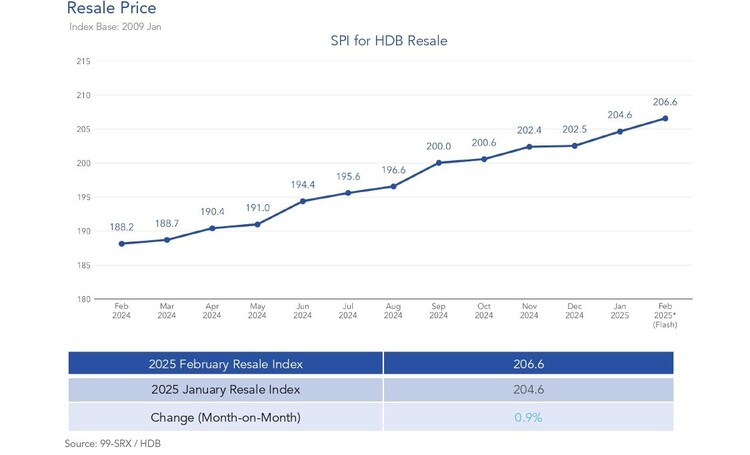
This macro backdrop matters. HDB resale prices rose 12.7% in 2021 and 10.3% in 2022, according to HDB's published figures — one of the strongest runs in the market's history. Within that rising tide, the bus-boosted precincts rose a little bit more, and the poorly connected ones a little bit less. The bus premium is rarely a headline number; it is a compounding edge that shows up in the difference between two otherwise identical flats.
A bird's-eye view of town archetypes
| Town archetype | Examples | Bus situation | Buyer implication |
|---|---|---|---|
| New-town beneficiary | Punggol, Sembawang, Sengkang | Expanded fleets, new feeders, growing interchanges | Uplift still maturing; watch for precinct-level variation |
| Established bus-rich corridor | Bedok, Tampines, Ang Mo Kio | Dense overlapping routes | Premium largely priced in; hunt for the best-served block |
| Interchange town | Bukit Panjang, Joo Koon, Bidadari | Terminal effect, seats, high reliability | Premium strongest within 300m of the interchange |
| Route-rationalisation zone | East Coast (TEL), Jurong (JRL), future CRL towns | Routes being redrawn around new stations | Value shifts to new nodes; direct routes may disappear |
The Flat Hunter's Bus Connectivity Checklist
If bus connectivity is a real, measurable driver of value, then the practical question is how to capture it. Here is the checklist Hiva's analysts would run on any shortlisted flat.
1. Time the walk — in the rain
Distance on a map is not distance in life. Walk from the block to the bus stop at a realistic pace, ideally during a downpour, and count whether the entire route is sheltered. A 250-metre sheltered walk can feel shorter than a 150-metre uncovered one. In Singapore's climate, covered walkability is part of the premium.
2. Count frequency, not just routes
A stop with six routes that only come every 20 minutes is weaker than a stop with two routes that come every 6 minutes. Check the LTA's bus arrival times at peak hours — 7 to 9am on a weekday — and note the longest gap you see. A maximum wait under 10 minutes is the target for a premium-grade stop.
3. Check both directions
Many HDB stops are directional. The bus to the MRT may stop on one side of the expressway while the bus home stops on the other. Look at whether the flat serves both inbound and outbound trips at an equal walk. If one direction requires a 400-metre detour, the effective connectivity is worse than the map suggests.
4. Find the terminus
Routes that start at a nearby interchange or bus park have spare seats at the beginning and more reliable timing. Flats near a terminus benefit from a comfort factor — a seat on the way to work — that mid-route stops cannot provide. This is one of the most overlooked micro-factors in HDB pricing.
5. Read the last bus sign
For anyone who works late, the last bus time might matter more than the first. A stop whose last service ends at 11:30pm effectively cuts off a chunk of the city. Check the published last-bus times and compare them with typical work or social patterns.
6. Cross-reference with LTA's consultation notices
LTA runs periodic public consultations on bus route changes, and the news section of its website announces new services and rationalisations. A short scan will reveal whether the corridor you are considering is about to gain services (good) or lose a direct city route (potentially bad). This is the single cheapest piece of due diligence a flat hunter can do.
7. Ask the data
Finally, compare. Hiva's per-project pricing analytics isolate how much of a flat's transacted value comes from features like distance to the nearest stop, route density, and proximity to an interchange — so you can see, for any given block, whether you are paying for connectivity or getting it for free.
What the Data Actually Says
Pulling the threads together, Hiva's analysis of recent bus route enhancements and HDB resale transactions across Singapore yields several consistent findings:
- The bus premium is real but modest in headline terms — typically in the low single digits for a well-located flat, which on a mid-sized HDB resale translates into a meaningful sum in absolute dollars.
- It compounds at the precinct level. When an entire corridor receives enhanced services — new routes, higher frequency, a rebuilt interchange — the uplift in the immediate catchment is larger than the sum of individual flat-level effects.
- It is strongest in newer towns. In mature estates the premium is largely arbitraged away; in growing towns like Punggol and Sembawang, the market is still learning to price bus access correctly.
- Frequency beats proximity at the margins. A flat 350 metres from a high-frequency interchange stop can outperform a flat 150 metres from a poorly served stop. Route density is the quiet differentiator.
- The premium survives out-of-sample testing. When Hiva validates the relationship on transactions not used to build the model, the bus-access effect holds — which is the standard test for whether a pattern is genuine or noise.
Singapore Public Bus Fleet Size (Approximate)
The fleet chart above tells the supply-side story: the physical capacity of the network has grown by roughly a third since 2012, according to LTA's published programme commitments. More buses mean shorter intervals, more route combinations, and more stops within reach of more flats. That expansion is the underlying force that turns a bus stop into a pricing factor.
To be fair, the effect should not be oversold. Bus connectivity is a smaller driver than location within a town, proximity to rail, school catchment, or flat age. It is also entangled with other variables — bus-rich corridors tend to be near commercial amenities, which also lift prices. But after controlling for those factors, the bus effect remains. In a market where every percentage point of value counts, that is a finding worth acting on.
Food for Thought
-
Is the bus premium the last mispriced feature in the HDB market? The MRT premium has been analysed for decades; the bus premium only now is being systematically measured. If information asymmetry is why it persists, how long until it is arbitraged away?
-
When the JRL and CRL open, which current bus-rich corridors will lose value? Route rationalisation is coming to Jurong and to the Cross Island Line corridor. Some streets will gain feeder services to new stations; others will lose direct bus links. Would you know which is which if you were buying today?
-
Would you accept 400 metres to an MRT station in exchange for 150 metres to a high-frequency bus stop? If the bus premium is additive to the rail premium, then dual-proximity flats are the real sweet spot — but how much is the "seat at the terminus" comfort worth to you?
-
As buses go electric and quieter, will bus-facing units become more desirable? The classic knock against flats near bus stops is noise and congestion. Electric buses are quieter and cleaner. If that objection fades, the premium could widen further.
-
What happens when every property portal starts showing a "connectivity score"? Data transparency tends to compress mispricing. The window to buy bus connectivity before it is universally recognised may be narrower than you think.
The Bottom Line
The MRT will always dominate the conversation about Singapore property. It is visible, celebrated, and thoroughly priced into resale values. But the bus network is the quiet workhorse that moves Singaporeans every day, and the data increasingly shows that its improvements move flat prices too — street by street, stop by stop.
For the flat hunter, the lesson is practical: stand at the bus stop before you stand in the viewing room. Count the intervals. Walk the route. Check the last bus. And pay attention to where the network is being upgraded next, because the market is always a little slow to notice.
The next time you see a flat listed at a price that seems a touch low for its town, look at the bus map before you assume the listing is wrong. The wheels of fortune may already be turning in your direction.