The email lands on a Tuesday afternoon. Your lease renewal: $4,600 a month — a full $800 more than what you paid last year. You scroll through property portals for a sanity check and find the same one-bedroom layout in the same condo listed at $4,900. Not a typo. Welcome to Singapore's post-COVID rental market, where a once-in-a-generation migration wave collided with an equally rare supply shortage — and tenants are feeling it directly in their monthly payments.
Singapore has always been a rental-heavy market. Close to one in five households rents, and the pool of people hunting for a lease keeps growing: foreign professionals on Employment Passes (EPs), students at global universities, young couples waiting out their Build-To-Order (BTO) flat, families between homes, and returning Singaporeans who left during the pandemic and are now streaming back. When borders closed in 2020, many of these renters vanished overnight. When borders reopened in 2022, they returned — all at once, with more urgency and far fewer homes available.
This article unpacks the forces behind the rental crunch, walks through district-level data that shows exactly where the squeeze was worst, and lays out practical, data-backed moves for both landlords and tenants. Whether you're thinking of buying a rental property or just trying to renegotiate your lease without hyperventilating, this guide is for you.
The Rental Market Has Been on a Wild Ride
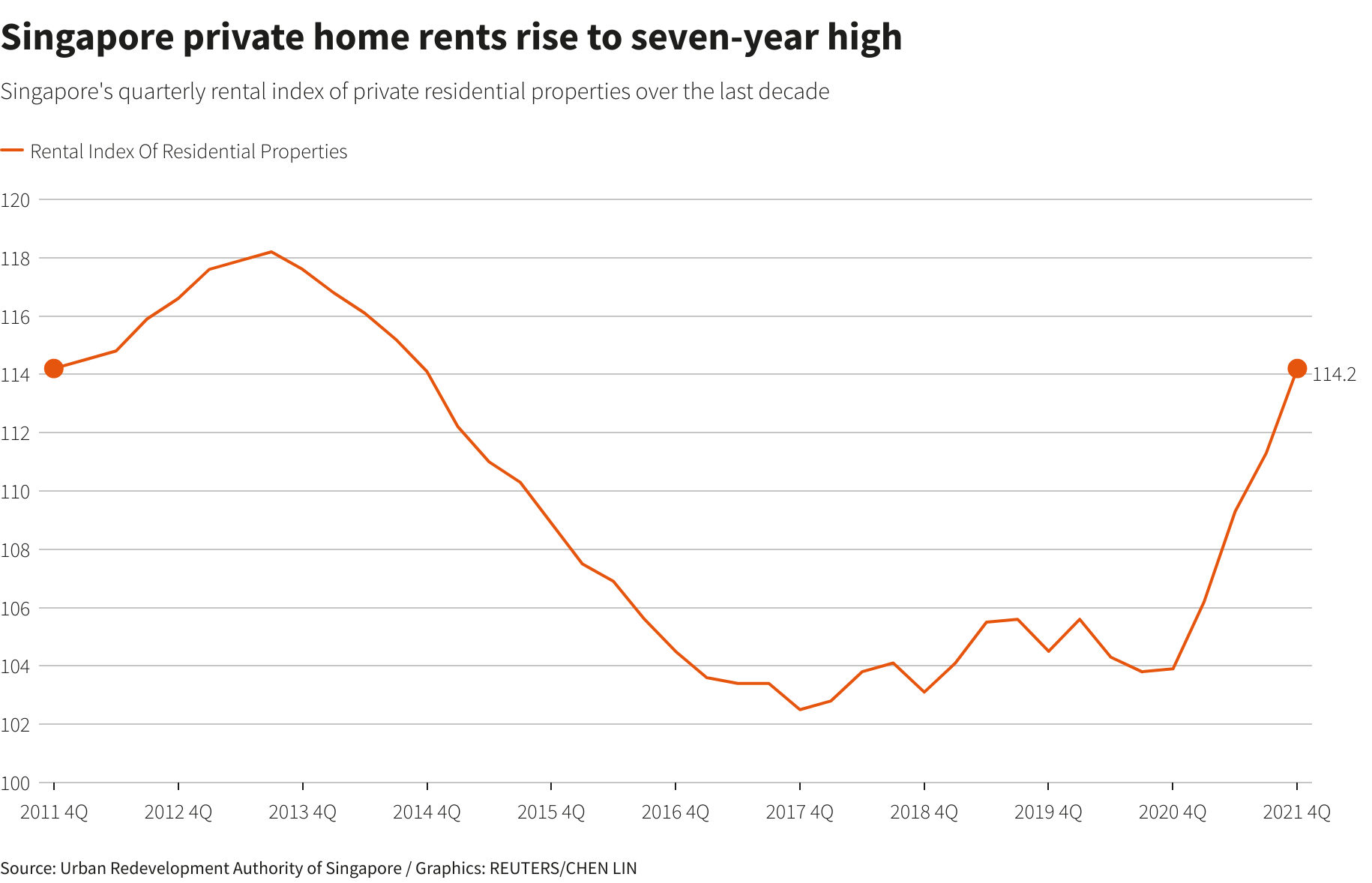
To understand where rents are headed, you need to see how far they've come. According to URA's rental index, private residential rents were essentially flat during the worst of COVID in 2020 — a -0.6% dip that surprised everyone expecting a crash. Then the dam broke. Rents jumped 9.9% in 2021, surged an unprecedented 29.7% in 2022, and rose another 8.7% in 2023 before finally easing by roughly 1% in 2024.
Private Residential Rents — Annual Change (%)
Even after the 2024 cooldown, URA's rental index remains roughly 50% higher than in 2019. In plain terms: a $3,200-a-month condo in 2019 now commands around $4,800 — and that's after the market softened. HDB rents followed a similar trajectory, with double-digit growth in 2022, further increases in 2023, and stabilisation in 2024, according to flash data from real estate portals.
The story behind these numbers is a collision between two forces: a migration wave that arrived faster than anyone expected, and a construction pipeline that delivered far less than the market needed — just in time for the rules of buying property to change.
Migration by the Numbers: The People Behind the Demand
You can't talk about Singapore's rental market without talking about migration. The city's entire growth model depends on attracting global talent, capital, and companies — and every person who arrives needs somewhere to live.
The sharpest number comes from the National Population and Talent Division's Population in Brief series. Singapore's non-resident population — the segment that drives most rental demand — collapsed to 1.47 million in 2021 as COVID restrictions and job losses pushed foreign workers, students, and dependants out of the country. By 2023 it had surged to 1.77 million, a 13.1% jump in a single year that was the sharpest rebound on record. In 2024, it climbed further to 1.86 million, roughly 10% above the pre-COVID level.
Singapore Non-Resident Population (Millions)
Here's a quick scorecard of how the population has moved:
| Year | Total population (millions) | Non-residents (millions) | What happened |
|---|---|---|---|
| 2019 | 5.70 | 1.68 | Pre-COVID baseline |
| 2020 | 5.69 | 1.64 | Borders close, economy stalls |
| 2021 | 5.45 | 1.47 | Population shrinks 4.1% — biggest drop on record |
| 2022 | 5.64 | 1.56 | Reopening begins, expats trickle back |
| 2023 | 5.92 | 1.77 | +13.1% non-resident growth — the great rebound |
| 2024 | ~6.0 | 1.86 | Non-residents exceed pre-COVID levels |
But not all non-residents rent condos. Work permit holders in construction, marine, and process industries largely live in dormitories and don't touch the open rental market. The segments that truly drive rental demand, according to Ministry of Manpower data, are the roughly 400,000 EP and S Pass holders, plus their dependants and international students. EP holders alone number close to 200,000 — back above pre-COVID levels and climbing, despite tighter qualifying salary thresholds.
A few other migration currents matter just as much:
- Returning Singaporeans. An estimated 200,000-plus Singaporeans live overseas, and a meaningful slice came home during and after the pandemic — bringing their families, their jobs, and their need for housing.
- Family offices and regional headquarters. Singapore has become Asia's wealth-management and HQ hub. Every relocation creates a rental first — even wealthy families typically rent for 6 to 12 months before buying (if they buy at all).
- Talent schemes. Programmes like the Overseas Networks & Expertise Pass and Tech.Pass were designed to pull senior executives and tech founders into Singapore. These are exactly the profiles who rent prime-district condos at premium rates.
- The new "never buy" class. Since April 2023, foreigners pay 60% Additional Buyer's Stamp Duty (ABSD) on residential purchases. On a $2 million condo, that's $1.2 million in tax. The logical response — for almost every foreign professional — is to rent instead of buy.
That last point is worth dwelling on. The ABSD hike didn't just cool the buying market; it actively redirected a huge pool of demand into the rental segment. Before 2023, a senior expat who planned to stay five years might have bought. Now, even stayers for a decade are renting, because the 60% tax makes purchasing economically irrational. This is a structural shift, not a temporary one — and landlords are the beneficiaries.
Why Rents Skyrocketed: Demand, Supply, and the Great Catch-Up
The migration numbers explain who needed homes. But rents skyrocketed the way they did because of a perfect storm of demand, supply, and policy.
The demand side
- Pent-up relocation. Companies postponed expat postings in 2020-2021 and released them all at once in 2022. Corporate relocation packages typically include one to two years of paid housing — which means budget was not the constraint. Rents were.
- Household splitting. Young Singaporeans who rode out COVID with their parents moved out once the economy recovered. Post-lockdown, the desire for independent space translated directly into rental demand.
- BTO delays. COVID disruptions pushed many HDB BTO completion dates back by up to a year or more. Thousands of engaged couples who expected keys in 2022-2023 found themselves renting in the interim — often for far longer than planned.
- Buy-side hesitation. Rampant cooling measures, high prices, and interest rate uncertainty made many potential buyers pause. Renting while waiting for "the right time to buy" became a strategy, not a compromise.
The supply side
- A thin completion pipeline. Private home completions dipped to roughly 7,500 to 9,000 units a year between 2021 and 2023 — well below what a growing resident base needed. It was only in 2024 that a bigger wave of about 19,000 completed units arrived, according to URA data, and rents finally softened.
- Landlords exiting the market. The 2021-2023 price surge tempted many landlords to sell into strength, shrinking the rental inventory. En-bloc sales and upgrading moves removed units permanently from the rental pool.
- Regulatory friction. Private homes can't be rented for less than three months, and HDB flats have a six-month minimum for most tenants — rules that stopped units from being used flexibly during the transition back to normalcy.
The result was a market where tenants bid against each other. In mid-2022, real estate agents reported viewings with 30 to 50 parties, tenants offering above asking price, and landlords receiving applications within hours of listing. That frenzy has since cooled, but the habits it created — anchoring on peak rents, signing 2-year renewals to lock in rates, expecting supply to stay tight — are still shaping behaviour today.
Where Rents Rose Most: A District-by-District Look
The national numbers hide a more granular story. Rental pressure was never evenly spread across Singapore — it concentrated in the districts where migrants, expats, and young professionals actually want to live.
Core Central Region (CCR): The Expat Heartland
Districts 1, 9, 10, and 11 — Marina Bay, Orchard, Bukit Timah, Newton — are the traditional landing zones for foreign professionals. These areas saw the most dramatic swings: rents reportedly reached $7 to $8 per square foot per month at the 2023 peak. One-bedroom units in prime condos were asking $4,500 to $6,000 a month, and three-bedders in landmark buildings crossed $10,000.
The tenant profile is predominantly EP holders in banking, consulting, and tech, plus wealthy family-office staff. Tenancy terms are longer here — two years is common — because expat relocation packages favour stability.
Rest of Central Region (RCR): The Squeeze Zone
Districts 5, 14, 15, and 21 (think Buona Vista, Geylang, Katong, and the Holland area) absorbed the overflow. Young professionals who refused to pay CCR prices, or who wanted shorter commutes to one-north and the CBD, flooded these districts. Newer condos in Katong and Joo Chiat saw one-bedroom rents push past $3,500 to $4,000 at the peak. District 15 is also home to several international schools, making it a magnet for expat families who want a quieter life than Orchard Road offers.
Outside Central Region (OCR): The HDB Pressure Cooker
HDB estates tell the most dramatic story of all. Four-room flats in popular mature estates like Bishan, Clementi, and Queenstown reportedly crossed $3,000 a month in 2023 — unheard of before the pandemic. Even newer estates in Punggol and Sengkang saw rental growth in the double digits. The demand came from three groups: PR households upgrading from rooms to whole flats, young couples whose BTO keys were delayed, and HDB homeowners who sold during the 2022 price boom and chose to rent while waiting for the market to settle.
Here's a snapshot of how the regional picture breaks down:
| Region | Core districts | Typical tenant profile | What happened at the peak | 2025 flavour |
|---|---|---|---|---|
| CCR | 1, 9, 10, 11 | Expat professionals, bankers, fund managers | One-bedders at $4,500-$6,000; rents up ~40% from 2019 | Softening, but prime units still move fast |
| RCR | 5, 14, 15, 21 | Young professionals, expat families, one-north workers | One-bedders at $3,500-$4,000; strongest growth post-2022 | Competitive; international-school zones hold up |
| OCR | 18, 19, 23, 25, 28 | PR families, HDB upgraders-to-be, BTO waiters | 4-room HDB flats crossing $3,000 in mature estates | Cooling fastest; more negotiation room |
Two other data-driven observations stand out:
- Project quality has become a pricing weapon. Within the same district, a newly completed freehold development can command 30% to 40% more rent per square foot than a 1990s leasehold block two streets away. Hiva's per-project pricing data shows this divergence clearly — a critical insight for landlords who think "location is everything" and for tenants who assume the district determines the price.
- Proximity is non-negotiable. The rental premium for walking distance to an MRT station, a supermarket, and an international school is visible in transaction data across every district. The units that rent fastest and hold their value best are rarely the biggest — they're the most convenient.
For investors deciding between districts, this is where Hiva's district scoring becomes practical. It consolidates signals like transport connectivity, amenities, school access, and rental demand into a single comparable view across Singapore's 28 districts — validated out-of-sample so you can compare, say, District 15 against District 19 without guessing. (The weighting machine stays under the hood; what matters is that the output gives you a data-grounded way to compare rental appeal.)
What Landlords Can Do: Protecting Yields in a Changing Market
If you own a rental property — or are thinking of buying one — the first question is whether the numbers still work. Industry estimates commonly put gross rental yields at 2.5% to 3.5% for private condos and 3.5% to 4.5% for HDB flats, with yields compressed in 2023-2024 as prices rose faster than rents. A $1.5 million condo renting at $4,000 a month yields just 3.2% gross — before property tax, maintenance, income tax, and vacancy. That's not a passive fortune; it's a business.
The good news is that Singapore's migration story gives landlords a structural tailwind. As long as the economy keeps drawing global talent, there will be a baseline of rental demand — and the 60% ABSD means a growing share of that demand can only rent.
That said, the 2024-2025 market is no longer a landlord's paradise. Asking rents are being negotiated down, and days-on-market are rising. Here's a data-driven playbook:
- Price against reality, not the peak. If the peak rent in your project was $4,500 in 2023 and the latest comparable transaction is $4,300, list at $4,300 — not $4,600. Landlords who anchor to peak pricing end up with 3-6 weeks of vacancy, which erases any marginal gain.
- Renew early. Approach your existing tenant two to three months before the lease ends. Offering a modest increase — 3% to 5% — is far better than losing a good tenant and facing re-letting costs, agent fees, and a possible empty month.
- Let data set the rent, not the neighbour's listing. Asking rents on portals are often inflated. Transacted rents — what tenants actually signed — are the honest benchmark. Hiva's per-project pricing tracks both, so you can see the gap between asking and transacted in your exact development.
- Furnish smartly. In the expat-heavy CCR and RCR markets, fully furnished units rent faster and at a premium. But "furnished" means modern, clean, and functional — not inherited from your parents' HDB in 1995. A light renovation and good lighting pay for themselves in weeks of reduced vacancy.
- Choose longer leases when the market is soft. A 24-month lease locks in income through the current supply wave. Given that 2024 and 2025 brought a surge of completions, locking in a tenant is often smarter than chasing a higher rent with a 12-month lease and hoping for appreciation.
- Watch the yield, not just the rent. With prices at record highs, a high-rent district is not automatically a high-yield district. Run the yield arithmetic on the actual purchase price before you buy — and compare against what a Hiva district score tells you about rental sustainability.
One more structural point: don't ignore the tenant-leverage shift. In 2022, landlords held all the cards. In 2025, tenants have more options — but only if they use data. The side that negotiates with actual transaction data, rather than emotion, is the side that wins.
What Tenants Can Do: Negotiate Smarter, Rent Smarter
If you're renting, the past three years have probably felt like a treadmill. But the market has turned in your favour — at least slightly. Rents have eased, supply has increased, and landlords who bought at peak prices are feeling the pressure of higher interest costs. That's leverage. Here's how to use it.
Negotiate like you have the data (because you do)
- Never accept the first renewal number. Landlords routinely test with a high figure. In the current market, a counter-offer of 5% to 10% below the proposed rent is reasonable — especially if you're a reliable tenant who pays on time.
- Use comparable transactions, not listings. Show the landlord what similar units in the same project actually signed for in the last three months. Asking prices are hopes; transacted rents are facts.
- Offer a longer lease. A 24-month lease at the current market rate is attractive to landlords who fear vacancy. Trade commitment for a lower monthly figure — it's the oldest trade in real estate, and it works.
- Renew early. Start the conversation two to three months before your lease ends. A landlord facing a potential vacancy is far more willing to negotiate than one who just got a renewal request a week before expiry.
Where to look for value
- Go one district out. If you were priced out of District 15, try District 19 (Serangoon/Hougang) — the commute may be 15 minutes longer, but the rent per square foot is a fraction of the price. The same logic applies to moving from District 9 to District 11, or District 10 to District 21.
- Consider older but larger. A 1990s condo in a great location often rents for less per square foot than a brand-new one — and you get a bigger living room and a more mature, leafy estate.
- Think HDB, not just condo. For tenants who don't need condo facilities, a 4-room HDB flat in a mature estate near an MRT station offers far more space at a lower absolute rent. HDB rules require a minimum six-month lease for most tenants, which is a non-issue if you're settling in for a while.
- Check the school and transport clustering. If you're a family, target districts near international schools — a stable tenant mix means landlords there are used to long leases and reasonable expectations.
The rent-versus-buy question
The decision tree below summarises the logic for most young renters in 2025:
Don't forget the small costs of renting: a tenancy stamp duty of 0.4% of the total rent (payable by the tenant), plus typically one month's deposit and one month's advance rent. It's modest — but it adds up, so factor it into your comparison with a mortgage.
Food for Thought
As you reflect on your own next move — lease renewal, new search, or first investment property — consider these questions:
- Is the 2024-2025 cooldown a correction or a pause? With non-resident population still climbing and ABSD keeping foreigners in the rental pool, the structural demand for rentals hasn't gone anywhere. When the current supply wave passes, do rents resume climbing?
- What would break the rental market's dependence on migration? Singapore's economy is built on attracting global capital and talent. If regional competition (think Tokyo, Hong Kong, Dubai) intensifies, which districts would feel the rental softness first — and how would that ripple into property prices?
- Are landlords doing enough to justify higher rents? In a market where tenants have more choices, the units that win are the ones offering genuine value — renovated, well-managed, fairly priced. Is your landlord one of them, and should you reward them with a longer lease?
- Does the 60% ABSD mean foreigners are permanent renters now? If so, the rental market has gained a structural support. But it also means a future policy change — an ABSD cut for foreigners — could flip the market overnight and drain rental demand into sales. How would you position yourself as a landlord or tenant if that happened?
- For young Singaporeans, does the rental crunch change the "BTO vs resale vs rent" calculus? With BTO waiting times of 3-5 years and resale prices at record highs, renting for flexibility is increasingly rational — but only if you invest the difference between rent and mortgage wisely.
The Bottom Line
Migration built modern Singapore, and it has just given the rental market its most volatile five years in a generation. The population collapsed, recovered, and then surged past pre-COVID levels — while supply took years to catch up and tax policy redirected foreign buyers into the rental pool. The result was a 50% jump in rents from 2019 to 2024, followed by a natural cooldown.
The good news is that both landlords and tenants now have something they lacked in 2022: information. Transaction-level rental data, per-project pricing, and district comparisons turn the rental market from a guessing game into a measurable one. The landlords who price realistically, the tenants who negotiate with evidence, and the investors who buy with yield — not hype — in mind are the ones who will win the next cycle.