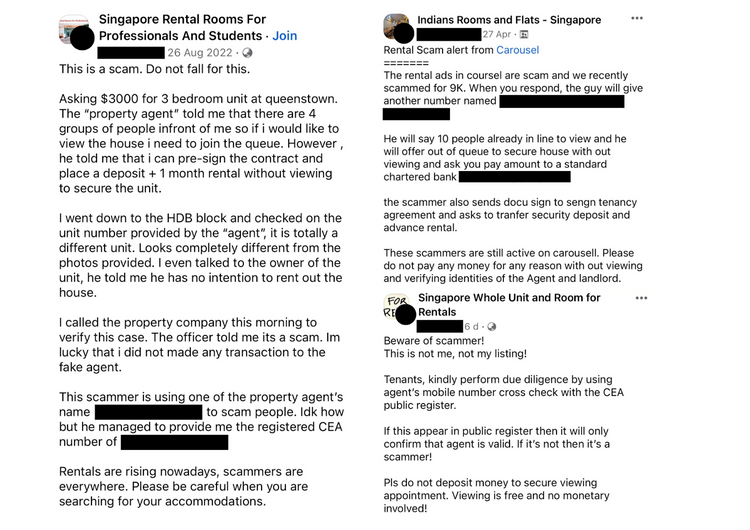
A Singapore property scam can look remarkably convincing. The advertisement may feature polished photographs, a plausible address, a real agent’s name and even a genuine Council for Estate Agencies registration number. Then the conversation moves to WhatsApp, demand appears overwhelming, and a “refundable” deposit is suddenly needed to reserve the unit.
That is the dangerous moment: when apparent legitimacy turns into artificial urgency.
Singapore’s property-listing verification platform is expected to launch in 2027, with backend checks and a unique code issued before an advertisement is published. Until then—and even after the platform arrives—buyers and tenants should verify four things separately: PRICE–PERSON–PLACE–PAYEE.
- Price: Does it fit recent transactions for genuinely comparable properties?
- Person: Does the exact telephone number belong to the registered property agent?
- Place: Have you inspected the exact unit and verified the advertiser’s authority?
- Payee: Does the recipient match the verified owner, seller or developer?
If any one of these checks fails, do not transfer money.
Why Fake Property Listings Remain Convincing
The stereotypical scam advertisement is poorly written and obviously suspicious. Real property scams are often more sophisticated.
Criminals can copy an authentic listing almost perfectly, including:
- Professional interior photographs
- Floor plans and descriptions
- The agent’s name and photograph
- A genuine CEA registration number
- An agency’s branding
- Tenancy agreements or Letters of Intent
- Stamp certificates and title screenshots
- Business cards and official-looking email messages
According to the Council for Estate Agencies, scammers have impersonated registered agents and reused legitimate property advertisements. The critical substitution is often the telephone number: the criminal uses a real agent’s identity but directs victims to a different WhatsApp account.
That is why searching for an agent’s name or registration number is not enough. The most useful identity check is to search the exact advertised telephone number on the CEA Public Register.
Singapore property scam losses have been substantial
Police and CEA figures show repeated waves of property-related scams. The periods overlap or use different reporting windows, so they should not be treated as a continuous annual series. They nevertheless demonstrate the scale of the risk.
| Reporting period | Reported victims or cases | Reported losses | Common method |
|---|---|---|---|
| January–August 2022 | At least 997 victims | S$3.9 million | Impersonation of registered agents and demands for payment before viewing |
| January–June 2023 | At least 616 victims | At least S$3.7 million | Fake Facebook or Carousell listings using genuine CEA details and photographs |
| July 2023–January 2024 | At least 389 victims | At least S$2.4 million | Pressure to pay quickly to secure a rental |
| January–October 2024 | More than 430 cases | At least S$2.7 million | Schemes including real units and viewings arranged through “personal assistants” |
Sources: Singapore Police Force advisory, August 2022, SPF industry announcement, November 2023, SPF advisory, February 2024 and CEA’s account of 2024 cases.
Reported Property Scam Losses by Reporting Period (S$ million)
These figures also show why one successful check cannot establish that an entire transaction is safe. A victim may meet someone at a real unit and still pay an unauthorised tenant or accomplice. A real agent’s identity can be attached to a fake number. A genuine-looking stamp certificate can be fabricated.
The correct approach is layered verification.
What Singapore’s 2027 Verified Listing Platform May Change
At the Singapore Estate Agents Conference on 28 July 2026, Senior Minister of State for National Development Sun Xueling announced that CEA would launch a full-scale platform in 2027 to verify online property listings.
According to reports by CNA and AsiaOne, the platform will conduct backend verification and issue a unique code before a listing is published.
It is intended to tackle four related but different problems:
- Properties that are fake or do not exist
- Advertisements placed without an owner’s authority
- Inaccurate property details
- Duplicate listings that distort apparent supply
The idea has been years in development. In November 2021, the Alliance for Action on Accurate Property Listings was formed, co-led by 99.co, PropertyGuru and the Singapore Estate Agents Association. Major estate agencies and EdgeProp also participated. The alliance subsequently proposed and tested a prototype that would authenticate listings before portal publication.
CEA’s 2021 media release described fake listings as both a consumer danger and a productivity problem. Duplicate, unavailable or invented units waste time, create false impressions of scarcity and undermine confidence in asking prices.
How the system evolved
| Date | Development |
|---|---|
| 2010 | CEA was established to license agencies, register agents and maintain a Public Register. |
| 2011 | Ethical-advertising guidelines prohibited dummy and misleading advertisements and required prior owner consent. |
| November 2021 | The Alliance for Action on Accurate Property Listings was formed. |
| 2021–2023 | A prototype involving authenticity checks and unique serial numbers was proposed and tested. |
| December 2022 | The competition regulator advised that access should rely on objective criteria and sensitive data should be limited to a need-to-know basis. |
| May 2024 | HDB launched its Resale Flat Listing service with verified information and one-listing control. |
| June 2026 | CEA improved the display of disciplinary and enforcement records in its Public Register. |
| July 2026 | The operational verification platform was confirmed for 2027. |
The earlier prototype concept associated its serial number with both the property and the agent marketing it. That is more meaningful than a permanent badge for an address because marketing authority can change even when the property does not.
What remains unknown
As of 1 August 2026, several practical questions have not been publicly resolved:
- Must every commercial portal participate?
- Will all residential, commercial and industrial sale and rental listings be covered?
- Can consumers check a code through a central government page?
- Which government and industry records will be queried?
- When will a code expire after a unit is sold, rented or withdrawn?
- How will direct-owner and direct-landlord listings be handled?
- Will verification confirm ownership at the point of payment?
- What remedy will consumers have if a coded listing is materially misleading?
These details matter. A code that confirms an agent was authorised to advertise a unit on Monday may not establish that the unit remains available on Friday. Nor would marketing verification necessarily prove that a bank account belongs to the owner.
HDB’s existing service offers a partial preview
The HDB Resale Flat Listing service already illustrates how verified data can improve a marketplace. A seller must personally register an Intent to Sell before listing. Important details such as the address, flat type and floor area are populated from HDB’s records, and only one listing may be posted for each flat.
Since May 2024:
- More than 12,500 verified HDB listings have been published.
- More than 60% proceeded to completed transactions.
- Close to four in ten completed transactions originating from the service involved owners who listed without an agent.
This model reduces inconsistent descriptions and duplicate stock. It does not remove the buyer’s obligation to inspect the flat, assess its condition, compare prices, check financing and follow the prescribed resale process.
The Singapore Property Scam Checklist: Six Immediate Red Flags
1. Someone demands a deposit before viewing
This is the clearest stop signal.
CEA states that no payment is required to secure a property viewing or rental. That applies regardless of how the request is described.
Be suspicious of demands for a:
- “Refundable viewing deposit”
- “Reservation fee”
- “Validation deposit”
- “Good-faith fee”
- Advance rental before inspection
- Payment to enter a viewing queue
The terminology is designed to make an abnormal request sound administrative. The explanation usually invokes competition: several other tenants supposedly want the same unit and the first person to transfer will receive priority.
High demand does not change safe payment practice. If the advertiser refuses to arrange a viewing without payment, stop.
2. The telephone number cannot be verified
Scammers frequently combine a real identity with a false contact channel. They may explain the mismatch by claiming that the agent recently changed numbers or that CEA takes two weeks to update its records.
CEA says telephone-number changes are reflected immediately.
Search the exact advertised or messaging number on the CEA Public Register. If there is no result, do not proceed through that contact. If a profile appears, compare:
- Registered name
- Profile photograph
- Registration status
- Estate agency
- Registered telephone number
- Recent residential transaction record
- Enforcement or disciplinary information
Then start a fresh call to the number shown in the register. Do not simply call back through the existing WhatsApp conversation.
Also obtain the agency’s main telephone number independently—through its official website or CEA record—and ask the agency to confirm that the agent is marketing the specific unit.
An incoming number displaying +65 is not proof of a Singapore-based caller or a genuine agent. CEA has documented number-spoofing cases.
3. The photographs appear elsewhere
A polished advertisement can be easier to fake because criminals can copy every visual asset from a genuine listing.
Run two or three interior photographs through Google Lens or another reverse-image search. Select images containing distinctive details such as:
- A unique balcony view
- Custom cabinetry or feature walls
- An unusual floor plan
- Recognisable neighbouring buildings
- A distinctive window orientation
- Furnishings that can be matched across advertisements
Search a memorable sentence from the property description inside quotation marks as well. Copied listings may preserve the original wording.
If identical images appear under different addresses, prices or agents, contact the registered agent and agency independently.
There are legitimate reasons for image duplication. Co-broking agents may market the same property, and developers may supply standard show-flat images. The important questions are whether the advertised address, unit characteristics, authority, availability and price are consistent.
A live video walkthrough can supplement these checks. Ask the advertiser to begin outside the building, show identifying common areas and continue into the unit without interruption. However, video is not a replacement for an in-person viewing or ownership verification.
4. The advertised price is improbably low—or changes immediately
An unusually cheap property is not automatically fraudulent. It may reflect poor condition, a difficult facing, low floor, urgent sale, awkward layout, short remaining lease or genuine negotiation.
The red flag appears when the advertiser cannot explain the difference—or admits that the advertised unit or price is unavailable.
In January 2026, The Straits Times reviewed more than 100 property advertisements and found numerous fake or misleading examples. A Bagnall Haus unit was advertised around S$100,000 below its actual price. An Arcady unit appeared at S$2.33 million, but the agent subsequently stated that it cost more than S$2.4 million.
This “bait” pattern commonly ends with one of two lines:
- “That unit was just taken, but I have another one.”
- “The displayed price is no longer available; the actual price is higher.”
Misleading advertisements can involve registered agents, not merely anonymous overseas criminals. If an agent will not confirm in writing that the displayed unit is currently available at the advertised price, treat the advertisement as lead generation and report it to the portal.
5. Payment is directed to an agent or unexplained third party
The payee is one of the most important checks in the entire transaction.
CEA’s transaction-money guidance states that property agents generally must not handle transaction monies relating to property sales or HDB leases. Agent commission should be paid to the property agency—not the individual salesperson.
Stop if:
- The PayNow recipient does not match the verified owner or contracting party.
- Funds are requested by an “assistant”, relative or finance officer.
- An alleged landlord’s representative cannot produce independently verifiable authority.
- The account changes midway through the transaction.
- Multiple recipients are introduced for different fees.
- Payment is requested through cash, cryptocurrency, gift cards or an overseas transfer.
- The advertiser discourages traceable bank transfers or crossed cheques.
A plausible explanation is not verification. Call the owner, agency, developer or lawyer through independently sourced contact information before following altered payment instructions.
6. Official-looking paperwork is presented as conclusive proof
Documents support a verified transaction; they do not create one.
Scammers can fabricate or alter:
- Tenancy agreements
- Letters of Intent
- Agent identity cards
- CEA emails
- Ownership screenshots
- Options to Purchase
- Stamp certificates
- Receipts and invoices
IRAS has specifically warned about fake stamp certificates and fraudulent demands for Additional Buyer’s Stamp Duty or “validation deposits” in rental situations.
ABSD is not payable on a tenancy agreement.
Stamp duty should be handled through IRAS-supported channels, and the resulting certificate should be authenticated independently. A PDF supplied over WhatsApp is not independent confirmation.
Is the Price Too Good to Be True?
There is no reliable rule that says a listing is fraudulent whenever it sits 10% below an average. Singapore’s property market contains wide variations between regions, projects, tenures, floors and individual units.
URA’s final Q2 2026 figures show why broad averages can mislead:
| Private residential indicator | Q2 2026 result |
|---|---|
| Overall price change | +0.5% quarter on quarter |
| H1 2026 price growth | +1.4% |
| Landed price change | +2.5% |
| Non-landed price change | −0.1% |
| CCR non-landed price change | +1.8% |
| RCR non-landed price change | −1.2% |
| OCR non-landed price change | −0.1% |
| Overall rent change | +0.7% |
| Resale transactions | 3,813 |
| Resale share of all transactions | 62% |
Q2 2026 Private Home Price Change by Segment (%)
ERA’s caveat analysis as of 1 July 2026 supplied further illustrations:
| Benchmark | Median price |
|---|---|
| Non-landed private resale | S$1,792 psf |
| Private sub-sale | S$2,430 psf |
| Hudson Place Residences | S$2,465 psf |
| Six-month RCR benchmark cited for comparison | Approximately S$2,643 psf |
| Tengah Garden Residences | S$2,113 psf |
| Vela Bay | S$2,862 psf |
Source: ERA’s Q2 2026 analysis.
Tengah Garden Residences and Vela Bay were both categorised as OCR launches, yet their recorded medians differed by S$749 psf. A single islandwide or regional figure therefore cannot determine whether a specific asking price is reasonable.
Compare like with like
For a meaningful price check, compare:
- The same condominium, HDB block or closely comparable nearby developments
- Similar floor areas and bedroom counts
- Comparable floor bands
- Similar facing, views and noise exposure
- Renovated units with units in similar condition
- The same tenure or comparable remaining lease
- Resale with resale, rather than a new launch with an older resale development
- Completed transactions rather than other advertisements
For private housing, URA provides sale and rental-contract information. Its project rental statistics include 25th-percentile, median and 75th-percentile PSF figures. For HDB flats, use HDB resale transaction resources and data.gov.sg rather than relying entirely on current asking prices.
A softer HDB market does not make every discount suspicious
HDB’s final resale price index for Q2 2026 stood at 202.8, down 0.3% quarter on quarter following a 0.1% decline in Q1. These were the first consecutive quarterly declines since 2019.
Industry analysis of the official figures found:
- 6,396 resale transactions in Q2 2026
- A 9.9% year-on-year decline in quarterly volume
- 12,681 transactions in H1 2026
- 491 million-dollar transactions in Q2
- Million-dollar deals representing 7.7% of quarterly resale volume
- A four-room Central Area median approaching S$1.2 million
- Four-room medians of at least S$1 million in Toa Payoh and Queenstown
Source: ERA’s Q2 2026 HDB report.
HDB Resale Transactions: Q2 and H1 2026
A softer index may give buyers more bargaining power, so a negotiated discount can be credible. An extreme gap from recent transactions for the same flat type, floor band and location still requires a clear explanation.
Rental comparisons require the same discipline
SRX estimated that in June 2026:
- Condominium rents rose 0.3% month on month and 2.4% year on year.
- Approximately 6,973 condominium leases were recorded.
- HDB rents rose 0.6% month on month and 1.4% year on year.
- Approximately 2,725 HDB flats were rented.
- Four-room flats represented 38.8% of estimated HDB rental volume.
Source: SRX’s June 2026 rental report.
These are market-level indicators, not valuations for individual units. A room near an MRT station, a whole flat with owner approval and a condominium unit with full furnishings cannot be judged against one broad rental average.
What to Check at Every Stage
A safer property search is not one giant background investigation. It is a sequence of small checks performed before risk increases.
Before contacting the advertiser
Save the full advertisement before it can be edited or removed. Keep:
- The URL
- Advertiser’s profile
- Date and time
- Stated address
- Asking price or rent
- Description and photographs
- Advertised telephone number
- Any platform verification badge
Then:
- Compare the asking figure with recent HDB or URA transactions.
- Reverse-search several photographs.
- Search distinctive description text in quotation marks.
- Check whether the arrangement is legally plausible.
- Read what any platform verification badge actually confirms.
For example, an HDB rental period shorter than six months is not permitted. An advertiser offering an unusually short whole-flat rental should therefore be questioned before documents or identity information are shared.
PropertyGuru’s voluntary verified-listing process requires an agent to submit an owner-signed advertising agreement. According to PropertyGuru’s rules, verification is free, may take up to five working days and generally lasts 90 days.
That badge is a useful signal, but not every listing is verified. It also does not establish that the payment account later supplied belongs to the owner.
Before arranging a viewing
Search the contact number on the CEA Public Register. Confirm that:
- Registration is current.
- The registered telephone number matches.
- The photograph and agency are consistent.
- The agent’s recent residential transactions are visible.
- Any listed enforcement action has been reviewed.
CEA enhanced the register in June 2026 to display enforcement actions from the preceding three years more clearly, including Letters of Censure, disciplinary proceedings and prosecutions. The agency explained the changes in its Public Register update.
Independently call the estate agency and ask it to confirm:
- The agent’s employment
- The property’s full address
- Whether the unit is currently available
- The advertised price or rent
- The agent’s authority to market it
Refuse every request to pay for a viewing.
At the viewing
Insist that the registered agent identified in the advertisement attends. If an assistant or colleague appears instead, independently confirm the arrangement with the registered agent and agency.
At the property:
- Match the unit number to the advertisement.
- Compare the actual layout, view and condition with the photographs.
- Ask who legally owns the unit.
- Ask who will sign the contract.
- Request evidence of the agent’s authority.
- Speak with the owner where possible.
- Clarify whether anyone currently occupies the unit.
- Note unexplained lockboxes, multiple tenant groups or occupants unaware of the listing.
A real viewing is important, but it is not conclusive. CEA documented 2024 cases in which scammers rented actual units and arranged convincing viewings through a supposed personal assistant. The victim saw a real home; the problem was that the advertiser lacked authority to lease it.
Before a tenant pays
The tenancy agreement should identify the verified owner and exact premises. Before transferring the deposit or advance rent:
- Obtain proof of ownership.
- Verify the agent’s authority to act.
- Confirm the owner’s identity independently.
- Match the payment recipient to the contracting owner.
- Record the deposit, advance rent and stamp-duty arrangements in writing.
- Authenticate the stamp certificate independently.
- Use a traceable payment channel.
For private property, ownership and title information can be checked through the Singapore Land Authority’s Land Titles Registry and INLIS.
For an HDB flat or bedroom, the owner must obtain the relevant HDB approval and register the tenant. The tenant can use HDB’s authorised-tenant enquiry service. HDB says the record is normally updated within two days of approval.
Pay the verified owner through a crossed cheque, PayNow or bank transfer after checking the recipient name. Do not transfer to an assistant or relative simply because the alleged landlord has supplied a letter of authorisation over WhatsApp.
Before an HDB buyer pays
HDB resale transactions follow a prescribed process.
Key safeguards include:
| HDB resale payment term | Limit or requirement |
|---|---|
| Maximum option fee | S$1,000 |
| Maximum option fee plus exercise fee | S$5,000 |
| Standard option period | 21 calendar days |
| Payment recipient | Seller, not agent |
| Required form | Prescribed HDB Option to Purchase without amendments |
Source: HDB resale purchase terms.
Both parties subsequently complete the transaction through the HDB Flat Portal. A request for an oversized “reservation deposit” paid to an agent falls outside this prescribed framework.
Before buying an uncompleted private home
Verify that the developer and housing project are legitimate. URA’s Home Buyer’s Guide explains that a developer must provide prescribed project and unit information before accepting a booking fee.
The regulated booking fee is generally 5% to 10% of the purchase price and is paid to the developer for issuance of the standard Option to Purchase. It is not transferred to an individual marketing agent.
For a completed private resale home, appoint a conveyancing lawyer to verify:
- Registered title
- Seller’s identity
- The Option to Purchase
- Encumbrances and relevant restrictions
- Payment instructions
- Completion arrangements
Material sums should not be transferred based solely on messaging-app instructions.
Official Singapore Channels to Bookmark
| What you need to verify | Official channel | What it can establish |
|---|---|---|
| Property agent | CEA Public Register | Registration, registered phone, agency, photograph, recent residential transactions and enforcement history |
| HDB resale advertisement | HDB Resale Flat Listing | Government-populated flat details and one-listing control |
| HDB rental status | HDB authorised-tenant enquiry | Whether approval was obtained and the tenant was registered |
| Private ownership and title | SLA INLIS | Ownership and title information |
| Private prices and rents | URA property-market data | Five years of sales and rental-contract information |
| HDB resale comparables | HDB and data.gov.sg | Registered resale transactions and median prices |
| Stamp certificate | IRAS | Certificate authenticity and applicable duty treatment |
| Suspicious approach | ScamShield or 1799 | Scam guidance and escalation |
| Agent misconduct | CEA complaint form | Reporting misleading or unauthorised advertising and estate-agency misconduct |
| Suspected crime | Singapore Police Force | Police reporting and evidence submission |
No portal badge or screenshot should replace an official lookup performed independently.
What Buyers, Investors and Tenants Should Prioritise
Buyers: separate listing accuracy from property quality
A genuine listing can still be a poor purchase.
Even if a future verification code confirms that the unit exists and the agent has marketing authority, buyers must assess:
- Fair value
- Financing affordability
- Remaining lease
- Physical defects
- Unauthorised alterations
- Renovation requirements
- Title and legal restrictions
- Future supply in the area
Fake and bait listings can anchor expectations at an artificially low level. Once a buyer has emotionally committed to a location or project, the advertiser may redirect the conversation to a more expensive property. Written confirmation of availability and asking price helps expose that tactic early.
Investors: use completed evidence for yield calculations
An unsupported “achievable rent” can make an ordinary property appear to offer an attractive yield.
Investors should distinguish among:
- Current asking rent
- Signed tenancy rent
- Stamped rental evidence
- Project median rent
- Net rent after vacancy, maintenance and other costs
A verified listing code would validate part of the marketing chain. It would not guarantee occupancy, tenant quality, rental growth, capital appreciation or investment value.
Tenants: prioritise authority and payee verification
Tenants often face the most immediate risk because a deposit and advance rent can be transferred within minutes.
Those under time pressure—including foreign students, newly arrived employees and relocating families—may be especially vulnerable to claims that viewings are unavailable or immediate payment is customary.
The safest response is procedural:
- Do not pay before viewing.
- Verify the exact number on CEA’s register.
- Confirm ownership and authority.
- Check HDB approval where applicable.
- Match the bank recipient to the owner.
- Authenticate documents through official channels.
Legitimate owners and agents: copied listings harm them too
Property scams do not only affect victims who lose money. Copied advertisements can damage a genuine agent’s reputation and direct angry victims towards someone whose identity was stolen.
Owners may face unauthorised visitors, privacy risks and photographs of their homes circulating across platforms. Duplicate and bait listings also waste marketing budgets and create false impressions of supply.
When a copied listing is found, notify both the genuine agent and agency through verified channels. They may be able to report the impersonation and protect other home-seekers.
Existing Rules Already Prohibit Fake and Misleading Listings
CEA’s ethical-advertising requirements have long required agents to:
- Obtain the owner’s prior consent.
- Advertise only an actual, available property.
- Provide accurate information about photographs, floor area, tenure, price and rent.
- Include the agent’s registered name and CEA number.
- Display the registered contact number.
- Identify the agency and its licence number.
- Avoid false or misleading statements.
Enforcement is not merely theoretical. CEA reported that the same salesperson was disciplined twice for repeated inaccurate pricing and misleading advertisements: a S$14,000 fine and five-month suspension in 2023, followed by a S$28,000 fine and six-month suspension in 2025. ERA received a Letter of Censure for supervisory failures, according to CEA’s enforcement account.
CEA recorded 328 enforcement outcomes in 2023 and 331 in 2024, covering warnings, Letters of Censure, disciplinary proceedings and prosecutions. These totals cover all enforcement categories and are not counts of fake listings. Source: CEA enforcement statistics.
Online platforms are also subject to anti-scam measures. Under the Online Criminal Harms Act’s E-Commerce Code, designated services must introduce detection, reporting and identity-verification measures. Carousell states that Singpass verification is mandatory for new Property-category listings.
Identity verification is useful, but it establishes who controls an account—not necessarily that the person owns or has authority over a specific home.
What to Do If You Suspect a Scam
If a listing becomes suspicious, do not argue with the advertiser or send a small “test” payment.
- Stop communication and make no further transfers.
- Save the evidence, including the advertisement, URL, account profile, phone numbers, messages, documents, bank details and receipts.
- Contact your bank immediately and ask whether a transfer can be frozen or recalled.
- File a police report.
- Report the listing and account to the platform.
- Contact the genuine agent and agency through independently obtained details if an agent’s identity was copied.
- Submit a CEA complaint for misleading advertising, unauthorised advertising, agent misconduct or unlicensed estate-agency activity.
- Call ScamShield at 1799 if you are uncertain about the next step.
- Protect personal information by avoiding public posts containing unredacted identity documents or bank details.
ScamShield’s property-scam guidance advises victims to preserve communications, stop further payments and make a police report.
Fast action matters after money is sent. It does not guarantee recovery, but delays can reduce the possibility of freezing funds.
Food for Thought
- If an advertisement is verified, what exactly has been confirmed: the identity, the property, current availability, marketing authority or all four?
- Would you still transfer a deposit if the listing carried a code but the PayNow recipient did not match the owner?
- Are you comparing an attractive price with completed transactions—or merely with other asking prices that may also be inaccurate?
- If a real viewing can be staged, what independent evidence would satisfy you that the person offering the property has authority?
- How much urgency would it take for you to skip a check that protects several thousand dollars?
Conclusion: Verify Before You Trust
Singapore’s 2027 listing-verification platform should make fake, duplicate, inaccurate and unauthorised advertisements harder to publish. It may also give genuine agents and owners a cleaner marketplace with fewer wasted enquiries.
It will not make due diligence obsolete. A verified advertisement can still be stale, overpriced or attached to altered payment instructions outside the portal. Until the new platform’s coverage and consumer protections are fully known, the most reliable safeguard remains PRICE–PERSON–PLACE–PAYEE.
Check the price against comparable transactions. Search the exact telephone number. Inspect the precise property and verify authority. Match every payment to the rightful recipient.