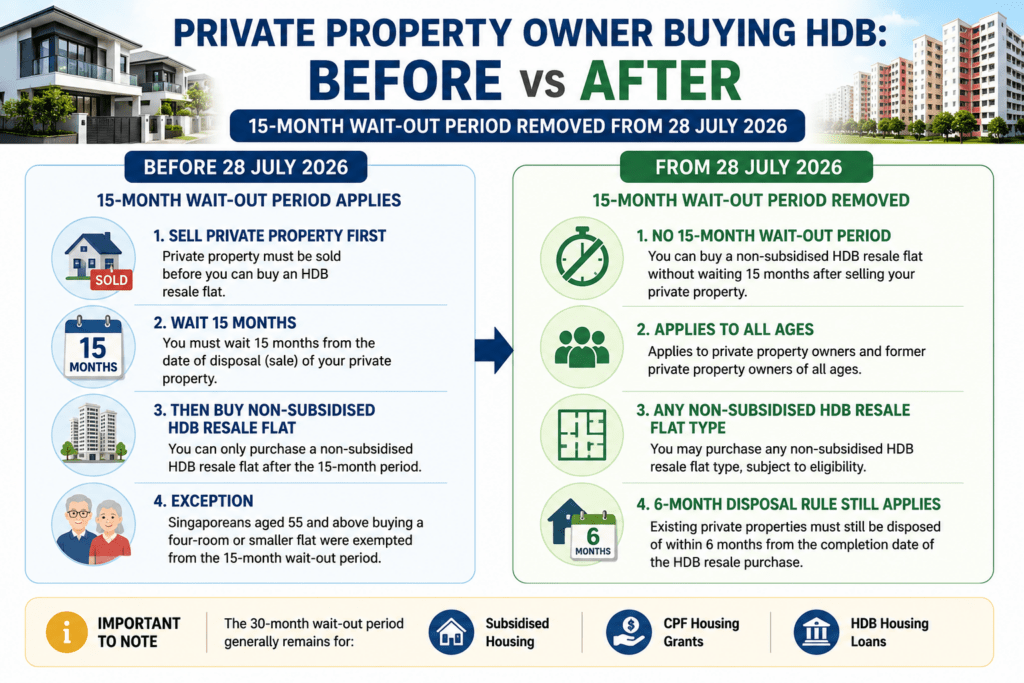
Singapore’s 15-month HDB wait-out period has been removed, giving private-property owners and recent former owners a faster route into the HDB resale market. From 28 July 2026, an eligible household may buy a qualifying non-subsidised resale flat without waiting 15 months—but only if it uses private financing and disposes of every local and overseas private residential property interest within six months of completing the HDB purchase.
That distinction matters. The policy removes a transaction-timing obstacle; it does not allow buyers to keep a condominium as an investment while moving into public housing. Nor does it remove the separate 30-month restriction attached to subsidised housing routes, ordinary housing grants and HDB loans.
For genuine right-sizers, however, the practical difference is substantial. Instead of selling a private home, renting for 15 months and moving twice, a household can secure its replacement flat first and sell its private properties afterward.
Here is who can use the new route, who still has to wait, and why financing may prove harder than eligibility.
What Changed When the 15-Month HDB Wait-Out Period Was Removed?
Before September 2022, eligible private-property owners could generally purchase a non-subsidised HDB resale flat and then dispose of their private property within six months.
That sequence changed on 30 September 2022. Under a temporary cooling measure, most private residential property owners had to:
- Sell all private residential properties.
- Wait 15 months.
- Buy a qualifying HDB resale flat.
The measure was introduced during an exceptional period of HDB resale price growth. The Government was concerned that private-property owners, who might possess more financial resources, could outbid first-time buyers or pay larger cash-over-valuation amounts.
A limited exemption remained for Singapore citizens aged 55 or older who were buying a four-room or smaller non-subsidised resale flat. Other households could appeal, but approval was reserved mainly for financial hardship or exigent circumstances.
On 28 July 2026, the Government removed the wait with immediate effect. According to the official HDB announcement, eligible private-property owners may once again buy first and dispose of their properties within six months.
The policy journey can be summarised as follows:
The Government cited better-balanced market conditions. HDB resale prices fell 0.1% quarter-on-quarter in Q1 2026 and another 0.3% in Q2, while transaction volumes were lower than a year earlier. More flats are also expected to reach their Minimum Occupation Period, potentially enlarging the future resale supply pool.
This followed several years of remarkable appreciation. The HDB Resale Price Index rose from 131.5 in Q4 2019 to 203.6 in Q4 2025, an increase of about 54.8%.
HDB Resale Price Index, Q4 2019 to Q2 2026
The chart explains the policy context. The wait-out period was introduced amid rapid appreciation and removed only after the index had levelled off and recorded two modest quarterly declines. The source figures come from HDB’s historical RPI table and its Q2 2026 public-housing release.
The Rule in One Sentence
A private residential property owner may now buy a qualifying non-subsidised HDB resale flat without an HDB loan, provided the household satisfies all other HDB conditions and disposes of every private residential property interest in Singapore and overseas within six months after HDB completion.
Four parts deserve emphasis:
- Non-subsidised resale only: The immediate route does not extend to BTO or SBF flats.
- No HDB loan: Financing must come from a bank or other MAS-regulated financial institution, CPF savings, cash, or a combination.
- Total disposal: The buyer cannot retain a local condominium, overseas home or relevant partial residential interest.
- Normal eligibility still applies: An HFE letter, an eligible household scheme, citizenship rules, quotas and flat-specific conditions remain in force.
The change therefore benefits owner-occupiers who genuinely intend to leave private residential ownership. It is not an HDB-plus-condo investment strategy.
Who Can Buy an HDB Resale Flat Immediately Now?
Several groups may benefit, but “immediately” refers only to the removal of the 15-month policy delay. Buyers must still complete the HFE, financing, valuation and conveyancing process.
Private-home owners who want to right-size
The clearest beneficiary is a household moving from a condominium or landed home into an HDB resale flat.
Under the former rule, a typical sequence was:
- Sell the private home.
- Find a rental property.
- Move into temporary accommodation.
- Wait 15 months.
- Find and purchase an HDB resale flat.
- Renovate and move again.
Now the household can secure its HDB flat before relinquishing the private home, provided it can finance the transaction and complete every required disposal within six months after the HDB purchase.
This offers several practical advantages:
- It can eliminate a 15-month rental bridge.
- The household may avoid moving twice.
- Renovation and moving dates can be coordinated more efficiently.
- The family has more certainty about its next home before selling.
- It is less exposed to short-term rental-price changes.
The six-month deadline is nevertheless strict enough to require careful planning. A buyer should not commit to an HDB flat on the assumption that any private property can “probably” be sold in time.
Former private-property owners who sold less than 15 months ago
Suppose a household sold its condominium six months ago and intended to purchase a non-subsidised HDB resale flat. Under the previous rule, it might have had another nine months to wait.
That remaining wait has now been removed for the eligible privately financed resale route. The household may proceed once it has a valid HFE letter and meets the other conditions.
The same former owner would still face the relevant 30-month wait when pursuing a subsidised route, such as:
- A BTO or SBF flat
- An ordinary CPF Housing Grant for a resale flat
- An HDB housing loan
- A new executive condominium purchased from a developer
The removal of 15 months should therefore not be interpreted as the removal of all private-property ownership history tests.
Seniors seeking five-room or executive flats
The previous exemption largely covered Singapore citizens aged at least 55 buying four-room or smaller non-subsidised resale flats.
With the broader wait-out period removed, an otherwise eligible senior household may consider a five-room or executive flat. This could suit older parents who want:
- Space for a live-in caregiver
- A room for visiting adult children
- Multigenerational living arrangements
- Proximity to family without downsizing as sharply
- An accessible home in a familiar neighbourhood
According to Singapore Business Review’s report, a senior holding an HFE letter issued under the former exemption may need to cancel it and reapply when switching to a larger flat.
More choice does not automatically make a larger purchase financially sensible. Seniors should compare the flat price, renovation expenditure, CPF refunds and remaining retirement liquidity rather than focusing only on the amount unlocked by selling a private home.
Eligible single Singapore citizens
Removing the wait-out period does not remove the singles age rules.
A single Singapore citizen may generally purchase an unclassified or Standard resale flat from age 35. Widowed or orphaned applicants may qualify from age 21 in specified circumstances, subject to the applicable HDB scheme.
A 32-year-old private-home owner cannot use this policy change to bypass the singles age requirement. Likewise, a qualifying single buyer must still obtain an HFE letter, satisfy the relevant flat conditions and dispose of all private residential interests.
The detailed rules are set out in HDB’s singles eligibility guidance.
Eligible Singapore permanent resident households
An all-SPR household may qualify to purchase a resale flat if it forms an eligible family nucleus and the relevant core members have generally held permanent resident status for at least three years.
SPR households remain subject to:
- The applicable family-nucleus rules
- The three-year SPR-status requirement
- The Ethnic Integration Policy
- The non-Malaysian SPR quota
- The HFE assessment
- The six-month private-property disposal condition
- The relevant stamp-duty treatment
Additional Buyer’s Stamp Duty requires particular attention. IRAS guidance gives the example of an SPR private-apartment owner paying 5% ABSD when right-sizing to an HDB flat because disposal of the private property is compulsory.
The precise treatment depends on the approved acquisition and household circumstances, so buyers should rely on formal HDB and IRAS assessments rather than informal assumptions.
HDB Resale Eligibility Flowchart After the Rule Change
The simplest way to understand the revised framework is to separate the immediate, non-subsidised route from the routes that remain subject to the 30-month rule.
Passing through the flowchart means satisfying several distinct tests.
An eligible household scheme
Depending on the route, this may include:
- A qualifying family nucleus with the relevant citizenship and relationship requirements
- An eligible all-SPR household
- A Singapore citizen buying under an applicable singles scheme
- Specified widowed or orphaned applicants aged at least 21
The policy announcement did not create a separate household scheme for private-property owners.
A valid HFE letter before the OTP
A buyer must have a valid HDB Flat Eligibility letter before obtaining an Option to Purchase and again at resale submission.
HDB states that processing may take up to one month after all required documents have been submitted. An issued HFE letter is generally valid for nine months, according to its HFE application guidance.
Affected pending applications are expected to be updated for the new policy. Buyers who previously appealed against the 15-month wait may submit or continue the HFE process under the revised conditions.
“Immediate” therefore does not mean that a buyer can view a flat today and safely sign an OTP tomorrow without prior eligibility approval.
A flat that passes quota and classification rules
The selected flat must remain available to the buyer under:
- The Ethnic Integration Policy
- The non-Malaysian SPR quota, where relevant
- Flat-type and remaining-lease rules
- The Standard, Plus or Prime classification conditions
- Any other household-specific restrictions
Plus and Prime resale flats carry BTO-style eligibility restrictions. Buyers should not assume that removing the general wait for a non-subsidised resale purchase overrides those conditions.
Financing without an HDB loan
This is likely to be the most consequential condition for many households.
A buyer using the immediate route must rely on:
- A loan from a bank or another MAS-regulated financial institution
- CPF Ordinary Account savings, subject to CPF rules
- Cash
- A combination of these sources
A household unable to obtain sufficient private financing cannot switch to an HDB loan and still treat the transaction as an immediate purchase under this route. Seeking an HDB loan reintroduces the applicable 30-month private-property restriction.
What Has Not Changed?
The announcement is easier to interpret when placed beside the restrictions that remain intact.
| Rule or purchase route | Position after 28 July 2026 |
|---|---|
| Non-subsidised resale flat without an HDB loan | 15-month wait removed |
| Disposal of private residential property | Still required within six months after HDB completion |
| Singapore and overseas residential interests | All relevant interests must be disposed of |
| HFE letter | Still required before obtaining an OTP |
| HDB housing loan | Unavailable under the immediate route |
| BTO or SBF flat | Applicable 30-month wait continues |
| Ordinary CPF Housing Grants for resale | Applicable 30-month wait continues |
| New EC bought from a developer | Applicable 30-month wait continues |
| Plus and Prime resale flats | Subject to their additional resale eligibility rules |
| EIP and SPR quota | Continue to apply |
| Owner occupation and MOP | Continue to apply |
| Keeping the private home as an investment | Not permitted under this route |
The Proximity Housing Grant has historically received different treatment from ordinary housing subsidies in some resale arrangements. As post-announcement pages and HFE assessments are updated, households intending to claim the PHG should not assume compatibility. The issued HFE letter should confirm the approved route.
The Six-Month Disposal Rule Is Broader Than Many Buyers Realise
A current private-property owner must dispose of every applicable interest in private residential property, not merely the home in which the family lives.
According to HDB’s resale purchase terms and conditions, private-property interests are defined broadly. A buyer’s inventory should consider:
- Condominiums and landed homes in Singapore
- Residential properties overseas
- Partial ownership shares
- Inherited residential interests
- Beneficial interests
- Properties held through relevant nominees or trust arrangements
- Other interests captured by HDB’s prevailing definitions
This can become complicated when ownership is not straightforward. An inherited one-quarter share in an overseas house may be harder to dispose of than a wholly owned Singapore condominium. Probate, co-owner consent, foreign taxes, title registration and currency controls can all affect the timeline.
Before obtaining an OTP, buyers should establish:
- What interests each household member owns.
- Whether every interest is residential property under the applicable rules.
- What legal steps are required for disposal.
- Whether completion is realistically achievable within six months.
- What happens if a co-owner or overseas authority causes delay.
The deadline should be treated as a compliance requirement, not an aspirational sale target.
Financing May Be the Real Wait-Out Period
The policy makes a household eligible to move sooner, but it does not necessarily make the purchase affordable.
A private-home owner who buys an HDB flat before selling may temporarily hold two properties and possibly two mortgages. That can reduce the available loan-to-value ratio and increase the cash required at completion.
Bank-loan limits
For a bank-financed HDB purchase, the broad regulatory limits include:
| Financing measure | General limit or treatment |
|---|---|
| Mortgage Servicing Ratio | 30% of gross monthly income |
| Total Debt Servicing Ratio | 55% of gross monthly income |
| Maximum LTV with no outstanding housing loan | Generally 75% |
| Lower LTV for certain longer-tenure or age cases | 55% |
| Maximum LTV with one outstanding housing loan | Generally 45% |
| Lower category with one outstanding housing loan | 25% |
| Typical minimum cash downpayment with no outstanding housing loan | 5% |
| Potential minimum cash component with another housing loan | 25% |
These are broad ceilings described in the MoneySense property affordability guide. A lender may approve less after considering income stability, age, existing debt and loan tenure.
Consider the contrast for a flat valued at $800,000:
- At a 75% LTV, the maximum loan would be $600,000.
- At a 45% LTV, the maximum would be $360,000.
- The difference in funding required from CPF and cash would be $240,000, before duties, renovation and any cash-over-valuation.
This is only an illustration of the regulatory percentages, not a quote from a lender. It shows why transaction sequencing remains crucial. Selling or redeeming the private mortgage first could materially alter the financing outcome, even though HDB no longer requires a 15-month wait.
The sensible order is to obtain in-principle bank approval based on the household’s actual position—including the existing mortgage—before committing to an OTP.
CPF usage while another property is still owned
CPF rules can also become more restrictive.
A buyer who still owns another property may be treated as using CPF for a second or subsequent property. Ordinary Account savings can generally be used only after setting aside the applicable Basic or Full Retirement Sum, depending on the remaining lease of the existing property. The relevant principles are explained in the CPF Board’s property-use guidance.
Other practical constraints include:
- Cash-over-valuation must be paid in cash.
- CPF use is tied to the property valuation and applicable withdrawal limits.
- CPF refunds from the private-property sale may arrive only after the HDB purchase.
- For sellers aged 55 or older, refunded CPF may first top up the Retirement Account.
- The cash proceeds available after a sale may be lower than the headline sale price suggests.
A right-sizer should prepare a full funds-flow schedule, not merely compare the sale price of the condominium with the purchase price of the HDB flat.
Stamp duties can change the economics
Buyer’s Stamp Duty remains payable on the HDB purchase.
For ABSD, IRAS provides remission mechanisms for approved HDB acquisitions. Where any purchaser is a Singapore citizen, full ABSD remission may apply to an approved acquisition. An eligible SPR acquisition subject to compulsory private-property disposal may receive the prescribed reduced treatment. The details appear in IRAS’s HDB remission rules.
The remission is linked to HDB approval and compliance with the disposal condition. Buyers should not treat it as detached from the six-month deadline.
Seller’s Stamp Duty on the outgoing private property can be an even larger issue. Private residential properties purchased on or after 4 July 2025 are subject to a four-year SSD schedule:
| Holding period covered by current schedule | SSD rate |
|---|---|
| First year | 16% |
| Second year | 12% |
| Third year | 8% |
| Fourth year | 4% |
Source: IRAS’s residential Seller’s Stamp Duty schedule.
A recent private-home buyer who commits to an HDB flat must still dispose of the private property within six months. If that disposal attracts SSD, the convenience created by the new policy could come with a substantial tax cost.
The HDB Resale Market Is Calmer—but Not Cheap
The wait-out period was removed against a softer market backdrop, not a return to pre-pandemic price levels.
| Q2 2026 market indicator | Latest result | What it suggests |
|---|---|---|
| HDB Resale Price Index | 202.8 | Down 0.3% quarter-on-quarter |
| Q1 2026 price change | -0.1% | First quarterly decline in nearly seven years |
| H1 2026 price change | -0.4% | Versus +2.5% in H1 2025 |
| Q2 resale transactions | 6,396 | Up 1.8% from Q1; down 9.9% year-on-year |
| H1 resale transactions | 12,681 | Down 7.4% year-on-year |
| Q2 million-dollar transactions | 491 | 7.7% of quarterly transactions |
| June million-dollar transactions | 188 | Record month; 8.8% of June sales |
| Q2 rental approvals | 10,002 | Up 4.9% quarter-on-quarter |
Sources include HDB’s Q2 public-housing data, ERA’s quarterly analysis and the 99-SRX June market report cited in the research.
Prices edged down at the index level, but the average transaction price rose because more sales involved expensive flat types.
Average HDB Resale Price by Flat Type, Q2 2026
According to EdgeProp’s Q2 transaction analysis, the average across all flat types reached $661,196, up 0.4% quarter-on-quarter even as the resale index fell 0.3%.
This is a useful reminder that an index and an average price answer different questions. The index seeks to track underlying market movement, while the average can rise simply because the quarter contains more large or well-located flats.
Location Premiums Remain Substantial
Private-home right-sizers are not expected to distribute their demand evenly across Singapore. Analysts anticipate greater interest in larger, newer and conveniently located flats—particularly homes that offer some of the space or accessibility associated with private housing.
June 2026 median prices illustrate the gap between mature central towns and more affordable suburban alternatives.
| Town | Four-room median | Five-room median |
|---|---|---|
| Queenstown | $1,092,500 | $1,260,000 |
| Toa Payoh | $1,029,000 | $1,222,500 |
| Tampines | $650,000 | $830,888 |
| Woodlands | $545,000 | $669,000 |
June 2026 Five-Room HDB Median Prices by Selected Town
The town figures come from 99.co and SRX resale data. Some town and flat-type cells contain fewer than 20 monthly transactions, so they should be treated as indicative market observations rather than formal valuations.
PSF figures also require care because HDB flats differ considerably in lease age, size and model. A notable premium transaction occurred in July 2026, when a two-room Queenstown flat reportedly sold for $696,000, or approximately $1,375 psf, setting a national record for that flat type. The transaction was reported by 99.co.
For broader—but non-official—context, a listing-based dataset recorded a median asking price of approximately $611 psf across 29,429 HDB resale listings on 22 June. That PropKaki measure reflects asking prices, not completed transactions or the official HDB index.
Could Removing the 15-Month Wait Push Up Resale Prices?
The likely effect is selective rather than islandwide.
Larger flats may receive a demand nudge
PropNex CEO Kelvin Fong expects the change to improve mobility for empty-nesters and households whose circumstances have shifted. PropNex highlighted the decline in larger-flat transactions immediately after the 2022 restriction:
| Flat segment | Q3 2022 volume | Q4 2022 volume | Quarter-on-quarter change |
|---|---|---|---|
| Five-room | 1,853 | 1,495 | -19.3% |
| Executive | Not stated in source summary | 418 | -22.0% |
Neither segment subsequently exceeded its Q3 2022 quarterly volume through H1 2026, according to PropNex’s policy commentary.
Removing the wait could return some of that demand, especially for:
- Five-room flats
- Executive apartments
- Newer flats
- Homes near MRT stations and amenities
- Flats in central or mature estates
- Units suited to multigenerational households
A two-speed market is plausible
OrangeTee expects a possible “two-speed” resale market:
- Larger, newer and centrally located flats may attract stronger demand.
- Smaller, older or less conveniently located flats may remain subdued.
This is more plausible than a uniform price surge because right-sizers form only part of the buyer pool, and many will have specific space, location and accessibility requirements. OrangeTee’s assessment also suggests rental demand could soften for larger HDB flats and smaller condominiums previously used as temporary homes.
Financing limits should restrain demand
The immediate route excludes HDB loans. Buyers carrying an existing mortgage may face a lower LTV, a larger cash component and tighter CPF access.
These constraints distinguish potential interest from effective purchasing power. A household may now be legally eligible to buy but still decide to sell first, redeem its mortgage or choose a cheaper flat.
More MOP supply is approaching
ERA describes the relaxation as a measured response to a more balanced market. It projects approximately 21,393 flats reaching MOP in 2028, more than three times the 2025 figure, and maintains a forecast of 26,000 to 27,000 HDB resale transactions in 2026.
The Government has also announced:
- 19,600 BTO flats planned for 2026
- About 11,644 BTO flats and 4,320 SBF flats in the first two 2026 exercises
- A further 7,960 BTO flats expected in October 2026
A flat reaching MOP does not automatically become a resale listing. Owners must choose to sell. Nevertheless, a larger eligible supply pool can help absorb incremental demand over time.
What the Change Means for Different Groups
First-time resale buyers
First-timers could face added competition for the same flats preferred by private-home right-sizers, especially:
- Five-room and executive flats
- Newer-MOP projects
- Central and city-fringe locations
- Units near parents, schools or MRT stations
- Rare layouts and high-floor units
However, the policy does not admit private owners directly into BTO purchases. Slower overall resale growth, lower year-on-year volumes, private-financing constraints and future MOP supply may also limit the effect.
A first-time buyer should assess comparable transactions at the project and block level instead of reacting to headlines about a broad new wave of demand.
Seniors and empty-nesters
Older households now have more freedom to select a home around caregiving, family proximity and accessibility. Yet right-sizing should still release capital rather than merely exchange one expensive property for another.
A useful calculation is:
Net retirement capital = private sale proceeds − outstanding mortgage − CPF refund − duties and selling costs − HDB purchase price − renovation and moving costs
For sellers aged 55 or older, CPF refunds may be directed first toward the Retirement Account where required. The amount visible as private-home equity may therefore differ from the cash that remains available after the transaction.
Buyers with overseas homes
This group faces one of the greatest compliance risks. Foreign disposals may involve:
- Probate or succession procedures
- Local capital-gains or transfer taxes
- Co-owner approvals
- Title-registration delays
- Exchange-control requirements
- Restrictions on remitting proceeds
- Different definitions of legal and beneficial ownership
The buyer needs confidence not merely that the property can be marketed within six months, but that the relevant interest can be legally disposed of within HDB’s deadline.
Tenants and landlords
The former wait created a small captive rental group: households with the financial means to buy an HDB resale flat but temporarily prohibited from doing so.
Removing the delay may reduce marginal demand for:
- Larger HDB rental flats
- Smaller private condominiums used as interim homes
- Leases designed around a 15-month timetable
- Storage associated with two-stage moves
The nationwide effect should remain modest. Q2 2026 still recorded 10,002 HDB rental approvals, while private residential rents rose 0.7% quarter-on-quarter.
Private-home sellers and investors
The policy may produce more condominium and landed-home listings as right-sizers secure HDB flats first and sell afterward.
Potential effects include:
- More resale inventory from genuine right-sizers
- Better transaction liquidity between the public and private markets
- Greater negotiating pressure on owners approaching the six-month deadline
- Less interim private rental demand
- More willingness to buy the replacement home before accepting an offer
This does not amount to an investment loophole. The household must relinquish its private residential interests and observe HDB owner-occupation restrictions.
The private market itself remained relatively firm in Q2 2026. According to URA statistics:
- Private residential prices rose 0.5% quarter-on-quarter.
- Private rents rose 0.7%.
- Private resale transactions increased 18.2% to 3,813.
- Resale homes accounted for 62% of all private residential sales.
- Vacancy edged up to 6.4%.
A modest increase in right-sizer listings is therefore more likely to improve choice than trigger a broad private-market correction by itself.
The MOP Still Draws a Firm Boundary
After buying the HDB flat, the household must occupy it as a home.
For an unclassified or Standard resale flat, the buyer generally observes a five-year Minimum Occupation Period. During the applicable MOP, restrictions generally cover:
- Selling the HDB flat
- Renting out the whole flat
- Acquiring another private residential property
- Treating the flat as a passive investment asset
Plus and Prime flats are subject to their respective conditions, which can be more restrictive.
The policy’s logic is therefore consistent: it facilitates movement from private housing into owner-occupied public housing, while preserving the separation between an HDB home and a private residential investment portfolio.
A Practical Checklist Before Taking an OTP
A private-property owner considering the immediate route should verify all of the following.
Eligibility and flat selection
- Purchase route: Confirm that the flat qualifies for a non-subsidised resale purchase.
- Household scheme: Check age, citizenship, relationship and family-nucleus rules.
- HFE letter: Ensure it accurately reflects existing property interests and intended financing.
- Classification: Confirm whether the flat is unclassified, Standard, Plus or Prime.
- Quotas: Check the EIP and, where relevant, the SPR quota before paying for an OTP.
- Remaining lease: Confirm that lease conditions support the intended financing and CPF use.
Private-property disposal
- Full inventory: Identify every local and overseas residential interest.
- Ownership form: Include inherited, partial and beneficial interests.
- Sale timeline: Establish whether completion within six months is realistic.
- SSD exposure: Check when the private home was acquired.
- Foreign requirements: Account for probate, tax, title and remittance procedures.
- Fallback: Decide what can be done if a sale is delayed or the offer is below expectations.
Financing and cash flow
- In-principle approval: Obtain a bank assessment while the existing mortgage is still outstanding.
- LTV: Confirm the applicable loan ceiling rather than assuming 75%.
- Cash component: Budget for the required minimum cash downpayment.
- CPF availability: Check second-property and retirement-sum rules.
- COV: Maintain cash reserves for any amount above valuation.
- Duties and fees: Include BSD, applicable ABSD treatment, legal costs and agent fees.
- Renovation: Avoid using every available dollar for the purchase price.
- Timing gap: Model what happens if private sale proceeds arrive after HDB completion.
Occupation and long-term plans
- MOP commitment: Be prepared to occupy the flat for the required period.
- No new private home: Do not plan another residential acquisition during the MOP.
- Space needs: Choose a flat that suits the household rather than simply maximising size.
- Retirement liquidity: Calculate what remains after CPF refunds and all transaction costs.
Food for Thought
-
If bank financing is much less generous while your existing mortgage remains outstanding, does buying the HDB first still improve your position—or merely replace a rental problem with a cash-flow problem?
-
Would a five-room or executive flat genuinely support your family’s future needs, or would a smaller flat preserve substantially more retirement capital?
-
If your preferred town has million-dollar transactions and limited supply, how much of its premium reflects enduring accessibility rather than recent buyer enthusiasm?
-
Can every overseas, inherited or partial private-property interest be legally disposed of within six months, including delays outside your control?
-
If right-sizer demand concentrates in newer and central flats, could a nearby older project offer better value without sacrificing the amenities that matter most?
Conclusion
The removal of the 15-month HDB wait-out period gives private-home owners a more practical route to right-size. Eligible buyers no longer have to sell, rent for 15 months and move twice before purchasing a non-subsidised resale flat.
But the boundary remains clear. The household must use private financing, obtain a valid HFE letter, satisfy ordinary eligibility and quota rules, and dispose of every applicable Singapore and overseas private residential interest within six months. Buyers seeking a BTO or SBF flat, an ordinary resale grant, an HDB loan or a new developer EC remain subject to the applicable 30-month framework.
The likely market effect is similarly bounded. Larger, newer and centrally located flats may receive more attention, but weaker aggregate volumes, bank-loan constraints and incoming MOP supply should make this a segmented demand shift rather than an automatic return to broad-based resale inflation.