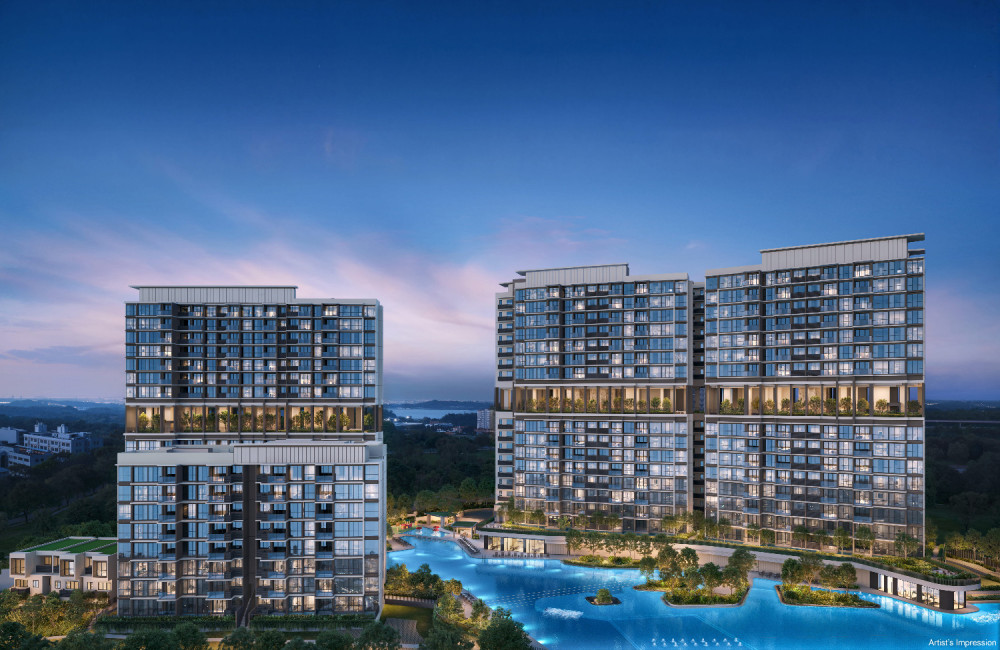
On 18 July 2026, Kingsford Group threw open the doors to Lentor Gardens Residences and, by the time the dust settled on launch day, 270 of its 499 units had sold — a 54% take-up at an average of roughly S$2,350 psf. On paper, moving 270 homes in a single day is a headline any developer would happily print. But in Lentor, a suburban estate that had spent the previous four years posting near-sellout opening weekends, 54% reads less like a triumph and more like a question mark.
That question mark is the whole story. Is Lentor Gardens Residences a strong launch that simply looks modest against unusually hot neighbours? Or is it the first visible crack in a micro-market that has absorbed six condo launches in under four years and still has more stock stacking up behind it? For anyone eyeing a home near the Thomson-East Coast Line (TEL), the answer shapes how hard you negotiate, which layout you chase, and how long you plan to hold.
This piece unpacks the 54% signal — how it compares to the rest of the Lentor launch scoreboard, what it says about buyer appetite for suburban launches, the pricing gaps versus neighbours, and the very real unsold-inventory risk as the Lentor cluster marches toward roughly 3,400–4,000 units at build-out.
The Headline Event: What Actually Happened on Launch Day
Let's start with the facts, because the framing depends entirely on them.
Lentor Gardens Residences is Kingsford Group's first project in Lentor Hills and the 7th of 8 condo launches planned for the estate. Its preview opened on 4 July 2026 and reportedly drew around 5,000 showflat visitors before the official launch two weeks later. When sales opened on 18 July:
- 270 of 499 units sold on day one — a 54% take-up rate.
- Average price: ~S$2,350 psf for residential units, with the lowest tier reportedly starting from ~S$2,050 psf.
- All three strata retail shops sold at ~S$2,550 psf.
- Entry quantum: 2-bedders from ~S$1.4–1.5M; 3-bedders from ~S$1.9M.
The mix of what sold is revealing. The 3-bedroom compact and 3-bedroom compact + study layouts — carrying palatable quantums of roughly S$2.05M–S$2.21M — sold out within hours. The premium tiers held up too: 2-bedroom premium moved 28 of 30 units (93%), and 3-bedroom premium sold 61 of 77 (79%). Overall, three-bedders made up about 42% of units sold, with two- and four-bedders combined accounting for roughly 40%.
The buyer profile skewed heavily toward owner-occupiers: first-time young couples, HDB upgraders (a notable share from nearby Ang Mo Kio), landed-estate residents right-sizing, and adult children buying near ageing parents. This was not, by most accounts, an investor-led launch.
One more fact matters enormously for the pricing debate: Kingsford secured the land at ~S$920 psf ppr — the cheapest in the entire Lentor GLS cycle. Hold that thought; it becomes the crux of the value argument later.
How 54% Compares: The Lentor Launch-Day Scoreboard
Here is the single most important piece of context, and it is the reason the "overheating" question exists at all: the six earlier Lentor launches collectively moved 2,929 of 2,954 units — roughly 99.2% eventual absorption. In a cluster where opening weekends had a habit of clearing the shelves, a 54% day-one result stands out.
But raw comparison is misleading without the full spread. Launch-day take-up across the Lentor estate has actually been wildly inconsistent — some projects flew out the door, others crawled. Here is the scoreboard:
| Project (launch order) | Developer | Units | Launch date | Launch avg psf | Launch-day / weekend take-up | Status now |
|---|---|---|---|---|---|---|
| Lentor Modern | GuocoLand | 605 | Sep 2022 | ~$2,107 | 84% (day 1) | Fully sold |
| Lentor Hills Residences | Hong Leong / GuocoLand / TID | 598 | Jul 2023 | ~$2,080 (fr. $1,834) | ~50% (weekend) | Fully sold ($2,272–$2,686 resale) |
| Hillock Green | Forsea / Soilbuild / UED | 474 | Nov 2023 | ~$2,100 | ~28% | ~$2,220 psf |
| Lentoria | TID / Hong Leong | 267 | Feb 2024 | ~$2,120 | ~19% | — |
| Lentor Mansion | GuocoLand / Hong Leong | 533 | Mar 2024 | $2,104–$2,478 | 75% (2 days) | ~97% sold |
| Lentor Central Residences | Hong Leong-led | 477 | Mar 2026 | ~$2,200 ($1,982–$2,573) | 93% (weekend) | 100% sold (median $2,222) |
| Lentor Gardens Residences | Kingsford | 499 | Jul 2026 | ~$2,350 (fr. $2,050) | 54% (day 1) | 270 sold, 229 unsold |
Lentor Launch-Day / Weekend Take-Up (%)
You can read this two ways, and honest analysis holds both.
The bull case. Selling 270 homes in one day — at the highest psf the estate has ever seen, on the 7th launch, after buyers have had years of alternatives — is a genuinely strong absolute result. It demolishes the weak launches (Hillock Green's ~28%, Lentoria's ~19%) and shows that TEL-served suburban demand runs deep and remains price-tolerant. Deep enough, in fact, to absorb a record-high launch price and still clear more than half the project before lunch on some layouts.
The bear, or "cluster fatigue," case. That same 54% sits well below the 84–93% posted by the estate's two best-located anchors (Lentor Modern and Lentor Central Residences), and it even trails Lentor Mansion's 75%. Crucially, the strongest absorption in the cluster came before Gardens, not after. The marginal Lentor buyer has become more selective, and 229 units now remain to be sold into a market that keeps adding new stock.
Notice, too, that the take-up numbers don't move in a straight line with quality or price — Hillock Green and Lentoria stumbled in the middle of the run, while Central Residences roared back in March 2026. That volatility is itself the point: Lentor is no longer a market where "launch = sellout." Location within the cluster, unit mix, and pricing discipline now separate the hits from the also-rans.
The 54% Signal: What It Says About Suburban Buyer Appetite
So what does a 54% day actually tell us about how Singaporeans are approaching suburban launches near the TEL?
First, demand hasn't collapsed — it's normalising. The compact three-bedders selling out within hours is unambiguous evidence that appetite exists, and that it's concentrated where quantum is manageable. Buyers weren't scared off; they were choosy. They chased the S$2.0–2.2M layouts and left thinner demand for the pricier and larger configurations. That is the behaviour of a discerning owner-occupier market, not a fearful one.
Second, the "launch-day sell-out" era in Lentor is over. When the first movers (Lentor Modern, Lentor Hills) launched, buyers were pricing in a still-maturing TEL and relatively scarce new supply. By the 7th launch, the estate's story is well known, the train line is running, and — critically — buyers can now comparison-shop across resale units in completed neighbours and unsold stock in other projects. Scarcity has evaporated, and with it the fear-of-missing-out that powers a same-day sellout.
Third, price tolerance has a ceiling — and Gardens is testing it. The estate absorbed a record launch psf, yes, but only 54% of it on day one. That is the market telling you where the current pain threshold sits. Push psf to the top of the range in a saturated cluster and you'll still find buyers, but you won't find all of them at once.
The synthesis: suburban TEL launches still sell, but absorption has slowed to a pace where price discipline, unit-mix selection, and location-within-cluster increasingly separate winners from laggards. That is a healthier, more rational market than a same-day sellout — but it's also one where buyers can no longer assume that "get in early or miss out" holds.
The Pricing Paradox: High PSF, Low Quantum
Here's where Lentor Gardens Residences gets genuinely interesting — and where prospective buyers need to think carefully.
The project carries the highest launch psf in the estate at ~S$2,350, yet it was deliberately engineered to offer accessible absolute prices through compact floorplates. That combination — expensive per square foot, affordable per unit — is the heart of its sales pitch and the heart of its risk.
Consider the comparison that matters most. Lentor Gardens Residences launched above Lentor Central Residences, which sold out just four months earlier at a median of ~S$2,222 psf — and which most observers regard as sitting on a better-located plot. So Gardens is asking buyers to pay a premium per square foot over a neighbour that was arguably superior and cheaper.
That's a hard sell to justify on fundamentals, especially given that Kingsford's land cost (~S$920 psf ppr) was the cheapest in the entire Lentor cycle. When a developer buys the cheapest land in the estate but launches at the highest psf, analysts read that as a thin margin of safety for the buyer. The developer captured the value of the low land cost; less of it flowed through to the purchaser.
| Metric | Lentor Central Residences | Lentor Gardens Residences |
|---|---|---|
| Launch date | Mar 2026 | Jul 2026 |
| Launch avg / median psf | ~$2,222 (median) | ~$2,350 |
| Land cost | Higher | ~$920 psf ppr (cheapest in cycle) |
| Launch weekend take-up | 93% | 54% (day 1) |
| Status | 100% sold | 270 sold, 229 unsold |
So why did the compact three-bedders still sell out first? Because buyers chased the quantum, not the psf. A S$2.05M three-bedder is a palatable cheque even at a record price per square foot, especially for an upgrader trading up from an HDB flat. That's a demand signal for affordability, not for price leadership — an important distinction. It means the project's momentum rests on keeping absolute prices digestible, and that momentum could stall the moment the affordable layouts run out and only the pricier stock remains.
Independent reviews of the project land on a fairly consistent verdict: the investment case "hinges predominantly on price advantage," and Gardens becomes genuinely investable only if entry pricing sits at or below Lentor Central Residences levels, with buyers prepared to hold 6–8 years to ride out the supply overhang. That's a conditional endorsement, not a green light.
Unsold Inventory and Cluster Fatigue: The Real Risk
The oversupply concern in Lentor isn't hand-waving. It's concrete, and it's quantifiable.
Start with the 229 unsold units sitting at Gardens after day one. That's not alarming in isolation — plenty of projects sell down over subsequent months. What makes it worth watching is the pipeline it's selling into:
- The Lentor estate is marching toward roughly 3,400–4,000 units at build-out.
- An 8th site — Lentor Central Plot 4 — was secured at a record S$1,278 psf ppr, guaranteeing a still-higher-priced future launch.
- A further ~560-home site remains to come.
Then there's the unit-type imbalance across the cluster. The estate's stock skews small:
- ~1,187 two-bedders
- ~976 three-bedders
- ~485 four-bedders
Lentor Cluster Unit Mix by Bedroom Type
This matters because the most abundant unit types face the fiercest internal competition when it comes time to sell or rent. If you own one of ~1,187 two-bedders in a single estate, you're competing against a wall of near-identical stock at resale and in the rental market. This is precisely why several reviewers explicitly steer buyers toward three- and four-bedders — the scarcer configurations — to sidestep the glut.
The timing compounds the problem. TOP (completion) dates run from 2025 (Lentor Modern, already done) through roughly 2029 (Gardens). That means multiple projects will be completing — and dumping resale and rental supply onto the same local market — within an overlapping window of 2027 to 2029. When a large chunk of an estate hits the market simultaneously, both resale prices and rents feel the squeeze.
This supply-side caution isn't new, either. Huttons' Lee Sze Teck had earlier linked developers' cooling appetite for Lentor land to the roughly 3,000-unit pipeline already in the ground — a warning that predated this launch. What's changed is that the caution has now migrated from the supply side (developers bidding less aggressively) to the demand side (a visibly slower opening weekend). When both ends of the market start flashing the same signal, it's worth taking seriously.
None of this makes Lentor a bad estate — the TEL connectivity, the amenities, and the maturing neighbourhood are all real. But it does mean the easy money has been made, and the next phase rewards selectivity over enthusiasm.
The Broader Backdrop: A Decelerating Private Market
Lentor Gardens Residences didn't launch in a vacuum. It arrived in a private residential market that is visibly cooling — which is exactly the environment where a saturated micro-market feels the most pressure.
The URA Q2 2026 flash estimate showed the overall private residential price index rising just +0.5% quarter-on-quarter, down from +0.9% in Q1. Cumulative first-half growth came in at +1.4%, softer than the +1.8% recorded in H1 2025.
URA Private Residential Price Growth by Region, Q2 2026 (% q/q)
The regional split is the part that should catch a Lentor buyer's eye. While the prime Core Central Region (CCR) firmed +1.8%, the segments where Lentor actually sits went the other way:
- Rest of Central Region (RCR): −1.2%
- Outside Central Region (OCR): −0.2%
In other words, the suburban and city-fringe mass-market segment was already softening even as prime property strengthened. Lentor is an OCR/RCR-flavoured story, and it launched into gently falling regional prices.
On top of that, the government is deliberately loosening the taps. The H2 2026 Confirmed List adds 4,745 units, bringing full-year Confirmed List supply to 9,320 units — over 50% above the 10-year annual average. This is policy by design: rather than reaching for new cooling measures like ABSD or TDSR tweaks, the current lever is supply expansion to cap price growth. And supply expansion is precisely the force that pressures an already-saturated micro-market like Lentor hardest.
The one reassuring data point: transaction volume held broadly flat, with roughly 5,420 units transacted in Q2 versus ~5,413 in Q1. Demand hasn't fallen off a cliff — it's being met and priced rather than starved. Buyers are still buying; they're just no longer paying up in a hurry. That's the macro version of exactly what played out at Gardens on 18 July.
What This Means for You
Different buyers should read the 54% signal very differently.
If you're an owner-occupier: The estate's core thesis — TEL connectivity, growing amenities, a maturing township — remains intact, and the compact three-bedders offer genuine value on quantum. But you're buying at the cluster's top psf with the most competing stock in the estate. Negotiate hard, favour differentiated layouts (larger or rarer configurations that won't drown in a sea of identical units), and don't let launch-day energy convince you that scarcity exists where it doesn't. There are 229 unsold units and more launches coming; time is more on your side than the showflat suggests.
If you're an investor: The margin of safety here is thin. Near-term capital upside is capped by the unsold overhang and the 2027–2029 TOP overlap, and the credible case requires a 6–8 year hold with disciplined entry at or below Lentor Central Residences pricing. Rental yields, in particular, face concentrated new supply completing in the same window — which is not what you want when you're relying on rent to carry the holding cost. This is a market for patient, price-disciplined capital, not for a quick flip.
If you're a tenant: Good news. The wave of near-simultaneous Lentor completions from 2027 to 2029 should ease local rents as a large volume of new units competes for tenants at once. This is shaping up to be a renter's window, not a landlord's.
Food for Thought
- If the cheapest land in the entire Lentor cycle produced the highest launch psf in the estate, where did that value actually go — and what does that tell you about who benefits most when a developer buys well?
- A 54% day-one result would be celebrated in most estates but reads as a slowdown in Lentor. How much of "cluster fatigue" is a real demand ceiling, and how much is simply the estate being benchmarked against its own unusually hot history?
- With roughly 1,187 two-bedders concentrated in one estate, will small-unit owners find themselves permanently competing against near-identical stock at resale and rental — and does the "compact quantum" strategy quietly transfer that risk from developer to buyer?
- The government is capping prices through supply expansion rather than cooling measures. For a saturated micro-market, is that a gentler tool or a more relentless one?
- If absorption is now separating winners from laggards within a single cluster, does the old heuristic of "buy near an MRT line and you'll be fine" still hold — or has location-within-cluster become the decision that actually matters?