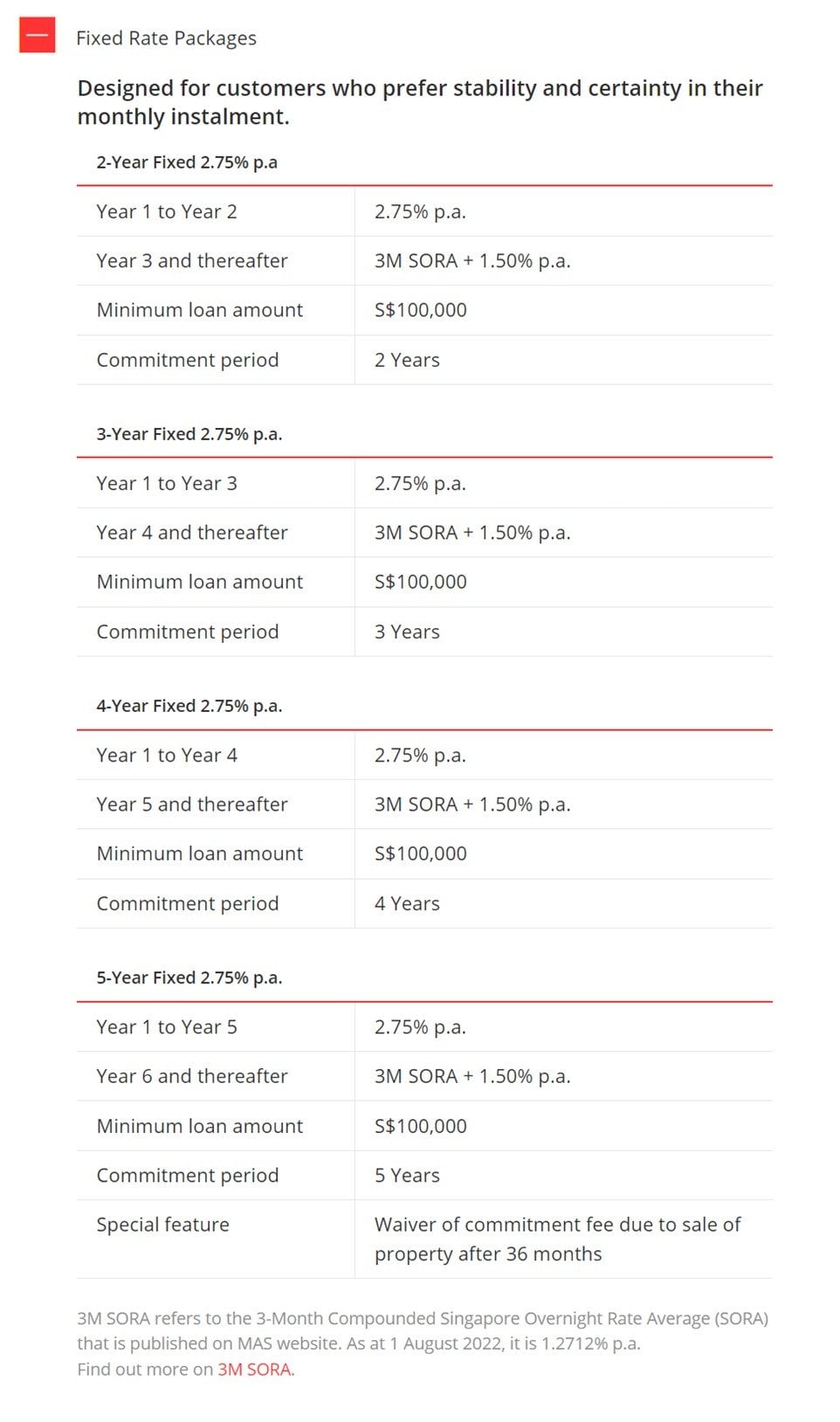
For the first time in three years, the cheapest home loan in Singapore starts with a "1". As of the week of 13 July 2026, banks are quoting fixed home-loan rates from 1.30% per annum, while the 3-month compounded SORA benchmark that anchors most floating loans sits at roughly 1.11%. If you signed a mortgage at the peak of mid-2024 — when SORA brushed 3.5% to 3.7% — you have watched your benchmark rate collapse by around 250 basis points. That is not a rounding error. On a million-dollar loan, it is the difference between straining and sleeping.
So the obvious question: with mortgage rates from 1.30% and SORA near multi-year lows, do you lock in a fixed rate now, or ride SORA lower and pocket the difference? The honest answer is that this is one of the closest fix-versus-float calls Singapore borrowers have faced in a decade — the two options have converged to within a whisker of each other. But there is a twist buried in the macro data that most rate-chasers are ignoring, and it could flip the entire calculation before your lock-in period even ends.
This piece walks through the numbers, the break-even math, the stress test that actually matters, and the geopolitical catch that makes "just float and enjoy the cheap money" a riskier bet than it looks.
The Setup: Fixed and Floating Have Basically Converged
Let's start with where rates actually are, because the headlines and the reality are not quite the same thing.
| Metric | Latest reading (July 2026) |
|---|---|
| 3-month compounded SORA | ~1.11%–1.13% |
| Overnight SORA (daily, 14 Jul 2026) | ~1.05% |
| Lowest fixed home-loan rate | From 1.30% p.a. |
| Lowest floating rate | 3M SORA +0.20% ≈ 1.32% |
| Typical fixed band | 1.35%–1.75% (1.40%–1.50% most common) |
| Typical floating spread | +0.20% to +1.00% over SORA |
| Large-loan teaser | From ~1.04% on $500k+ quantum |
Sources: MortgageWise, LoanSaver, MacroMicro/MAS, PropertyNet, Redbrick
Here's the headline that matters. The gap between the lowest fixed rate (1.30%) and the lowest floating rate (~1.32%) is roughly two basis points. Even the more realistic comparison — a typical 2-year fixed at 1.40%–1.50% against a floating package at SORA +0.20% ≈ 1.32% — leaves a spread of only about 8 to 20 basis points.
For most of the last three years, fixing your rate meant paying a meaningful "insurance premium" for certainty. That premium has almost vanished. The market is offering budgeting certainty for pocket change — which sounds like a slam dunk for fixed, until you remember the other side of the coin: if the premium for fixing is near zero, so is the room for SORA to keep falling. At 1.1%, the benchmark is scraping the floor of a normal rate cycle. The easy gains from floating are mostly behind us.
3-Month SORA: From Peak to Trough (indicative)
A quick word on that "from 1.30%" number
Advertised "from" rates are the shop window, not the shelf. The 1.30% quote is a promotional, lowest-tier rate — typically reserved for larger loan quanta and stronger borrower profiles. The banks even dangle teasers from ~1.04% on loans above $500,000. Most ordinary borrowers refinancing a $600,000–$900,000 loan will be quoted something in the 1.40% to 1.55% range for a 2-year fixed package.
Treat "from 1.30%" as the market floor — proof of how cheap money has become — not as the rate you will personally sign. When you model your own decision, use the rate you are actually quoted, not the billboard.
The Twist: A Middle East Oil Shock and the July MAS Meeting
Now for the part almost nobody is pricing into their fix-versus-float decision.
Since late February 2026, shipping through the Strait of Hormuz has been severely constrained. That chokepoint carries a huge share of the world's seaborne crude, natural gas, and petrochemicals. The disruption has pushed up energy and imported-goods prices, and Asia — Singapore very much included — has felt it through higher import costs and, in places, physical shortages.
This is not abstract. The Monetary Authority of Singapore (MAS) responded at its April 2026 Monetary Policy Statement:
- It steepened the S$NEER appreciation slope to roughly 1.0% (from 0.5%) — a modest tightening — while keeping the band width and midpoint unchanged.
- It raised its 2026 core and headline inflation forecasts to 1.5%–2.5%, up from 1%–2%.
- It explicitly flagged "persistently higher oil import prices" and the risk of second-round effects as costlier imports feed into broader prices.
The next MAS meeting is due in July 2026. Analysts (per ING) expect MAS to hold but keep the door open to further tightening — staying "cautious and data-dependent" while it watches whether that second-round inflation actually sticks. In other words, the tail risk points toward more tightening, not less.
The nuance that trips everyone up: MAS tightening ≠ SORA rising
Here is where casual commentary goes wrong, and where you need to be careful. It is tempting to reason: "MAS is tightening → interest rates go up → my floating rate rises → I should fix now." That chain is not mechanically true in Singapore.
Unlike the US Federal Reserve, MAS does not set interest rates. It manages the exchange rate — the trade-weighted Singapore dollar, or S$NEER. SORA is market-determined. And counter-intuitively, a faster SGD appreciation path can actually put downward pressure on SGD interest rates. Through interest-rate parity, investors are willing to accept lower SGD yields when they expect the currency itself to appreciate. So "MAS tightens" can, all else equal, nudge SGD rates down.
So the genuine upside risk to SORA does not run through MAS's exchange-rate lever. It runs through the global and Fed channel:
- The US Fed reversing course. SORA's steep 2025 fall was driven largely by markets pricing in Fed rate cuts. If supply-shock inflation forces the Fed to pause — or reverse — those cuts, USD rates stay higher for longer, and SGD rates get dragged up with them. Repricing can happen fast.
- SGD appreciation expectations fading. If the market stops believing in a strengthening SGD, the downward pull on local rates weakens.
- Domestic liquidity tightening.
The bottom line for your decision: the reversal risk is real, but it comes from the inflation regime and the Fed — not from a simple "MAS raised rates" story. The cycle low may already be in. Cheap rates are not guaranteed to last, and a supply-shock inflation regime is precisely the kind of scenario that ends cheap-money cycles. That is the twist. You are not just betting on where rates go; you are betting on whether a real inflation shock takes hold.
Fix vs Float: The Decision, Framed Honestly
Given all that, how should you actually choose? Here is the decision tree, followed by the reasoning.
Choose FIXED (from ~1.30%–1.55%) if you:
- Value budgeting certainty and cannot absorb a payment shock without pain.
- Believe the supply-shock inflation scenario could force rates back up within your lock-in window — the Hormuz situation is a live, unresolved risk, not a hypothetical.
- Are near your affordability ceiling (more on stress-testing below).
- Want to note the obvious: the premium over floating is now only about 0.1%–0.2%, so this insurance is unusually cheap. You are paying almost nothing to remove uncertainty.
Choose FLOATING (from ~1.32%) if you:
- Expect SORA to stay rangebound near lows through 2026 — the base case in most forecasts is roughly 1.0%–1.5%.
- Plan to sell or refinance within 2–3 years. A fixed package's lock-in period can trap you with penalties precisely when you want to move.
- Want optionality. Some SORA packages carry no lock-in or waive penalties, letting you reprice or refinance freely if the picture changes.
The framing that matters more than the rate
There is a line worth internalising, from mortgage brokerage DollarBack: "In 2026, loan structure often matters more than the exact rate level." When fixed and floating are eight basis points apart, chasing the lowest headline number is almost beside the point. What matters is your ability to reprice or refinance without penalty when conditions shift.
And note the intellectual honesty of the market itself: most credible commentators refuse to forecast SORA's direction. They stress optionality instead of making a call. That humility is a signal. If the professionals whose job is to read rates won't bet the house on a forecast, you probably shouldn't structure your mortgage as if you can either.
The Break-Even Math: Run the Numbers
Abstract advice is easy to nod along to and hard to act on. So let's put real figures against a concrete loan. Assume a $1,000,000 loan over a 25-year tenure. (Recompute for your own quantum and tenure — the shape of the answer holds regardless.)
Today's cost, fixed versus floating
| Scenario | Effective rate | Approx. monthly instalment |
|---|---|---|
| Floating today (SORA 1.12% + 0.20%) | 1.32% | ~$3,930 |
| Fixed today | 1.40% | ~$3,948 |
| Difference | +0.08% |
Eighteen dollars a month. That is the price of certainty right now — less than two kopi-and-kaya-toast sets. The break-even logic follows directly: with the fixed premium at only ~8–20 basis points, floating "wins" only if SORA stays put or falls further. If the average floating rate over your lock-in period rises by more than about 0.1%–0.2%, fixing was the better call.
Because the two options sit almost on top of each other, this is not really a bet on carry (the ongoing cost difference). It is a bet on direction and volatility. You are being asked, essentially: how confident are you that rates won't reverse?
The rate-reversal stress test
Now flip the scenario. Suppose the supply-shock inflation story plays out, the Fed holds or reverses, and SORA climbs back up. Here is what happens to that same $1,000,000 floating loan:
| SORA reverts to | Floating rate | Monthly instalment | vs today |
|---|---|---|---|
| 2.0% | ~2.2% | ~$4,340 | +~$410/mo |
| 3.0% | ~3.2% | ~$4,840 | +~$910/mo |
| Regulatory floor 4.0% | 4.0% | ~$5,280 | +~$1,350/mo |
Monthly Instalment on a $1M / 25yr Loan as Rates Rise
A move back to 3% — which is below the 2024 peak, not some doomsday scenario — adds roughly $910 a month, or nearly $11,000 a year, to your outgoings. That is the asymmetry at the heart of this decision. On the upside, floating saves you $18 a month. On the downside, a reversal costs you hundreds. When the potential loss dwarfs the potential gain and the insurance is nearly free, the case for fixing writes itself — unless you have a specific reason to expect rates to stay pinned, or you plan to be out of the loan before any reversal bites.
(All instalment figures are illustrative approximations. Recompute with your actual quantum, tenure, and quoted rate.)
The Stress Test That Actually Matters: Qualify at 4%, Not 1.3%
Here is the reassuring part — and the part that should discipline your decision. Singapore's regulators have already built a rate-reversal stress test into the system. You just have to respect it.
When a bank assesses your loan for a private residential property, it does not use your actual 1.3% rate. It qualifies you against a medium-term interest-rate floor of 4.0% per annum, in force since 30 September 2022. In other words, the system already asks: could this borrower still afford the loan if rates were three times higher? If the bank approved you, you have a built-in buffer.
The key regulatory anchors:
- TDSR (Total Debt Servicing Ratio): 55% of gross monthly income — applies to all property loans. All your debt obligations, not just the mortgage.
- MSR (Mortgage Servicing Ratio): 30% — applies to HDB flats and ECs bought from developers only.
- Medium-term interest-rate floor: 4.0% p.a. for stress-testing private residential bank loans.
- LTV (Loan-to-Value): 75% for a first housing loan.
- Variable-income haircut: only 70% of commissions, bonuses, and other variable income counts toward your qualifying income.
The actionable takeaway: don't let the 1.1% headline lull you into over-borrowing. Before you choose floating, run your own numbers at 3.5%–4% and confirm the payment is genuinely comfortable — not "technically affordable on paper," but comfortable alongside your other commitments. If it isn't comfortable at 4%, then either fixed (to remove the risk) or a smaller quantum (to remove the strain) is the disciplined choice. The 4% floor isn't red tape; it's the exact stress scenario this article is about, pre-loaded into your approval.
The Refinancers' Playbook: Where the Real Money Is
If you're a new buyer, the fix-versus-float debate is genuinely close. But if you're a refinancer, the opportunity right now is far less ambiguous — and potentially worth thousands.
Consider anyone whose loan was locked in at the 3.5%–4% peak of 2024 and is now maturing in 2026 or 2027. Repricing or refinancing to today's rates could save up to ~200 basis points. On a $800,000 outstanding balance, shaving 2 percentage points off your rate is roughly $16,000 a year in interest — real money that was previously flowing straight to the bank.
A few practical rules from the market:
- Refinancing usually beats internal repricing. Banks reserve their best "new customer" incentives for borrowers they're trying to win, not retain. Loyalty is rarely rewarded with the sharpest rate.
- Start shopping about six months before your lock-in expires. Refinancing takes time — valuation, legal work, approvals — and you want the new package ready to kick in the moment penalties lapse.
- Watch the clawback clauses. If your original loan came with subsidies (legal fees, valuation), leaving early may trigger a clawback. Factor that into the break-even.
For refinancers, the fix-versus-float question is secondary to the simple fact that today's rates are dramatically cheaper than what you're paying. The main risk is inertia — letting the loan roll onto a punitive post-lock-in rate because you didn't start the process in time.
Market Backdrop: Cheap Money Is Propping Up Demand
None of this happens in a vacuum. Ultra-cheap financing is one of the biggest forces holding up buyer demand right now, and understanding the market context tells you who is most exposed if rates reverse.
The URA Q2 2026 flash estimate (released early July) painted a picture of a market that is cooling but not cracking:
- Private residential price index: +0.5% quarter-on-quarter in Q2 2026 — a slowdown from +0.9% in Q1.
- Segment split (non-landed): CCR +2.0%, RCR −1.4%, OCR −0.2%; Landed +2.6%.
- Sale volume: 5,420 units (to mid-June), broadly flat against Q1's 5,413.
- The softening was partly attributed to the June school-holiday lull, yet new launches still sold well — Tengah Garden Residences hit 99% take-up, Vela Bay 72%, Hudson Place Residences 61%.
- HDB resale prices extended their decline in Q2 2026.
- ERA's full-year forecast: +3% to +5% price growth, with 9,000–10,000 new-home sales and 13,000–14,000 secondary transactions.
Private Residential Price Change by Segment, Q2 2026 (% q/q)
Note that the full URA Q2 statistics are due to land on 24 July 2026, which will confirm or revise these flash figures.
Connecting the threads: cheap financing is a key demand support, especially for the large pool of HDB upgraders unlocking equity and channelling it into OCR and RCR homes. When mortgages start at 1.3%, the monthly stretch of trading up feels manageable. But that's exactly why a rate reversal is the single biggest downside risk to this market. The affordability tailwind reverses fastest for the most stretched buyers — upgraders operating near their ceiling and investors relying on thin yield spreads. If SORA climbs back toward 3%, the marginal buyer who made the sums work at 1.3% suddenly can't, and demand cools from the edges inward.
Who should do what
| Buyer type | The move |
|---|---|
| New buyers | Cheapest financing in 3 years — but qualify at 4% and don't over-lever on the assumption rates stay at 1.1%. |
| Refinancers | Loans locked at 3.5%–4% can save up to ~200bps. Shop ~6 months before lock-in expiry; refinancing usually beats internal repricing. |
| Investors | Thin fixed-vs-float spread favours floating for flexibility — but stress-test rental yield and the rate-reversal scenario together, not separately. |
| Tenants | Less direct, but a rate reversal that cools buying could loosen rental demand at the margin, especially in the softening RCR/OCR segments. |
The Verdict
So — lock in or ride SORA lower? Here is the disciplined read of the evidence.
Because the fixed premium has collapsed to near zero, fixing is unusually cheap insurance against exactly the supply-shock inflation scenario now in play. You are paying roughly $18 a month on a million-dollar loan to protect against a reversal that could add hundreds. When the downside dwarfs the upside and the protection costs almost nothing, that asymmetry favours the certainty of fixing — particularly if you're near your affordability ceiling or you believe the Hormuz-driven inflation story has legs.
But floating still wins for a specific, disciplined borrower: anyone planning to sell or refinance within 2–3 years, who can genuinely absorb a payment shock, and who values the optionality of a no-penalty package over a few basis points of certainty. If you'll be out of the loan before any reversal bites, the lock-in is a cage you don't need.
What you should not do is float by default, lulled by the 1.1% headline, without running your own number at 4% first. The cycle low may already be behind us. The room for SORA to fall further is thin; the room for it to reverse — through the Fed and the inflation regime — is very much open.