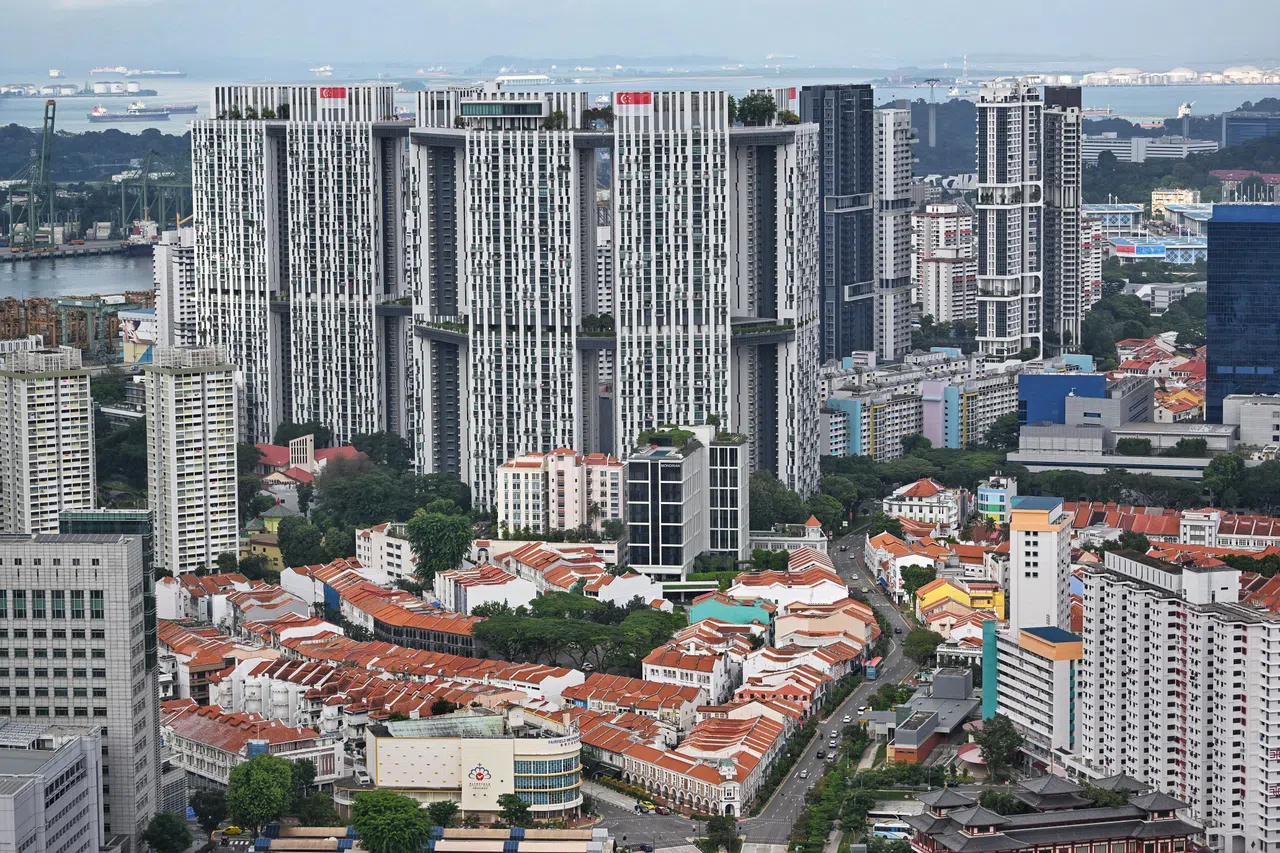
In June 2026, something happened in Singapore's public housing market that would have sounded absurd a decade ago: 188 HDB resale flats — government-built, subsidised, owner-occupied public housing — each changed hands for at least S$1 million in a single month. That is a record. It beats the 166 million-dollar deals in May 2026, and it means that on any given day in June, roughly six seven-figure flats were being sold across the island. These were not penthouses or landed homes. They were the same kind of flat your parents might have queued for at a BTO launch, now trading at prices that rival entry-level private condominiums.
Here is the part that makes the story genuinely strange. This record for million-dollar HDB resale flats was set while the broader resale market was cooling. The HDB Resale Price Index actually slipped in Q2 2026 — the first back-to-back quarterly decline in nearly seven years. Volumes fell. The mass market softened. And yet the number of seven-figure flats kept climbing to fresh highs. It is a paradox that tells you almost everything about where Singapore's housing market is heading: not toward a broad bubble, but toward a hardening two-tier structure, where a small "prime public housing" elite pulls away from everything below it.
This article unpacks that paradox — the record 188 deals, the cumulative 4,953 million-dollar flats now on the books, the four central towns that dominate the leaderboard, the record-shattering S$1.728 million sale at Henderson Road, and the structural forces (MOP timing, lease freshness, location scarcity) that decide which flats break the million-dollar ceiling and which never will.
The Headline Numbers: A Record Amid a Slowdown
Let us start with the raw scale of June 2026, because the figures reframe how you should think about the word "HDB."
- 188 million-dollar resale flats transacted in June 2026 — an all-time monthly record.
- That was 8.8% of all resale transactions that month.
- The average price across those 188 deals was roughly S$1,151,191, at an estimated ~S$995 psf.
- The cumulative all-time count of million-dollar HDB flats now stands at 4,953, tracked since the very first such sale in July 2012.
That last number deserves a pause. It took from July 2012 to reach nearly 5,000 million-dollar flats — but the acceleration has been brutally recent. According to aggregator data from 99.co, 1,591 of those flats (about 32.1% of the all-time total) transacted in just the trailing 12 months. In other words, roughly one in three million-dollar HDB flats that has ever sold, sold within the last year.
Million-Dollar HDB Flat Sales by Year
The trajectory above is close to exponential. From just 82 deals in 2020, the annual count crossed 1,000 in 2024, hit 1,594 in 2025, and by the end of June 2026 had already logged 902 in the first half alone — a pace that puts 2026 on track to exceed the 2025 full-year figure. Cumulatively, the total stood at around 4,029 through end-2025 and reached 4,953 by end-June 2026. Read that against the trailing-12-month figure and the conclusion is stark: nearly a fifth of all million-dollar flats ever sold were transacted in the first half of 2026.
Now hold that against the market backdrop, because this is where the paradox bites.
The Paradox: Records While the Market Turns the Corner
If seven-figure flats are being minted at record speed, you would assume the whole HDB resale market is red-hot. It is not. The headline index is doing the opposite.
- HDB Resale Price Index, Q2 2026: 202.7, down 0.3% quarter-on-quarter — following a −0.1% dip in Q1 2026.
- That is the first back-to-back quarterly decline since the Q3 2018–Q2 2019 stretch — nearly seven years.
- Resale volume is shrinking: Q2 2026 saw 6,268 units (−0.3% q-o-q); the first half of 2026 recorded 12,553 units, down 8.3% year-on-year versus 13,692 in 1H 2025.
- The mass market still runs the show: flats priced below S$750,000 made up about 71.1% of Q2 2026 transactions. Million-dollar flats were only around 7.9% of the quarter.
So the median flat is getting slightly cheaper and harder to sell, even as the number of trophy flats hits records. How can both be true at once?
The answer is that the distribution is not shifting — its tail is thickening. As 99.co's analyst Luqman frames it, activity at the top end keeps growing even as overall volume shrinks. More flats cross the S$1 million line each month, but the buyer pool at large is not expanding much. The mass of transactions is cooling under policy weight and heavier supply, which drags the headline index sideways or slightly down. Meanwhile, a growing sliver of prime, lease-fresh, well-located flats keeps setting new records at the top. The average barely moves; the extremes stretch.
Eugene Lim, Key Executive Officer at ERA Singapore, put the cooling in measured terms: "This is the first time in nearly seven years that HDB resale prices have softened across consecutive quarters. While it is still too early to call this a correction, the market has turned the corner." Crucially, he reads the softening as "a sign of housing policies taking effect, rather than a pullback," adding that "periods of measured cooling… actually help to take some heat out."
That interpretation matters for how you read the 188 record. This is not classic froth, where prices detach from fundamentals across the board on speculative fervour. It is concentration — a genuine "prime public housing" tier forming at the top while the mainstream market digests policy and supply. Two markets wearing the same "HDB" label.
The Estate Heatmap: Where Million-Dollar Flats Actually Live
If the phenomenon were spread evenly across the island, it would be less interesting. It is not. Million-dollar HDB flats are ferociously location-bound, clustering in a handful of mature, central towns and appearing essentially nowhere in the newer, further-out estates.
Look at the June 2026 heatmap for the towns driving the record.
| Town | Million-dollar deals (June 2026) |
|---|---|
| Bukit Merah | 28 |
| Toa Payoh | 28 |
| Queenstown | 23 |
| (Central Region total) | 81 |
Million-Dollar Deals by Town, June 2026
Three towns alone — Bukit Merah, Toa Payoh and Queenstown — accounted for 79 of the month's 188 million-dollar deals, and the Central Region as a whole delivered 81. For context on how busy these towns are overall, Bukit Merah was the single most active HDB resale town in June 2026 across all price bands, with 45 transactions. More than half of those crossed the million-dollar mark. The top single deal of the month was a 5-room flat at SkyTerrace @ Dawson (Dawson Road, Queenstown), which sold for S$1.65 million.
Zoom out to the all-time leaderboard (through end-2025) and the same names dominate.
| Town | All-time million-dollar flats (through end-2025) |
|---|---|
| Toa Payoh | 609 |
| Bukit Merah | 507 |
| Queenstown | 449 |
| Kallang/Whampoa | 429 |
| Bishan | 369 |
All-Time Million-Dollar HDB Leaderboard by Town (through end-2025)
Now the mirror image — the towns that have never recorded a single million-dollar HDB flat: Chua Chu Kang, Jurong West, Sembawang and Tengah. Four towns, a clean zero. This is the single most illustrative fact in the entire dataset. It tells you that the million-dollar phenomenon is not about "HDB flats getting expensive" as a general trend. It is about specific flats in specific places commanding a premium that has almost nothing to do with the building material and almost everything to do with the ground it sits on.
To keep the year-to-date picture straight: by end-June 2026, 521 million-dollar deals had been logged year-to-date, sitting inside a first-half total of 902 (with Q2 alone contributing 491). The concentration in the central belt is not a June fluke — it is the structural signature of the whole trend.
The Record: S$1.728 Million at Henderson Road
Every frenzy needs its landmark, and 2026's is a 5-room flat at 96A Henderson Road, part of the City Vue @ Henderson development in Bukit Merah. In April 2026 it sold for S$1.728 million — the current national record for an HDB resale flat.
The flat itself reads like a checklist of every premium factor:
- Size: approximately 1,215 sq ft (113 sqm) — a generous 5-room layout.
- Floor: somewhere in the 46th–48th storey range, a high-floor corner unit at the Henderson Road / Tiong Bahru Road junction.
- PSF: roughly S$1,381 (some outlets cite a slightly higher ~S$1,421 — a discrepancy worth flagging, and one to verify against primary HDB records).
- Lease: commenced 2019, leaving roughly 92 years remaining — a near-fresh lease that sidesteps the lease-decay discount that erodes older flats.
- Recognition: City Vue @ Henderson won an HDB Design Award in 2019.
- The clincher: unblocked high-floor views toward Tiong Bahru and River Valley.
It edged out the previous record — a 1,313 sq ft 5-room flat at SkyTerrace @ Dawson (Dawson Road, Queenstown), which sold for S$1.7 million (~S$1,295 psf) in February 2026. So within roughly two months, the record changed hands between two of the most iconic prime-location HDB projects in the country, in a kind of head-to-head duel between Queenstown's Dawson and Bukit Merah's Henderson.
City Vue @ Henderson, in particular, has been a serial record-breaker. Its climb reads like a stock chart that only goes up.
From S$1.4 million in 2022, to S$1.588 million in June 2024, to S$1.728 million in 2026 — a single development has redefined the ceiling three times in four years. Little wonder that analysts now widely expect the first S$2 million HDB flat within the next year or two. Given the trajectory, that milestone feels less like a question of if and more of when and where — with the smart money on another lease-fresh, high-floor, 5-room unit in exactly this central belt.
What Actually Drives a Seven-Figure Flat
Across every source that has dissected these sales, the same cluster of factors explains the premium. None of them is mysterious. Together they form a fairly precise recipe — and understanding it is the difference between guessing which flats will command a premium and knowing.
1. Location. Proximity to the CBD and central area, MRT interchanges, and the deep amenity base of a mature estate. This is why Queenstown, Bukit Merah, Toa Payoh, Bishan and Kallang/Whampoa dominate every list, and why Tengah and Sembawang sit at zero. You cannot manufacture centrality.
2. Lease freshness. The record-setters — Dawson, Henderson — are relatively young flats with 90-plus years of lease remaining. A long remaining lease avoids the lease-decay discount that increasingly drags on older flats, and it keeps the unit fully financeable and CPF-usable for the next buyer. Freshness is quietly one of the most powerful price levers in the resale market.
3. Size and type. 5-room flats, jumbo flats, DBSS units, and premium lofts and maisonette or terrace layouts. These are comparatively rare in the resale pool, and rarity commands a premium. The record flats are consistently spacious 5-room or larger layouts.
4. Height and views. High-floor, unblocked units in landmark blocks. The Henderson record flat's corner position and views toward Tiong Bahru and River Valley were explicitly cited as a draw. A view is a scarce, non-replicable asset even within the same block.
5. MOP timing. This is the structural driver that makes 2026 specifically so intense. When flats hit their five-year Minimum Occupation Period in prime, BTO-subsidised locations — Dawson, Henderson, Bidadari, Kallang — they become eligible for resale and immediately reprice from their subsidised purchase price to full market value. That gap is enormous. MOP timing is, in effect, the single biggest supply engine for new million-dollar listings. The flats that entered the market in 2026 were largely bought cheaply as BTOs around 2019–2021, in locations that have since become some of the most desirable public housing in Singapore.
That fifth point is worth dwelling on, because it explains the timing of the record — and it connects directly to policy.
Why Now: The MOP Wave and the Policy Backdrop
Two forces converged in 2026 to produce the record: a huge wave of flats reaching MOP, and a policy regime designed to cool the mass market without touching the cash-rich top.
The MOP wave is the big one. An estimated 13,480 units reach their Minimum Occupation Period in 2026 — a 93.3% jump from 6,973 in 2025. Many of these sit in prime, subsidised BTO estates. The effect is two-sided and slightly counterintuitive:
- In the prime towns, this MOP wave feeds the exact locations that mint million-dollar sales — owners who bought subsidised now free to sell at market.
- Across the market as a whole, the same wave loosens overall supply, adding to the inventory that is helping soften the headline index.
So one supply surge simultaneously pushes the top-end records higher and cools the broad market. That is the mechanical heart of the paradox.
HDB Flats Reaching MOP (units)
On the policy side, the cooling levers are doing their work at the bottom while leaving the top largely untouched:
- The 15-month wait-out period, in force since late 2022, requires most private-property downgraders to wait 15 months before buying a resale HDB flat. Per ERA, this — combined with larger BTO launches — has eased resale pressure since early 2025.
- BTO supply is being ramped up: HDB launched 6,952 BTO flats in June 2026, with roughly 7,970 more slated for the October exercise. More new-build supply gives budget-conscious buyers an alternative to the resale market, taking heat out of demand.
- Grants and loan limits — reduced loan-to-value ratios, lower income ceilings on some grants — continue to shape affordability at the entry level. But they do little to restrain a cash-rich buyer paying S$1.7 million for a landmark flat, often with substantial equity from a previous property.
The net picture is a market being deliberately steered toward "measured cooling" at the mass-market level, while the prime tier — driven by scarcity, freshness and MOP timing — operates on a different logic entirely.
Froth or a New Normal? Reading the Evidence
This is the question every reader actually cares about: is this a bubble that will pop, or the shape of things to come? The evidence leans firmly toward the latter — a structural new normal of concentrated luxury, not broad froth. Here is the case, laid out.
Point one: the concentration is at the top, not across the board. Million-dollar flats were only about 7.9% of Q2 2026 transactions, while flats under S$750,000 made up roughly 71.1%. The mass of the market is not participating in the record-setting. A bubble inflates the whole distribution; this is inflating only the tail.
Point two: the headline index is softening, not surging. Prices dipped for two consecutive quarters — the first such stretch in nearly seven years. Volumes fell 8.3% year-on-year in the first half. That is not the signature of a market losing its mind. It is the signature of a market cooling under policy while a niche pulls ahead.
Point three — and this is the structural check most people miss: HDB flats cannot be bought as pure investments. Owner-occupation rules apply, there is no foreign or corporate ownership, and every buyer must actually live in the flat and serve the MOP before selling. That means the million-dollar premium is an owner-occupier premium, not a speculative flipping premium. There is no leveraged flipping cohort, no shadow inventory of investors ready to dump at the first wobble. This is one of the most important guardrails against classic bubble dynamics — the demand is real, use-based, and rule-constrained.
Point four: the supply engine is durable. MOP waves are not a one-off. As successive cohorts of prime BTO estates — Bidadari, Kallang, Dawson, and future launches in equally central spots — clear their MOP, they will keep feeding the top tier for years. The pipeline of potential million-dollar flats is structurally embedded in where HDB chose to build a decade ago.
Put together, the read is a maturing two-tier market: a permanent, growing "prime public housing" tier — think of it as the top few percent of flats behaving almost like a distinct asset class — sitting above a mainstream resale market that is cooling under policy weight and heavier supply. The word "froth" implies fragility and reversal. What the data describes is closer to stratification: a durable split that is likely to widen, not snap back.
That said, a few caveats are worth stating plainly. Some of the figures — the 4,953 cumulative count and the 1,591 trailing-12-month number — come from a single aggregator (99.co) and are best sanity-checked against HDB's official transaction data before being treated as gospel. There are minor source discrepancies worth verifying too: the Henderson record flat's PSF is cited as both ~S$1,381 and ~S$1,421, and June's top deal at SkyTerrace @ Dawson is referenced under two adjacent block addresses. None of these change the shape of the story, but precision matters when the headline is a record.
What This Means for You
Depending on where you sit in the market, the million-dollar frenzy reads very differently.
- Buyers and upgraders: Seven-figure resale flats in prime towns increasingly rival the entry price of mass-market private condos, narrowing the traditional "HDB-to-condo" upgrade gap. If a prime resale flat and a suburban condo cost similar amounts, the calculus of upgrading changes — and budget-conscious buyers are pushed toward non-mature estates or the BTO ballot instead.
- Sellers: The clear winners are MOP-completing owners in Dawson, Henderson, Bidadari and Kallang, who bought subsidised and can now realise large, tax-free capital gains. If you own a lease-fresh, high-floor 5-room flat in the central belt, the market is handing you an extraordinary exit.
- "Investors": There is no pure-investment play here. Owner-occupation rules and the ban on foreign or entity ownership mean this is not a speculative asset. Anyone chasing the trend has to actually live in the flat — which is exactly why the premium has a real floor under it.
- Tenants: The effect is secondary and, on balance, easing. The softening overall index and the larger MOP supply are gradually loosening the rental crunch that peaked in 2022–2023, as more flats become available and the broad market cools.
Food for Thought
The record raises questions that go well beyond June's numbers — the kind worth chewing on the next time someone tells you "it's just an HDB flat."
- If a subsidised public flat can resell for S$1.728 million, is it still "public housing" in any meaningful sense — or has a slice of the HDB stock quietly become a luxury asset class the policy framework never intended?
- The four zero-record towns — Chua Chu Kang, Jurong West, Sembawang, Tengah — reveal how much of a flat's value is pure location. As new estates like Tengah mature and gain MRT lines and amenities, will they eventually mint their own million-dollar flats, or is the central belt's advantage structurally permanent?
- MOP timing is driving the current wave. When the 2026 cohort of 13,480 MOP units is absorbed, does the top-tier momentum fade — or does the next wave of prime BTO estates simply take the baton?
- If the first S$2 million HDB flat arrives within a year or two, what does that do to the psychology of upgraders weighing a prime resale flat against a private condo at a similar price?
- Cooling measures have softened the mass market but barely dented the cash-rich top. Should policy try to close that gap — and if it did, would it risk cooling the very affordability it is meant to protect?
The Bottom Line
June 2026's 188 million-dollar flats are not a sign that HDB has "gone crazy." They are a sign that Singapore's public housing market is maturing into two distinct markets wearing one name — a small, durable, prime tier setting records at the top, and a much larger mainstream market cooling under the deliberate weight of policy and supply. The headline index stays flat not because nothing is happening, but because two opposite things are happening at once. The tail is thickening while the body holds still.