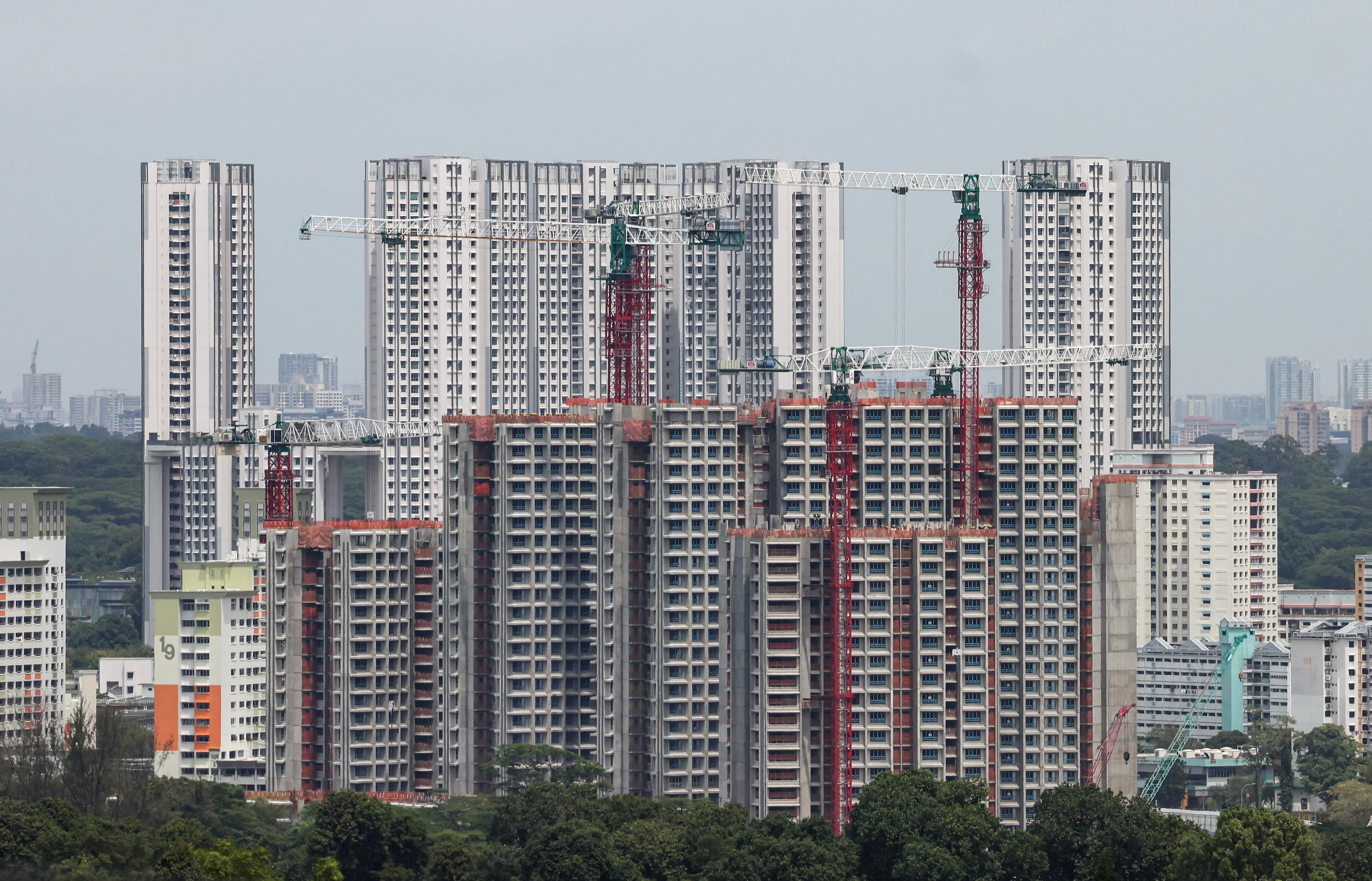
In the first three months of 2026, Singapore's public housing market did something that, on paper, shouldn't be possible. The official HDB Resale Price Index slipped for the first time in nearly seven years — and in the exact same quarter, a record 412 flats changed hands for S$1 million or more, up 23.4% year-on-year. One number says the market is cooling. The other says it's setting records. Both are true at once, and the gap between them is the most important story in Singapore property right now: the HDB resale market has quietly split into two speeds, and the "average flat" no longer describes anyone.
This is the paradox of the two-speed market — a softening headline index sitting beside an exploding count of million-dollar HDB flats, roughly 91% of them concentrated in a handful of mature, central towns like Toa Payoh, Bukit Merah and Queenstown. In this article we'll reconcile the contradiction, map exactly where the seven-figure deals cluster, dissect the new national record — a S$1.728 million flat on Henderson Road — and unpack why cooling policy may be quietly concentrating demand into the premium tier rather than cooling it. At the end, you'll get a simple scorecard to gauge whether your own flat sits in the premium segment or the slow lane.
The Background: Two Numbers That Shouldn't Coexist
For most of the last decade, the HDB resale story was simple: prices went up. They climbed through the pandemic boom, kept climbing as private-property upgraders spilled back into the resale market, and by 2024 the index had logged years of uninterrupted gains. So when Q1 2026 printed a fall, it landed as a genuine inflection point — the end of an era, symbolically if not yet in magnitude.
Here's the contradiction in a single table:
| Signal | Q1 2026 reading | What it tells you |
|---|---|---|
| HDB Resale Price Index | −0.1% quarter-on-quarter | The typical flat is cooling — first fall since 2019 |
| Million-dollar transactions | 412 flats, a record, +23.4% y-o-y | The top of the market is accelerating |
| Resale volume | Down roughly 4–5% y-o-y | Fewer deals overall, closing more slowly |
| Concentration of S$1m deals | ~91% in mature towns | The premium tier is geographically tight |
The resolution to the paradox is deceptively simple: the index and the million-dollar count measure two different things. The Resale Price Index is a broad, volume-weighted gauge of the typical flat across the whole island. The million-dollar count tracks the extreme top of the price distribution. When the broad middle plateaus while a thin trophy tier keeps breaking records, you get precisely what we saw — a falling index next to a record headline. The average is hiding a widening gap.
Think of it as two populations moving in opposite directions:
When two halves of a market diverge, the average lands somewhere in the empty middle — describing neither. That's the two-speed market in one sentence, and it's why reading this market off a single headline number will lead you badly astray.
How Big Is the Trophy Tier Getting?
It's tempting to wave away 412 flats as a rounding error in a market that turns over thousands of units a quarter. So let's size it honestly.
Million-Dollar HDB Flats Sold by Quarter
The cleanest comparison is the year-on-year jump: roughly 334 million-dollar flats in Q1 2025 versus 412 in Q1 2026 — a 23.4% increase. This isn't a one-quarter spike, either. It's the continuation of a multi-year acceleration that saw the annual count of seven-figure flats roughly double across 2024 and 2025 as more and more central, fresh-lease flats crossed the line.
A few framing facts to keep the number honest:
- Million-dollar flats are now around 6–7% of all resale transactions — up from roughly 5% a year earlier. The premium tier is growing as a share of the market, not just in raw count.
- That cuts both ways. More than nine in ten resale flats still trade well under a million dollars. The story is the bifurcation, not the disappearance of affordable public housing.
- Crucially, the surge is being driven by more flats crossing the S$1m threshold from below — not by existing trophy flats levitating ever higher.
That last point reframes the whole headline. The S$1 million mark is no longer a rare ceiling that a handful of exceptional flats punch through. In a growing list of central towns, it's becoming the entry price — the floor you start negotiating up from.
Where the Million-Dollar Flats Actually Cluster
A two-speed market isn't only split by price — it's split by geography. Million-dollar flats don't scatter evenly across the island; they pool in a tight ring of mature, central estates. This is where the ~91% concentration comes alive.
Top towns by million-dollar transaction count, Q1 2026:
| Rank | Town | Million-dollar deals |
|---|---|---|
| 1 | Toa Payoh | 72 |
| 2 | Bukit Merah | 57 |
| 3 | Queenstown | 55 |
| 4 | Ang Mo Kio | 41 |
| 5 | Kallang/Whampoa | 32 |
Top Towns by Million-Dollar HDB Deals (Q1 2026)
These mature estates — with Bishan and the Central Area just behind — account for the overwhelming majority of premium transactions. The common thread is unmistakable: central location, strong MRT access, and either prestige addresses or freshly-MOP'd projects. These are towns within striking distance of the city core, where land is finite and no new supply of unrestricted central flats is coming online.
The clearest signal of the two-speed split is when a town's median flat starts knocking on the million-dollar door. When the typical five-room flat in Toa Payoh trades around S$1.1 million, a million-dollar flat there isn't a freak outlier — it's the normal flat. In those towns, the trophy tier is the market.
Zoom in to the project level and you can see the engine. Newer developments that have just crossed their five-year Minimum Occupation Period (MOP) — with 90-plus years of lease remaining — produce clusters of million-dollar deals all at once. A whole cohort of owners becomes resale-eligible simultaneously, a wave of modern, long-lease flats in a desirable estate hits the market, and it clears at premium prices. That's the fresh-MOP flywheel, and it explains why a single project can rack up 20+ seven-figure transactions in one quarter.
Anatomy of a Record: The S$1.728M Henderson Road Flat
Every two-speed market has a flagship, and by mid-2026 the title belonged to a five-room flat on Henderson Road, in Bukit Merah, which sold for approximately S$1.728 million — the highest-priced HDB resale flat on record across all flat types.
It edged past the previous benchmark set just months earlier: a S$1.7 million five-room Premium Apartment Loft at SkyTerrace @ Dawson in Queenstown, transacted in February 2026. The fact that the record changed hands twice in a single quarter tells you the momentum in the trophy tier is structural, not a fluke.
What makes a Henderson Road flat worth nearly S$1.73 million? It's the same four attributes stacking on top of each other:
- Location prestige — Bukit Merah sits on the edge of the city core, a short hop from the CBD, Tanjong Pagar and the Greater Southern Waterfront redevelopment.
- A fresh, long lease — newer central blocks with 90-plus years remaining unlock full financing for buyers (more on why that matters below).
- Height and view — premium flats cluster on mid-to-high floors, where an unobstructed outlook commands a measurable, repeatable premium.
- Scarcity of layout — large, well-configured five-room units in landmark central blocks are simply rare.
Here's how the record ladder climbed across early 2026:
| Flat | Price | When |
|---|---|---|
| SkyTerrace @ Dawson (Queenstown), 5-room loft | S$1.70m | Feb 2026 |
| Henderson Road (Bukit Merah), 5-room | ~S$1.728m | Early May 2026 |
| Pinnacle@Duxton (Central), 5-room | ~S$1.63m | Late May 2026 |
| Tiong Bahru, 4-room (45-year lease) | ~S$1.53m | May 2026 |
The ceiling keeps rising even as the index drifts down. That single juxtaposition — a record-breaking trophy price printed in the same window the broad index fell — is the two-speed market in its purest form.
That Tiong Bahru entry deserves a flag, because it breaks the usual rules. A four-room flat with only 45 years left on its lease sold for roughly S$1.53 million. By standard lease-decay math, a flat that far into its 99-year clock should trade at a steep discount. But Tiong Bahru's conservation-era character and proximity to town overwhelmed the lease logic entirely. For a tiny handful of genuinely irreplaceable addresses, location can beat lease — a sign of just how powerful the centrality premium has become.
The Twist: Size No Longer Commands the Premium
If you pictured million-dollar HDB flats as sprawling executive units and big five-room layouts, the Q1 2026 breakdown will surprise you.
| Flat type | Million-dollar deals (Q1 2026) |
|---|---|
| 4-room | 190 |
| 5-room | 143 |
| Executive | 78 |
| Multi-generation | 1 |
Million-Dollar HDB Flats by Type (Q1 2026)
Four-room flats now outnumber five-room flats in the million-dollar club — 190 to 143. This is arguably the single most revealing data point of the quarter, because of what it says about what people are actually paying for.
A seven-figure price tag is no longer about square footage. If raw size drove the premium, executive flats and five-roomers would dominate. Instead, a centrally located four-room flat with a fresh 90-plus-year lease and a high floor comfortably beats a larger but older, further-flung executive unit. The market is pricing location, lease, and floor far more aggressively than floor area.
Put plainly: a compact, well-located, newly-MOP'd four-room flat near an MRT station has become a more desirable — and more expensive — asset than a big flat in the wrong place with a shrinking lease. The premium has detached from size and reattached to scarcity.
So what, specifically, pushes a flat into the trophy tier? The transaction data points to four attributes, in rough order of leverage:
- Location and centrality — the dominant driver. You cannot build more Queenstown or more Tiong Bahru. Mature central estates walkable to MRT and the CBD carry a scarcity premium nothing else replicates. This is the single biggest lever.
- Lease freshness. A long, clean lease (90+ years) matters for hard financial reasons, not just sentiment — as a lease shortens, CPF-usage rules and loan limits tighten, shrinking the pool of buyers who can fully finance the purchase. A fresh lease removes that friction and signals a newer building.
- Floor and view. Premium flats cluster on mid-to-high floors, where height and an unobstructed outlook carry a repeatable premium.
- Rare layouts and prestige addresses. Lofts with double-volume ceilings, DBSS and Premium Apartment formats, maisonettes, and landmark blocks command the absolute top.
Why It's Happening: When Cooling Policy Fuels the Premium
Here's the part that makes the two-speed split feel almost engineered. Singapore's cooling measures — designed to keep the broad market in check — land very differently on the two tiers. And the result may be the opposite of what was intended for the top end.
Cooling measures bite the mass market hardest. The loan-to-value (LTV) limit for HDB loans was cut to 75% (effective August 2024, down from 80%), stacked on top of the Mortgage Servicing Ratio cap (30% of gross monthly income) and the Total Debt Servicing Ratio ceiling (55%). These rules squeeze stretched, leverage-dependent buyers — exactly the people competing for ordinary flats. They barely register for cash-rich buyers bidding on trophy flats, who often aren't borrowing anywhere near the limit. So the measures thin out competition in the mass market while leaving the premium tier largely untouched.
The Plus/Prime framework concentrates demand on a shrinking pool. New BTO flats are now classified as Standard, Plus, or Prime by location desirability. The desirable, central Plus and Prime flats come with a subsidy clawback on resale (a percentage of the resale price returned to HDB), a 10-year MOP, and tighter rental and eligibility rules. Here's the critical mechanism:
Today's million-dollar resale flats are overwhelmingly older Standard-type flats not subject to Plus/Prime restrictions. A buyer who wants a central flat they can freely sell later — no clawback, no decade-long lock-in — effectively must buy one of these on the open market. So demand for an unrestricted central flat gets funnelled into a fixed, finite, and effectively shrinking pool.
Policy intended to cool the market has, for the top tier, channelled demand into exactly the cohort already setting records — reinforcing the very scarcity premium it was meant to temper.
And incoming supply offers little relief. A large share of upcoming central BTO launches in high-demand areas like Bishan, Bukit Merah and Ang Mo Kio are expected to be Plus or Prime — meaning more central flats are coming, but locked behind clawback and 10-year MOP rules. They do nothing to ease the unrestricted-resale scarcity for at least a decade.
Two Markets, Two Realities: What It Means for You
Depending on which flat you own — or are hunting for — Q1 2026 delivered almost opposite news.
- Mass-market buyers got their first real bargaining power in seven years. A softening index, slower deals, and an LTV-thinned field of rivals mean genuine leverage — outside the premium towns. If you're patient and flexible on location, this is your window.
- Premium / upgrader buyers face the reverse: record prices and bidding tension for central, fresh-lease, high-floor units. In Toa Payoh, Queenstown and Bukit Merah, S$1 million is the entry point, not the ceiling.
- Sellers of trophy flats retain pricing power — but should note that the surge is about more flats crossing the line, not infinite upside per flat. The easy, uncapped gains are maturing.
- Sellers of ordinary flats must price realistically. The index says the typical flat is flat-to-down, and buyers know they can wait.
- Investors can't buy HDB purely as an investment (owner-occupation rules apply), but the data validates a clear "central + long lease + high floor" thesis for own-use value retention.
- Tenants get little near-term relief — sustained high resale values plus the 10-year Plus/Prime MOP keep central rental stock tight.
The deceleration in the broad market is the genuine trend on that side of the divide:
HDB Resale Price — Annual Growth Slowing Toward Zero
Year-on-year, the broad market is still technically positive — but at a fraction of the near-double-digit pace of 2022–24. The momentum has drained out of the middle while it has pooled at the top.
Is Your Flat in the Premium Tier? A Simple Scorecard
Here's the practical payoff. Score your flat against these six factors. The more you hit, the closer you are to the trophy tier that has decoupled from the softening index — and the further you are from the −0.1% buyer's market.
| Factor | Premium-tier signal | Why it matters |
|---|---|---|
| Location | Toa Payoh, Bukit Merah, Queenstown, Ang Mo Kio, Kallang/Whampoa, Bishan, or Central | These towns hold ~91% of S$1m deals; scarcity premium |
| MRT distance | Under ~5–10 min walk | Core driver of central-flat demand |
| Lease remaining | 90+ years (fresh-MOP) | Unlocks full CPF/loan financing for buyers; newer building |
| Floor | Mid-to-high (~10th storey and up) | The view-premium band where psf peaks |
| Flat type / layout | 5-room, executive, or central 4-room; rare formats (loft, maisonette, DBSS, Premium Apt) | Layout scarcity — remember 4-room now leads the count |
| Regulatory status | Older Standard flat, not Plus/Prime | Freely resellable, no clawback / 10-yr MOP → demand magnet |
The takeaway: if your flat hits four or more of these, it's plausibly tracking the trophy-tier curve rather than the headline index. If it hits zero or one, the falling index and a buyer's market are simply your reality. Either way, the lesson is the same — the "average HDB flat" no longer describes anyone. It's the midpoint of two markets pulling apart.
Food for Thought
-
If S$1 million is becoming the entry price for a central flat rather than the ceiling, what does "affordable public housing" mean a decade from now? When the median five-room in Toa Payoh already sits around S$1.1m, the definition of "accessible" is quietly migrating.
-
Cooling measures were designed to tame the broad market — but did the Plus/Prime framework accidentally turbocharge the premium tier by locking up future central supply? When policy creates a fixed pool of unrestricted central flats, does it cool demand or concentrate it?
-
A four-room flat now outsells five-room and executive flats in the million-dollar club. If size no longer commands the premium, are we witnessing the end of "bigger is better" in Singapore housing — and what does that mean for owners of large, ageing flats in non-central towns?
-
A 45-year-lease Tiong Bahru flat sold for S$1.53m. At what point does location prestige fully override the lease-decay math — and is that a rational price or a behavioural one?
-
If the index keeps drifting down while records keep rising, which number is the "real" market — and which one will the news keep leading with?
The Bottom Line
Q1 2026 didn't hand us a cooling market or a booming one. It handed us both at once — a broad mass market finally giving buyers some leverage, and a thin trophy tier breaking record after record on the back of location, lease and floor. The single figure that captures the era is 412: a record count of million-dollar flats, printed in the very quarter the index fell for the first time in nearly seven years. Read together, they reveal that the average has stopped being a useful description of anything.