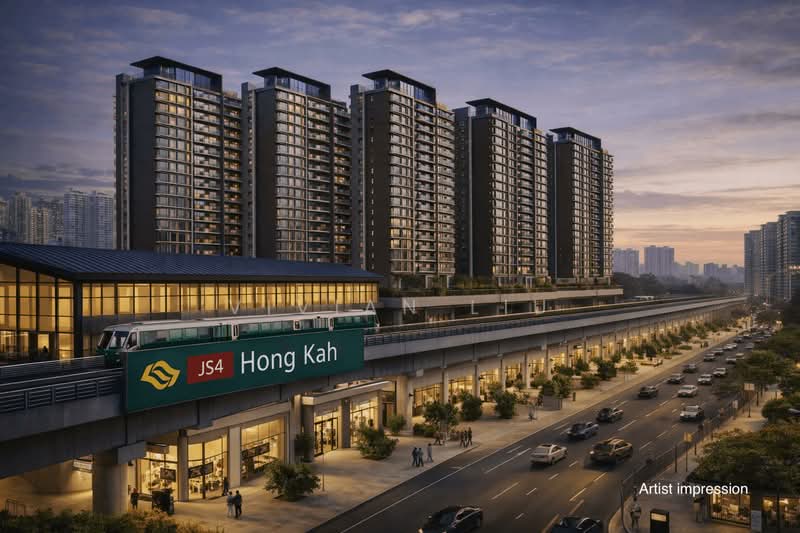
Picture this: it's a Saturday afternoon in late April 2026, and by 3pm, a brand-new condominium in a town that didn't even have a private condo until that morning has sold 853 of its 863 units. That's a 98.8% take-up rate before most Singaporeans had finished their weekend brunch. The project is Tengah Garden Residences, the first private condominium in Tengah New Town, and its near-instant sell-out has become the defining new-launch story of the year — a single afternoon that tells you almost everything you need to know about the state of Singapore's property market in 2026.
When a launch clears that fast, it's tempting to chalk it up to hype. But the Tengah Garden Residences sell-out wasn't a fluke or a marketing stunt. It was the predictable result of three forces colliding at exactly the right moment: aggressive pricing, a deep pool of ready-to-move upgraders, and the tightest new-launch supply year in over a decade. This article unpacks each of those forces, looks at the numbers behind the headline, and asks what this blockbuster weekend signals for buyers, investors, and anyone watching Singapore property in a supply-starved year.
The Headline, By the Numbers
Let's start with the hard facts, because they're genuinely striking. Tengah Garden Residences launched its public sales on Saturday, 26 April 2026, following a two-week preview that began on 11 April. By mid-afternoon on launch day, only 10 of 863 units remained — and all 10 were the largest, most expensive configuration: the 4-bedroom premium with yard.
| Metric | Detail |
|---|---|
| Units sold | 853 of 863 (98.8% take-up) |
| Average price | S$2,120 psf |
| Price range | S$1,779 – S$2,340 psf |
| Tenure | 99-year leasehold |
| Structure | 9 towers, 16 storeys each |
| Location | Tengah Garden Avenue, District 24 |
| Developers | Hong Leong Holdings + GuocoLand + CSC Land Group (JV) |
| Expected TOP | ~2029–2030 |
| Preview | From 11 April 2026; ~2,000 groups visited over two weeks |
| Buyer profile | ~90% Singaporean |
| Retail | ~30,000 sq ft commercial space at first storey |
The pricing structure is where the story really begins. Developers built a ladder of entry points designed to catch buyers at every budget tier — and crucially, the bottom rung started below the psychologically critical S$1 million mark.
| Unit type | Starting price | Approx. PSF | Share of mix |
|---|---|---|---|
| 1-bedroom | S$980,000 | ~S$2,025 | <1% (~6 units) |
| 2-bedroom | S$1.11 million | ~S$1,779 | ~40% |
| 3-bedroom | S$1.588 million | ~S$1,993 | ~40% |
| 4-bedroom | S$2.288 million | ~S$2,025 | ~20% |
Note what's happening here. The bulk of the project — roughly 80% of units — sat in the 2- and 3-bedroom range, the exact configurations that HDB upgraders shop for. And the 2-bedders at ~S$1,779 psf were priced startlingly close to recent executive condo (EC) levels, collapsing the premium that private condos normally command. For a young family selling a Bukit Batok flat, the maths suddenly worked.
Tengah Garden Residences Unit Mix by Bedroom Type
According to Huttons Asia CEO Mark Yip, the result made Tengah Garden Residences the best-selling launch of 2026 by unit count — and the strongest condo launch since ParkTown Residences in February 2025, which itself sold 87% on its launch day. The developer reported demand was "robust across all unit types," with that ~90% Singaporean buyer base underscoring just how local — and upgrader-driven — this event really was.
Why It Sold: Three Forces, One Weekend
It helps to visualise how the pieces fit together. The sell-out wasn't one cause but a convergence — pricing, demand, and scarcity all pointing in the same direction at once.
Let's take each force in turn.
Force One: Pricing That Broke the EC Barrier
At S$2,120 psf average, Tengah Garden Residences was one of the most attractively priced private launches of the year. To appreciate how aggressive that was, you have to look at what else came to market in 2026. Many launches were priced in the S$2,500–2,900 psf band — and Tengah came in hundreds of dollars per square foot below that.
The real masterstroke was the 2-bedroom pricing. At ~S$1,779 psf, those units sat almost on top of recent EC pricing. ECs are subsidised, income-capped hybrid properties; private condos normally trade at a meaningful premium for the freedom of no income ceiling, no resale restrictions, and no minimum occupation period quirks. By pricing 2-bedders close to EC levels, the developers handed buyers a private condo at near-public-housing-adjacent value. For the price-sensitive western upgrader, that was an irresistible proposition.
How could developers afford to price so sharply? The answer lies in the land deal, which we'll come to — but the short version is that a low land cost gave them headroom to chase volume over margin, and the bet paid off in hours rather than months.
Force Two: A Primed Army of Western Upgraders
Pricing only works if there's someone ready to buy. And in the west of Singapore, there was an enormous, primed cohort waiting.
Analysts pointed to roughly 7,500 four- and five-room HDB flats in nearby estates — Bukit Batok, Choa Chu Kang, Bukit Panjang, and Jurong — reaching their 5-year Minimum Occupation Period (MOP) between 2022 and 2026. Once a flat clears its MOP, owners can sell on the open market, unlocking their sale proceeds and CPF for an upgrade. That's a vast pool of households sitting on equity, with cash and CPF ready to deploy, and — until April 2026 — virtually no private condo option in their own backyard.
- Bukit Batok, Choa Chu Kang, Bukit Panjang, Jurong — the catchment estates
- ~7,500 four- and five-room flats hit MOP between 2022–2026
- These owners had sale proceeds + CPF primed for an upgrade
- Tengah Garden Residences was, for thousands of them, a backyard purchase
This is the engine that powered the sell-out. For a Choa Chu Kang family, buying into Tengah meant staying in the part of Singapore they already know — same schools, same hawker centres, same commute patterns — while stepping up from public to private housing. That emotional pull, combined with the value pricing, created concentrated and almost competitive demand on launch day.
Force Three: First-Mover Scarcity in a 42,000-Home Town
Tengah Garden Residences is the first private condominium in a 700-hectare township that will eventually hold around 42,000 homes. Anyone who wanted a private home in Tengah — to live in or to bet on the town's future — had exactly zero alternatives. And they won't have many for a while.
That first-mover scarcity is a powerful psychological accelerant. Buyers weren't just choosing between this condo and another nearby launch; they were choosing between now and who-knows-when. In a market already starved of supply, that urgency compresses months of decision-making into a single weekend.
The Land Deal: How the Margin Math Worked
The aggressive pricing makes far more sense once you understand what the developers paid for the land. The site at Tengah Garden Avenue was won through a Government Land Sales (GLS) tender that closed on 14 January 2026 with just three bids.
| Bidder | Bid (psf ppr) | Outcome |
|---|---|---|
| Hong Leong–led consortium | S$821 | Winner |
| Kingsford Group | S$815 | 2nd (–0.73%) |
| Sim Lian | S$812 | 3rd |
The winning bid of S$675 million, or S$821 psf per plot ratio (psf ppr), edged out the Kingsford Group by a razor-thin 0.73%. Three bidders within a whisker of each other tells you developers had real conviction in this site — but it was still a competitive, disciplined tender rather than a runaway auction.
Here's the crucial number: a land cost of ~S$821 psf ppr against an eventual average selling price of ~S$2,120 psf gave the developers comfortable room to price aggressively and still sell out fast. This was a deliberate volume-over-margin strategy. Rather than squeeze every dollar of margin and risk a slow burn, the consortium priced to move — and cleared 98.8% of inventory in an afternoon. In a supply-crunched year, that's arguably the smartest play available.
Land Cost vs Selling Price (S$ psf)
The site itself spans roughly 273,906 sq ft with a maximum gross floor area of about 821,720 sq ft, zoned "Residential with Commercial at 1st storey" — which is why the project includes around 30,000 sq ft of retail at ground level, a genuine differentiator in an area still building out its amenities.
The Tengah Master-Plan Story: Buying Into a "Forest Town"
Beyond price and timing, Tengah Garden Residences sells a narrative — and it's a compelling one. Tengah is Singapore's "Forest Town," the first entirely new HDB town planned in over 20 years, since Punggol. It's being built on the last large undeveloped land parcel in the west, and the ambition behind it is unusually bold.
- Scale: ~700 hectares; ~42,000 homes at completion (~30,000 public, ~12,000 private)
- Five themed districts: Plantation, Garden (where this condo sits), Park, Brickland, and Forest Hill — each built around a nature concept
- Singapore's first car-free town centre: roads run beneath the centre, the ground level is fully pedestrianised and integrated with the future MRT
- Green infrastructure: a 100m-wide, 5km-long forest corridor linking the Western and Central catchments, plus a 20-hectare Central Park as the town's green lung
- Smart-town systems: automated waste collection, centralised cooling, and smart energy management — marketed as Singapore's most sustainable town
The pitch agents reach for most often is "a better Punggol of the west." Early Punggol buyers, the comparison goes, bought into an unproven, half-built town and were rewarded as it matured into one of Singapore's most liveable estates. Tengah offers the same "ground-floor" story — but with a sustainability-first master plan and a car-free centre that Punggol never had. Whether the comparison holds depends entirely on execution, but as a sales narrative, it's potent.
JRL Timing: The Connectivity Bet
If the Forest Town story is the emotional pitch, the Jurong Region Line (JRL) is the financial one. Singapore's seventh MRT line is being built specifically to serve the west, and Tengah Garden Residences leans heavily on it.
The nearest stations are Hong Kah and Tengah / Tengah Plantation on the JRL (sources differ on which is the doorstep station — Hong Kah is most frequently named). The line opens in three phases, with the Tengah-area stations falling in the later phases, roughly 2028–2029 — conveniently around the same time the condo is expected to receive its TOP.
What does the JRL connect to? This is the heart of the investment thesis:
- Jurong East — Singapore's planned "second CBD" and future commercial heart
- Jurong Lake District — the largest mixed-use business hub outside the city centre
- Jurong Innovation District — a research and advanced-manufacturing cluster
- NTU — one of Singapore's two largest universities
In plain terms, buyers are paying 2026 prices for connectivity and a town that largely materialises between 2028 and 2030. This is a classic "buy ahead of the infrastructure" bet. The upside: if the JRL and Jurong Lake District deliver on schedule, today's entry psf could look cheap in five years. The risk: interim years living in a half-built town with an incomplete MRT, and execution timelines that, as every Singaporean knows, can slip.
The Macro Backdrop: A Supply Crunch Made Visible
Here's the context that turns a well-priced launch into a blockbuster. 2026 is the tightest new-launch year Singapore has seen in over a decade.
Consider the pipeline. Roughly 17 new condo projects are expected to launch across 2026, bringing approximately 8,100 units to market. That's a ~30% year-on-year drop from the ~23 projects and 11,000-plus units in 2025 — and reportedly the thinnest launch pipeline since around 2014.
New Private Condo Units Launched (Approx.)
The contrast with 2025 is stark. Last year was a record: developers launched 11,482 private units (excluding ECs), up 72.7% year-on-year. Then the taps tightened. Q1 2026 launch activity fell to 1,844 units, down 41.3% year-on-year — a deliberately lighter early-year schedule. Huttons' Mark Yip estimated around 8,892 units across roughly 20 projects for the second through fourth quarters of 2026, with Tengah Garden Residences (863 units) among the headline launches, alongside Vela Bay (515), Lentor Gardens Residences (499), and Hudson Place Residences (327).
Critically, around 64% of 2026 launches are concentrated in the Outside Central Region (OCR) — the mass-market segment where upgrader demand lives. So the supply is not only thin; it's thin in exactly the places where the deepest demand sits.
The mechanism is simple:
Fewer launches → pent-up upgrader demand has nowhere to go
→ it funnels into the handful of projects that do come to market
→ anything sharply priced sees outsized, competitive take-up
Tengah Garden Residences is the supply crunch made visible. When buyers have few choices and one of them is sharply priced in their own backyard, you get 853 units gone by 3pm.
The 2026 Dividing Line: Price vs Prestige
Not every 2026 launch sold out — and the ones that didn't tell you exactly where the market's price sensitivity sits. Comparing Tengah Garden Residences with its peers reveals a clear dividing line.
| Project | Location | Launch take-up | Avg PSF |
|---|---|---|---|
| Tengah Garden Residences | Tengah (OCR) | 98.8% (day) | S$2,120 |
| Rivelle EC | Tampines | 92.5% (day) | EC pricing |
| Pinery Residences | — | ~92.5% (weekend) | S$2,546 |
| ParkTown Residences | — | 87% (day) | — |
| Vela Bay | East Coast (prime) | ~72% (day) | S$2,886 |
Look at the two ends of that table. Tengah cleared 98.8% at S$2,120 psf. Vela Bay — a prime East Coast project, arguably a more prestigious address — moved a healthy but far-from-sold-out ~72% at S$2,886 psf. Same year, same buyers, very different outcomes.
Launch Take-Up Rate vs Price (2026 Launches)
The pattern of 2026 is unmistakable: well-priced, mass-market OCR projects sell out fast; pricier CCR and RCR launches sell well but not out. In a cautious, value-driven market, price and scarcity are beating location prestige. Buyers will pay up for the right address — but in 2026, far more of them are voting with their wallets for value.
How Far Tengah Has Re-Rated
It's worth pausing on how much Tengah's pricing has moved in a short time. The town's first-ever private-style launch was Copen Grand EC in October 2022 (a CDL and MCL Land project, 639 units). It sold 465 units — 73% — on day one at around S$1,300 psf, and was fully sold within a month.
Fast-forward roughly three and a half years, and Tengah Garden Residences launched at ~S$2,120 psf. Some of that gap reflects the EC-versus-private distinction — ECs are subsidised and start cheaper. But a jump from ~S$1,300 to ~S$2,120 psf in under four years also captures how dramatically the town's pricing has re-rated as the master plan progressed and confidence in Tengah grew.
Tengah Launch Pricing Over Time (S$ psf)
For early Copen Grand buyers, that re-rating is a paper gain and a validation of the "buy into a new town early" thesis. For 2026 buyers, it's both reassurance and caution: the town has proven it can re-rate, but they're also buying at a level that already prices in a good deal of optimism.
The Q1 2026 Market Context
The sell-out is even more interesting against a softening broader market. The headlines through early 2026 were not uniformly bullish:
- URA all-private price index: +0.88% q-o-q, +3.41% y-o-y in Q1 2026 — modest and decelerating, but still positive
- Landed homes: –0.40% q-o-q, reversing Q4 2025's +3.4% gain (though still +6.7% y-o-y) — agents described a "pricing stand-off" between firm sellers and cautious buyers
- HDB resale prices posted their first quarterly decline in nearly seven years in Q1 2026, per PropNex flash-estimate commentary
That last point is the nuance worth sitting with. The HDB resale market is precisely what funds western upgraders — they sell the flat, then buy the condo. Even as that resale market cooled slightly, demand for a value-priced new launch held up. The takeaway isn't that demand has vanished; it's that buyers have become more price-sensitive and more selective. They'll still buy enthusiastically — but the price has to be right.
For 2026 as a whole, analyst forecasts for private residential prices remain modestly positive:
| Firm | 2026 forecast (private residential) |
|---|---|
| CBRE / Cushman & Wakefield | +2% to 4% |
| OrangeTee / Realion | +2.5% to 4.5% |
| PropNex | +3% to 4% |
| ERA | +3% to 5% |
These are growth forecasts in the low-to-mid single digits — consistent with the government's broader policy stance of keeping price rises roughly in line with income growth.
The Policy Frame
It's worth noting what didn't happen: there was no new cooling measure tied to this launch. But the prevailing policy environment shaped the buyer mix profoundly. The cooling measures already in force include:
- Additional Buyer's Stamp Duty (ABSD) — including the steep 60% rate for foreigners since the April 2023 hike
- Total Debt Servicing Ratio (TDSR) capped at 55%
- The 15-month wait-out for private owners looking to buy an HDB resale flat
Together, these largely explain the ~90% Singaporean, upgrader-led buyer base. With foreign demand heavily taxed out of the mass market, launches like Tengah Garden Residences are won or lost on local upgrader appetite — which is exactly why pricing for the western HDB upgrader mattered so much.
What It All Signals
So what does a 98.8% weekend actually tell us about Singapore property in 2026? A few things stand out:
- For buyers and upgraders: The best value of 2026 sits in OCR mass-market launches priced near EC levels — but you have to move fast. The supply crunch means well-priced units clear in hours, not weeks. Those who missed Tengah face a thin pipeline and likely firmer pricing on the next OCR launch.
- For investors: This is a leveraged bet on the JRL (2028–2029) and the Jurong Lake District thesis. Near-term rental demand is limited until the town and MRT mature, but the ~S$2,120 psf entry leaves room if the western transformation delivers. The caveat is real: early-town launches carry execution and timeline risk.
- For tenants: Rental relevance is a 2029-and-beyond story. With TOP around 2029–2030 and an immature town centre, the western rental market will keep leaning on Jurong East and Bukit Batok stock for now.
- For the resale market: The sell-out reinforces a supply-crunch narrative that hands pricing power to sellers of comparable western resale stock — even as headline HDB resale prices dipped in Q1.
Above all, Tengah Garden Residences is the cleanest example yet of a simple 2026 truth: when price, scarcity, and genuine local demand align, the market doesn't hesitate.
Food for Thought
- If a sharply priced OCR launch can sell 98.8% in an afternoon, what does that reveal about how much pent-up upgrader demand is sitting on the sidelines — and what happens to prices when the supply pipeline eventually loosens again?
- Buyers paid 2026 prices for a town and an MRT line that arrive around 2028–2030. Is "buying ahead of the infrastructure" a savvy value play, or are early buyers underwriting execution risk that doesn't show up in the launch-day euphoria?
- Tengah's launch pricing jumped from ~S$1,300 psf (Copen Grand EC, 2022) to ~S$2,120 psf in under four years. How much of that is genuine value creation from the master plan, and how much is optimism that still has to be earned?
- Vela Bay sold ~72% at S$2,886 psf while Tengah sold out at S$2,120 psf. In a market where price is beating prestige, what happens to the long-held assumption that location is everything in Singapore property?
- The HDB resale market — the engine that funds western upgraders — posted its first decline in nearly seven years in Q1 2026. If that softening continues, does the upgrader demand that powered Tengah's sell-out start to thin?
Conclusion
The Tengah Garden Residences sell-out wasn't magic — it was math. Low land cost enabled aggressive pricing; aggressive pricing met a primed army of western upgraders; and all of it landed in the tightest supply year in over a decade. Strip away the headline drama, and you're left with a textbook illustration of how Singapore's 2026 property market actually works: value plus scarcity plus genuine local demand equals a weekend that empties an 863-unit project before tea time.