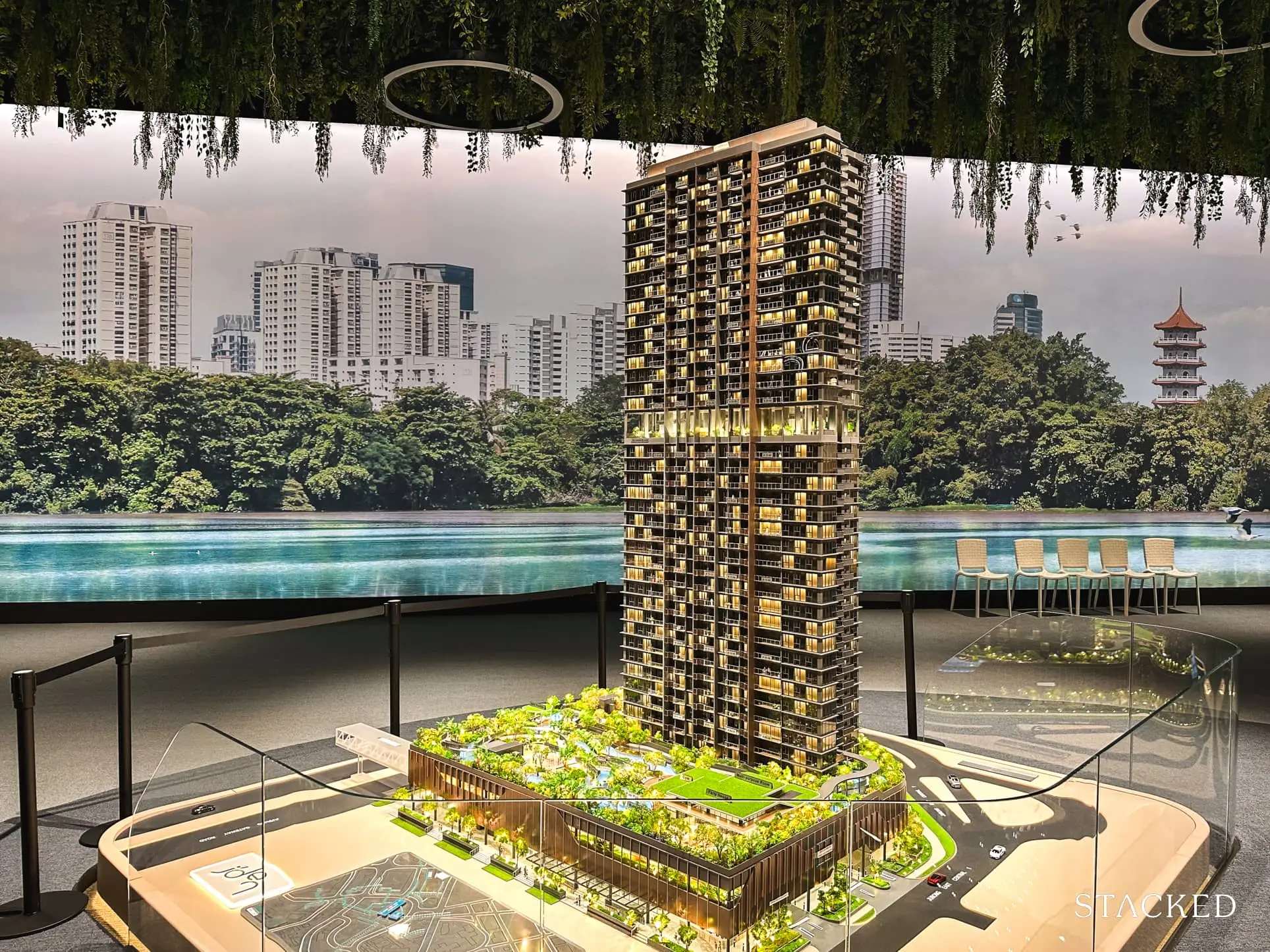
In a property market that has seen its fair share of cautious buyers and measured launches, one development has shattered expectations and rewritten the playbook for suburban success. J'den, the highly anticipated integrated development in Jurong East, achieved what many thought impossible in today's climate—selling 89% of its 368 units in a single weekend at an average price of S$2,302 per square foot (psf). This isn't just a sales milestone; it's a watershed moment that cements Jurong East as Singapore's most compelling suburban investment story and signals a fundamental shift in how buyers perceive value in the Outside Central Region (OCR).
For young Singaporeans navigating an increasingly complex property landscape, J'den's record-breaking performance raises critical questions: What does this mean for OCR affordability? How are integrated developments reshaping suburban living? And perhaps most importantly, is Jurong East's transformation from industrial backwater to Singapore's second Central Business District (CBD) finally translating into tangible buyer confidence?
This deep-dive unpacks the J'den phenomenon, examining the confluence of factors—from the Jurong Lake District transformation to the enduring appeal of transport-mall-residence integration—that have propelled this unassuming western suburb into the property spotlight.
The J'den Phenomenon: Breaking Records in a Cautious Market
When J'den opened its doors for booking on launch weekend, the response was nothing short of extraordinary. In an era where developers often stage multiple sales events to move inventory, J'den accomplished what few projects have managed since Grand Dunman's headline-grabbing launch in 2023—near-instantaneous sell-out success.
By the Numbers: What 89% Sales Really Means
To appreciate the magnitude of J'den's achievement, consider the context:
| Metric | J'den Performance | Market Context |
|---|---|---|
| Units Sold (Weekend 1) | ~327 of 368 units (89%) | Most launches achieve 20-40% in initial phase |
| Average Price | S$2,302 psf | Highest OCR launch price in recent memory |
| Comparison Benchmark | Best since Grand Dunman (2023) | Grand Dunman sold 73% on launch weekend |
| Location Category | Outside Central Region (OCR) | Traditionally 15-25% cheaper than RCR |
J'den vs Recent Major OCR Launch Performances
The S$2,302 psf average is particularly striking. For context, this pricing places J'den firmly in Rest of Central Region (RCR) territory—traditionally home to established city-fringe locations like Tiong Bahru, Queenstown, and Kallang. Yet buyers were not deterred. Instead, they embraced the narrative that Jurong East's future value proposition justifies present-day premiums typically reserved for more central locations.
Who's Buying and Why?
The buyer profile for J'den reveals much about shifting preferences in Singapore's property market. According to market observers, the development attracted:
- Young professionals and couples drawn to the integrated lifestyle and direct MRT connectivity
- Jurong upgraders seeking to remain in a familiar neighbourhood while elevating their living standards
- Investors betting on the Jurong Lake District transformation narrative and anticipated rental demand from the district's future workforce
- Multi-generational families attracted to the area's improving amenities and long-term growth prospects
This diverse buyer mix suggests that J'den's appeal transcends traditional demographic boundaries. It speaks to a broader recognition that Singapore's urban development priorities are shifting westward, and that early positioning in this transformation could yield significant returns.
The S$2,302 PSF Question: Redefining OCR Affordability
Perhaps no aspect of J'den's launch has generated more debate than its pricing. At S$2,302 psf, J'den has effectively redrawn the boundaries of what constitutes "affordable" suburban living in Singapore. To understand whether this represents a dangerous escalation or a rational repricing, we need to examine the evolving landscape of OCR affordability.
The OCR-RCR Price Gap: Narrowing but Not Closed
Historically, the Outside Central Region has served as Singapore's property entry point, offering significantly lower per-square-foot prices than the Rest of Central Region and Core Central Region (CCR). However, this gap has been steadily narrowing:
| Region | Typical Price Range (2024-2025) | Year-on-Year Change |
|---|---|---|
| Core Central Region (CCR) | S$2,800 – S$3,500 psf | +2.1% |
| Rest of Central Region (RCR) | S$2,200 – S$2,800 psf | +3.8% |
| Outside Central Region (OCR) | S$1,800 – S$2,400 psf | +4.5% |
OCR vs RCR Price Growth Trends (2020-2025)
The data reveals a telling story: OCR prices have been outpacing RCR growth in percentage terms, even if absolute prices remain lower. This suggests that buyers are increasingly willing to pay premiums for well-located suburban projects with strong growth narratives—exactly what J'den represents.
Is S$2,302 PSF Justified? Breaking Down the Value Proposition
To assess whether J'den's pricing is sustainable or speculative, consider what buyers receive for their investment:
Integrated Development Premium
- Direct access to Jurong East MRT interchange (East-West and North-South Lines)
- Connected to JEM, Westgate, and IMM via covered walkways
- Future connection to Jurong East Bus Interchange
- On-site retail and F&B options
Jurong Lake District Transformation Upside
- Proximity to Singapore's designated second CBD
- Anticipated 100,000 new jobs by 2040-2050
- Planned commercial, residential, and recreational developments
- Potential for significant capital appreciation as district matures
Quality and Design
- Modern architecture with attention to wellness and sustainability
- Comprehensive facilities catering to diverse resident needs
- Reputable developer track record
When stacked against RCR alternatives at similar price points, J'den's value proposition becomes clearer. A comparable S$2,300 psf unit in the RCR might offer proximity to the city centre but lack the integrated convenience and future growth catalyst that J'den provides. For many buyers, particularly those working in or near the Jurong Lake District, this trade-off makes compelling sense.
The Affordability Paradox
J'den's pricing does raise legitimate concerns about OCR affordability for first-time buyers and young families. At S$2,302 psf, even a modest 700 sq ft two-bedroom unit commands approximately S$1.6 million—a figure that stretches the budgets of many aspiring homeowners.
However, this pricing also reflects a broader market reality: as Singapore's urban development expands and matures, the traditional notion of "cheap suburbs" is evolving. Jurong East is no longer a distant, inconvenient location—it's a self-contained regional centre with employment, entertainment, and lifestyle amenities that rival central districts. In this context, S$2,302 psf may represent not an affordability crisis, but a recalibration of value based on actual utility rather than mere distance from the CBD.
The Integrated Development Advantage: Why Singapore Can't Get Enough
J'den's success cannot be separated from its identity as an integrated development—a property type that has consistently outperformed the broader market in Singapore. Understanding why these projects command such fervent demand is key to decoding J'den's appeal.
What Makes Integrated Developments Special?
Integrated developments combine residential, commercial, and transport components into a single cohesive project. In J'den's case, this means:
This integration creates a self-reinforcing ecosystem of convenience that appeals to multiple buyer segments:
For Owner-Occupiers:
- Elimination of daily friction points (weather-protected commute, groceries within reach)
- Time savings that compound over years of residence
- Lifestyle amenities that enhance daily quality of life
For Investors:
- Consistent rental demand from tenants prioritising convenience
- Premium rental rates compared to non-integrated alternatives
- Resilience during market downturns due to irreplaceable location attributes
The Data on Integrated Development Performance
Historical performance data strongly supports the integrated development premium:
| Project | Location | Launch Price (PSF) | Recent Resale (PSF) | Price Appreciation |
|---|---|---|---|---|
| The Orchard Residences | Orchard | S$2,800 (2007) | S$3,500+ | +25% |
| Marina Bay Residences | Marina Bay | S$2,500 (2008) | S$3,200+ | +28% |
| Hillion Residences | Bukit Panjang | S$1,400 (2015) | S$1,800+ | +29% |
| North Park Residences | Yishun | S$1,300 (2015) | S$1,600+ | +23% |
While past performance doesn't guarantee future results, the pattern is clear: integrated developments tend to outperform their non-integrated counterparts in both capital appreciation and rental resilience. J'den buyers are essentially purchasing exposure to this proven formula, applied to what may be Singapore's most transformative urban district.
The "Last-Mover Advantage" in Jurong East
A critical factor driving J'den's demand is the scarcity of comparable future supply. As one of the last major integrated developments in the immediate Jurong East precinct before the full Jurong Lake District transformation unfolds, J'den offers buyers a degree of scarcity value. Future launches in the area may command even higher prices as the district matures, or they may be located in less prime positions within the broader JLD. For buyers convinced of Jurong's long-term trajectory, J'den represents a timely entry point.
Jurong Lake District: When Master Planning Translates to Buyer Confidence
No analysis of J'den's success is complete without examining the Jurong Lake District transformation—the macro narrative that has elevated Jurong East from a regional hub to a national priority.
The Vision: Singapore's Second CBD
The Jurong Lake District masterplan represents one of Singapore's most ambitious urban transformation projects. Spanning 410 hectares with over 120 hectares available for development over the next 30 years, JLD is explicitly positioned as Singapore's second Central Business District. The numbers are staggering:
- 100,000 new jobs by 2040-2050
- 20,000 new homes in the district
- 1 million residents already in the West Region, forming an immediate catchment
Jurong Lake District Development Mix (Planned)
This isn't aspirational planning—it's already underway. The second phase of JLD's transformation has revived interest in Jurong East, with infrastructure investments, land sales, and early commercial developments already changing the area's character.
From Industrial Zone to Innovation District
Jurong's evolution mirrors Singapore's own economic transformation. What began as an industrial estate in the 1960s has progressively diversified:
- 1960s-1980s: Heavy manufacturing and port-related industries
- 1990s-2000s: Addition of commercial and retail components (Jurong East MRT, IMM, JCube)
- 2010s-present: Transition to knowledge economy hub with research institutions, healthcare facilities, and business parks
- 2020s onwards: Full integration into Singapore's innovation ecosystem as second CBD
This trajectory gives buyers confidence that JLD's transformation is built on genuine economic fundamentals rather than speculative hype. The district already hosts major employers including:
- Advanced manufacturing and engineering firms
- Healthcare and biomedical research institutions
- Clean energy and sustainability companies
- Future-ready business services and technology operations
The Confidence Multiplier Effect
J'den's sales performance demonstrates how master planning narratives translate into concrete buyer behaviour. When purchasers commit S$1.6-3 million to a property, they're making a bet on the future—and JLD's clear, government-backed development roadmap reduces the perceived risk of that bet.
Key confidence indicators include:
- Government commitment: The JLD transformation is a stated national priority with allocated resources
- Infrastructure delivery: The Jurong Region Line (opening progressively from 2027) and Cross Island Line will enhance connectivity
- Commercial anchor tenants: Early commitments from major corporations signal genuine business interest
- Residential demand pipeline: The 20,000 planned homes suggest confidence in long-term population growth
For young buyers who may hold their properties for 10-20 years, this visibility into future development is invaluable. It allows them to invest not just in a home, but in a district's entire growth trajectory.
Jurong East Resale Benchmarks: Contextualising J'den's Premium
To properly assess J'den's value proposition, we must compare it against existing resale benchmarks in Jurong East. How does S$2,302 psf stack up against established properties in the area?
Private Condominium Resale Landscape
Jurong East's private resale market has shown steady appreciation, though it remains below J'den's launch pricing:
| Development | Tenure | Recent Transacton (PSF) | Age | Premium/Discount to J'den |
|---|---|---|---|---|
| J Gateway | 99-year (2017) | S$1,850 – S$2,000 | 7 years | -15% to -20% |
| Ivory Heights | 99-year (1997) | S$1,100 – S$1,300 | 27 years | -45% to -55% |
| The Centris | 99-year (2009) | S$1,400 – S$1,600 | 15 years | -35% to -40% |
| Lake Grande | 99-year (2019) | S$1,700 – S$1,900 | 5 years | -20% to -25% |
| Parc Oasis | 99-year (1998) | S$1,200 – S$1,400 | 26 years | -45% to -50% |
J'den commands a 15-25% premium over the newest comparable resale developments like J Gateway and Lake Grande. This premium reflects:
- Superior integration (direct MRT vs. walking distance)
- Newer construction and design standards
- Full Jurong Lake District transformation upside
- Scarcity value as a fresh launch in a mature precinct
HDB Resale Trends: The Upgrader Pipeline
Jurong East's HDB resale market provides crucial context for understanding J'den's buyer base. Many private condominium purchasers in the area are upgraders from HDB flats, and their selling prices determine their purchasing power.
Recent HDB resale transactions in Jurong East illustrate this dynamic:
| Flat Type | 2018 Average | 2024-2025 Range | Appreciation |
|---|---|---|---|
| 3-room | S$280,000 | S$485,000 – S$530,000 | +75-89% |
| 4-room | S$407,500 | S$650,000 – S$750,000 | +60-84% |
| 5-room/Executive | S$520,000 | S$800,000 – S$950,000 | +54-83% |
Jurong East HDB Resale Price Growth (2018 vs 2025)
This substantial HDB appreciation has created a cohort of Jurong East residents with significant equity to deploy into private properties. For a 4-room HDB owner who purchased at S$400,000 and sells at S$700,000, the S$300,000 profit (plus CPF returns) provides a meaningful down payment toward a S$1.6 million J'den unit. This "upgrader pipeline" is a structural demand driver that supports J'den's pricing and future resale values.
Rental Yield Analysis: The Investor Perspective
For investors evaluating J'den, rental yields in Jurong East provide important benchmarks:
Private Condominium Rental Yields (Jurong East):
- Q2 2022 average: 6.13% (notably strong)
- 2024-2025 estimate: 4.5% – 5.5% (compressed due to price appreciation but still attractive)
HDB Rental Yields (Jurong East Street 21 sample):
- Block 218: 7.97% (based on rental psf of S$3.06 – S$4.08 vs. valuation)
- Neighbouring blocks: 5.5% – 7.0%
These yields compare favourably to Singapore's overall rental market, where private condominium yields typically range from 3.0% – 4.5%. The higher yields in Jurong East reflect:
- Strong tenant demand from nearby employment hubs
- Excellent transport connectivity attracting renters who work across Singapore
- Relative affordability compared to central districts
- Growing amenities and lifestyle offerings
For J'den specifically, investors can reasonably project:
- Estimated monthly rental: S$5,500 – S$6,500 for a 2-bedroom unit
- Gross rental yield: Approximately 4.0% – 4.8% at purchase price
- Yield improvement potential: As JLD matures and employment density increases
While not the highest-yielding investment in absolute terms, J'den offers a compelling combination of reasonable current yield and significant capital appreciation potential—a profile that appeals to investors with longer holding horizons.
Market Outlook: What J'den Signals for 2026 and Beyond
J'den's launch performance doesn't exist in isolation—it's a data point in Singapore's broader property market narrative. Understanding where the market is headed helps contextualise whether J'den buyers are making a timely entry or catching a peak.
2026 Market Projections: Moderate Growth Continues
Analyst consensus suggests continued but measured price growth in 2026:
| Metric | 2025 Performance | 2026 Projection |
|---|---|---|
| Private Home Price Growth | +3.4% (slowest in 5 years) | +2.5% to +4.5% |
| Sales Volume | Moderate | Likely to ease with fewer launches |
| OCR Price Growth | +4.5% (outperformed) | Expected to remain resilient |
| Rental Growth | Stabilising | Capped by increased supply |
Key factors shaping the 2026 outlook include:
Supportive Factors:
- Low interest rate environment sustaining borrowing capacity
- Strong employment in key sectors (technology, finance, healthcare)
- Continued government infrastructure investment
- Limited land supply in prime locations
Headwinds:
- Increased private residential supply coming online (nearly 9,200 units in H1 2026 GLS programme)
- Additional cooling measures if prices accelerate
- Global economic uncertainty affecting foreign demand
- Rental market normalisation after post-pandemic surge
The OCR Opportunity Window
Analysts like Mark Yip of SRI anticipate that OCR launches will constitute a substantial portion of 2026's new supply, with many transactions falling in the S$1.5 million to S$2 million range. This creates an interesting dynamic for J'den:
- Competition: More OCR launches could dilute attention from J'den in the resale market
- Validation: Successful sales at similar price points would validate J'den's pricing
- Scarcity: J'den's integrated development status and Jurong East location maintain differentiation
For buyers who secured units at launch, the near-term outlook appears favourable. The combination of limited comparable supply, ongoing JLD development milestones, and general market stability suggests supportive conditions for J'den's value retention and growth.
Policy Watch: Cooling Measures and Market Stability
Singapore's property market operates under active government oversight, with cooling measures representing a persistent risk factor. The most recent measures in July 2025 included:
- Increased Seller's Stamp Duty (SSD) rates for properties sold within holding periods
- Tighter loan-to-value limits for certain buyer categories
- Additional buyer's stamp duty adjustments
Notably, these measures did not dampen demand for well-positioned projects like J'den. This suggests that policy interventions are currently calibrated to curb speculation rather than suppress genuine demand in growth areas.
Historical context is reassuring for long-term holders: despite over 10 rounds of cooling measures since 1995, Singapore's URA property price index has increased nearly eightfold between 1980 and 2024. The policy objective is stability, not stagnation.
Food for Thought: Questions for Prospective Buyers
As you process the implications of J'den's record-breaking launch and Jurong East's rising prominence, consider these thought-provoking questions:
-
Is "suburban" still a meaningful category when integrated developments offer city-fringe convenience at OCR locations? As Jurong East and similar regional centres mature, will traditional location hierarchies (CCR > RCR > OCR) give way to more nuanced assessments based on actual connectivity and amenities?
-
How much of J'den's premium is justified by tangible current value versus future transformation promises? If Jurong Lake District development encounters delays or falls short of job creation targets, does S$2,302 psf still represent fair value? What's your risk tolerance for master plan execution risk?
-
For young buyers entering at these price levels, what happens if interest rates rise or income growth stalls? J'den's buyers are committing to substantial mortgages in an environment of historically low rates. Have you stress-tested your affordability against less favourable scenarios?
-
Will integrated developments become the default expectation for new launches, or will they retain scarcity value? If the government mandates integration more broadly, does J'den's premium hold, or does it normalise toward non-integrated benchmarks?
-
How does Jurong East's transformation compare to other "new centre" narratives in Singapore's history? From Tampines Regional Centre to the original Marina Bay development, not all transformation stories deliver equally. What distinguishes JLD's prospects, and what's your conviction level?
Conclusion: Jurong East's Moment Has Arrived
J'den's 89% sell-out in a single weekend is more than a sales triumph—it's a declaration that Jurong East has arrived as a premier residential destination. The S$2,302 psf pricing, once unthinkable for an OCR location, now seems almost conservative given the convergence of factors supporting the area: world-class integration, transformative master planning, genuine employment growth, and a demonstrated buyer appetite for quality suburban living.
For young Singaporeans navigating property decisions, J'den's success offers several takeaways. First, location narratives matter—but they must be backed by concrete government commitment and infrastructure delivery. Second, integration commands a premium that the market consistently rewards. Third, the traditional boundaries between "central" and "suburban" are blurring, creating opportunities for early movers in emerging districts.
Whether you secured a unit at J'den, are considering future Jurong East opportunities, or are simply observing market trends, one thing is clear: Singapore's property landscape is evolving, and the west is playing an increasingly central role in that evolution. The question is no longer whether Jurong East can justify premium pricing—J'den's buyers have answered that emphatically. The question is how high the ceiling might be as Singapore's second CBD takes shape over the coming decades.